

Skip to Content
Prestige Prehistory

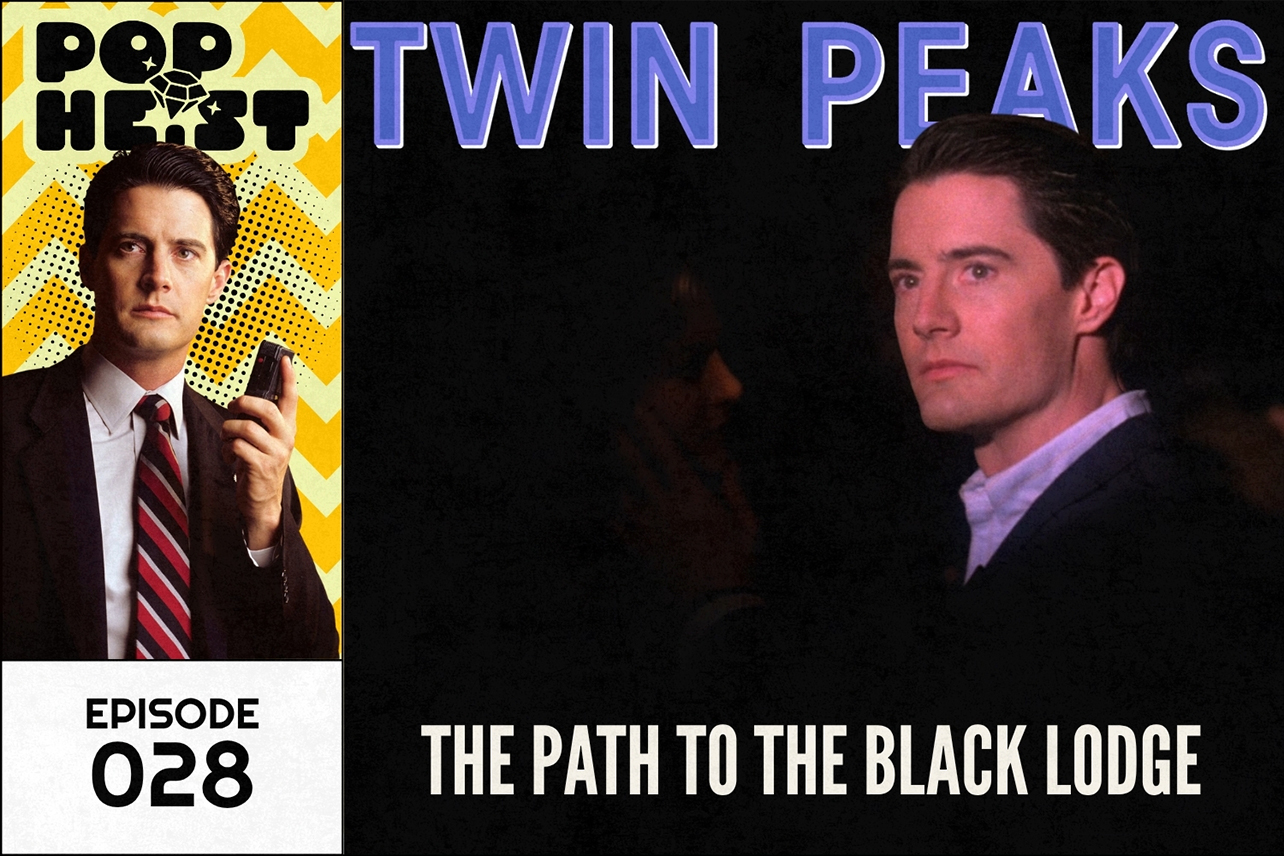
‘Twin Peaks’ 2×20 Recap: The Possibility That Love Is Not Enough

There's something wrong here.

Cooper in darkness

In PRESTIGE PREHISTORY, Pop Heist critic Sean T. Collins takes a look at classic TV shows that paved the way for the New Golden Age of Television — challenging, self-contained series from writers and filmmakers determined to push the medium forward by telling stories their own way.

Twin Peaks Season 2, Episode 20
“Episode 27” aka “The Path to the Black Lodge”
sometimes erroneously listed as “The Path to the Black House”
[NOTE: The pilot episode of Twin Peaks is not numbered; this, the 28th episode overall, is officially designated “Episode 27.”]
Original Airdate: April 18, 1991
Writer: Harley Peyton & Robert Engels
Director: Stephen Gyllenhaal
Cast: Kyle MacLachlan, Michael Ontkean, Mädchen Amick, Dana Ashbrook, Richard Beymer, Lara Flynn Boyle, Sherilyn Fenn, Warren Frost, Peggy Lipton, James Marshall, Everett McGill, Jack Nance, Kimmy Robertson, Joan Chen, Piper Laurie, Eric Da Re, Harry Goaz, Michael Horse, Kenneth Welsh, Billy Zane, Ian Buchanan, Heather Graham, Robyn Lively, Don Davis, Gary Hershberger, Mary Jo Deschanel, Dan O’Herlihy, Willie Garson, John Boylan, Carel Struycken, Ron Blair, Ron Kirk, Ted Raimi, Frank Silva


“There’s something wrong. This isn’t right. There’s something wrong here.” 

These are the last words of this episode, spoken by Dwayne Milford, mayor of the town of Twin Peaks. He hasn’t suddenly developed concerns beyond his usual ones: badly presiding over local events, talking slowly, flirting with his much younger girlfriend Lana. He is in fact simply struggling with the microphone at a Miss Twin Peaks event. There’s a sight gag where he adjusts the mic only for it to sink away from him when he lets go that’s one of the funniest moments of the episode, even. 

But we’re privy to information and observations to which Mayor Milford is not. We’ve spent a full episode listening to some of composer Angelo Badalamenti’s most unsettling work, much of it a series of ambient, ominous whooshing and humming. We hear it over the roar of the falls, in the wooden interiors of the Great Northern, in the formica paradise of the Double R diner. There’s something wrong here.

The camera of Stephen Gyllenhaal (Jake and Maggie’s dad) follows suit, its slow movements drawn out to at times genuinely striking lengths. There’s a seemingly endless shot of Coop and Annie mooning at each other over the counter, talking Augustine and Heisenberg as if this is how everyone flirts, where our viewpoint drifts further and further from them, as Badalamenti’s horror-movie synth slowly overwhelms the jaunty country-western music on the diner jukebox. 

There’s no immediate explanation for any of this, no source of the visual or sonic disturbance that we can identify, no real reason for the shot, which ends with a breathless match cut on Annie and Coop leaning in for a kiss, at all. And there’s no reason for the slow-motion shot of syrup dripping from shattered dishware on a noisily dropped tray, oozing like blood, that follows the kiss. There’s something wrong here. 

This isn’t the first disturbance in the Double R, even. Earlier, during a lovely scene in which our two favorite beautiful idiots Bobby Briggs and Shelly Johnson once again pledge their love to one another, we’re eased into their conversation with a completely incongruous moment. An older woman we’ve never seen before (the actress remains unidentified) suddenly experiences tremors in her right arm and hand as she tries to eat a slice of the diner’s famous cherry pie, as creepy high-pitched music plays. And then — nothing. Bobby tells Shelly he realizes how badly he’s treated her, as if some unexplained phenomenon didn’t just happen five feet away from them. My notes at this point read “God, what the fuck was that?” There’s something wrong here.

And it happens again, when Ben Horne hears the high-pitched sound in the Great Northern, whipping his head around as if expecting to see someone there. It happens again, when Cooper’s hand shakes just like the woman’s did, to the same frightening music. Pete Martell’s arm seizes in the same way as he tears up for the young love of Audrey Horne and Jack Wheeler, who’ve snuck off to the cabin of his private jet so she can lose her virginity to him. No matter where, no matter who, no matter what, there’s something wrong here.

Windom Earle is where the rot originates. The rogue agent’s history with Twin Peaks and the woods surrounding it goes back far beyond the arrival in town of his romantic rival and nemesis Dale Cooper. Major Briggs divulges that Earle was expelled from Project Blue Book, the Air Force’s paranormal investigation project, when his obsessiveness with the dark forces in those woods drove him become secretive and even violent with his colleagues. 

Then he provides us with evidence. He plays Dale and Harry a grainy black-and-white video tape on the Sheriff’s Department’s CRT television of a younger Earle, shot from above and in extreme closeup, as he rants and raves about the secret history in which he now believes. The resulting footage feels as magical and sorcerous and cursed as the tape from The Ring.

VHS tape of Windom Earle

Earle’s rant is worth reading in its entirety. It begins in medias res, making it clear that his enthusiasm for his area of inquiry is inexhaustible, even if he himself is on the brink of nervous collapse.

“These, uh, these evil sorcerers, um — dugpas, they’re called — they, uh, cultivate evil for, for the sake of evil, nothing else. They, uh, express themselves in darkness, for darkness, with, without leavening motive. Uh, now this, this ardent purity allows them to access a secret place where the cultivation of evil proceeds in exponential fashion, and with it, the furtherance of evil’s resulting power. Th-th-this place of power is tangible, and as such, it can be found, entered, and perhaps utilized in, in some fashion. The, the dugpas have, have many names for it, but chief among them <cough> is the uh, is the Black Lodge.

“You don’t believe me, do you. You think I’m mad. Overworked. Go away.”

You can see that Harley Peyton and Robert Engels’s script has Earle’s monologue written in the same heightened register as all the speechification we’ve heard from him about such matters in the present day. He talks like several other characters who’ve been touched by the Lodges — Mike the One-Armed Man, Margaret the Log Lady, the “Fire walk with me” poem. By the time we meet him in the present, that manner of speech is fully locked in.

But actor Kenneth Welsh does something extraordinary on this videotape, which you can also see in the verbatim transcript above. He stutters. He repeats himself. He peppers his speech with “uh”s. He coughs to clear his throat before the denouement. There’s no cackling, arrogant triumph in his voice when he tells his unseen interlocutors they think he’s mad: He says “Go away” less like a preening heel tired of communicating with his lessers and more like a man frustrated with his own inability to convince anyone of the dark miracle he’s discovered.

The performance is a complete one-eighty from Welsh’s grinning supervillainy all these decades later, and the change is shocking. The realism of his mannerisms and speech patterns stands out against his character’s previous depiction in particular and the knowingly artificial blend of Lynch and soap dialogue that characterizes the show in general. This contrast makes his words all the more frightening. He sounds like a real person — yes, a real person losing his mind, but a real person.

And if he’s real, maybe the things he’s talking about are real too. 

So Windom Earle’s real endgame has been revealed. Cooper’s presence in Twin Peaks may not exactly be a coincidence, but it was not the point of Earle’s arrival, only a side bonus. He has wanted the Black Lodge for longer than he even knew Dale existed.

Walking around town, however, you wouldn’t know that an evil genius is attempting to crack open a portal to hell. Love remains in the air almost everywhere you look. Bobby and Shelly, as noted, are back together, inspired by Bobby’s realization of how special she is to him when he saw her kissing Gordon Cole last episode. Their reunion is steamy, in part because these are two of the prettiest people you’ve ever seen, and in part because of the coy way the writers approach the heat beneath the tenderness. “Bobby, I’ve missed you,” Shelly purrs. “I’ve missed all the things we used to do together.” Whatever could she mean?

Bobby and Shelly kissing

Coop and his girl Annie have a similar conversation at the Miss Twin Peaks dance. He’s already gone on and on to Harry about how head-over-heels he is for this woman (allowing actor Michael Ontkean to do some fine work in reaction, conveying Harry’s grief about the death of his own lover, Josie, without naming her). We’ve had that bizarre long take in the Double R where their sweet flirtation is belied by sourceless dread.

At the dance, the flirtation goes from sweet to hot. “Your body feels nice against mine,” Annie tells Coop. “Listen, if I’m being too forward…I want more than your kisses. I want…” Annie is cut off by Dwayne’s mic shenanigans at this point, but she picks up the topic in a few moments. “When you hold me, when we kiss, I feel safe and eager. I’m not afraid of anything that you make me feel, or want.” Whatever could she mean? 

Jack in jet

Audrey, on the other hand, pulls no punches when she finally catches up with Jack Wheeler, departing on urgent business involving a murdered colleague, as he’s literally taxiing on the runway in his private jet. 

“I’m a virgin.”

“...what?”

“I want you to make love with me.”

“What, here and now?”

“It’s your jet.”

“[pause] Thank God for that!”

Then Pete Martell, who drove Audrey to this last desperate rendez-vous, waits in his truck as the two lovebirds fuck until nightfall. It’s a really horny episode in addition to being a really scary one.

Some love is more complicated than others. Lucy tells Deputy Andy that in 24 hours — quite possibly on stage at the Miss Twin Peaks contest itself — she will choose the father of her child: “Deputy Andy Brennan…or clothing salesman Richard Tremayne.” I’d like to think this is an easy decision, but this is a town where Norma Jennings, Big Ed Hurley, and Shelly Johnson all got married to the wrong people in high school. Then again, Dwayne and Lana Milford have their sights set on ol’ Dick, hoping to seduce him into fixing the Miss Twin Peaks pageant in Lana’s favor, and I’m gonna guess Lucy will take his response into consideration.

Shirtless Ben

Elsewhere, in a fascinating pairing of actors and characters, Doc Hayward gives Ben Horne his checkup…and begs him to stay away from his wife Eileen. The birth certificate a breathless Donna finds in the Haywards’ attic, showing no one listed as her father, makes it clear what her dad is worried about. 

As sympathetic as the newly reformed Ben is with his old friend Will, this is a promise he can’t make. He’s trying to be a good man, and that means no more lies, not even if the truth is destructive.

Doc’s heartfelt response is worth thinking about. “Damn it, Ben, it’s not that simple. I believe you. I applaud your desire to do the right thing. But goodness in you is…it’s like a time bomb. There’s nothing good about ruined lives.”

In attempting to do good, do people in Twin Peaks wind up doing evil instead? What good does doing good do anyone?

Cooper’s do-gooding hasn’t stopped Windom from killing people. Rusty, the metalhead found in the giant chess piece, was killed without Earle announcing the move in advance, indicating he’s scrapped the chess-game conceit for his killings entirely. Future Sex and the City star Willie Garson shows up as the man’s friend — I think it’s conceivable they were more than friends, actually — who sobs as he tells Coop and the others the story Rusty’s big dreams, cut short by some man from the woods. (Andy cries too.) I’m glad for this moment, which redeems the goofiness of the metalhead character’s death into something with emotional heft.

But there’s still his three queens to consider. Cooper gathers Audrey, Shelly, and Donna, warning them that the mysterious men they’ve met are all one and the same person, and that they’re in grave danger. He institutes regular check-ins between the girls and the Sheriff’s Department, and insists they no longer go out alone. 

Cooper with three queens gathered

He’s worried about the wrong people. Listening to much of Cooper, Harry, and Briggs’s deliberations via the bug he planted in the bonsai tree given to Harry as a gift from “Josie,” he decides to kidnap Briggs and grill him about the petroglyph in Owl Cave, which he sees as an “invitation” to the Black Lodge. He does this, as he does everything, in bizarre fashion. Eschewing his usual convincing disguises, he instead enlists Leo to serve as the rear in an ugly black-and-white pantomime horse costume, trots up to Briggs as he strolls through the woods, quotes Mr. Ed, and shoots him with a poison dart, knocking him out.

(Leo is fresh from an unsuccessful rebellion against Earle, in which he misunderstand how his shock collar works, steals the remote, tries to zap Windom, and instead electrocutes himself. This certified piece of wife-beating shit is becoming and more sympathetic, goddammit.)

When next we see Briggs he’s tied to an enormous bullseye, and Earle is shooting arrows at him with his crossbow as he interrogates him about his visions of the petroglyph.

Briggs attached to bullseye

Finally tiring of Briggs’s steadfast refusal to divulge any information, he doses him with some kind of truth-serum drug. Earle asks several factual questions to test its efficacy, but he includes a query that produces one of the most soul-chilling lines in the entire series.

“Garland,” he asks, “what do you fear most in the world.”

“The possibility that love is not enough,” Major Briggs replies without hesitation.

It’s a motherfucker of an idea, isn’t it? The most noble thing about us as humans, our capacity to love other people, the planet, all living things, life itself — what if it’s meaningless in the face of the world’s evil? What if love, compared to hatred and those animated by it, amounts to nothing at all? This is the man who told his son Bobby about that beautiful vision, in which the two were surrounded by love, immersed in it, transfigured by it. For him to worry that love is not enough should terrify us.

Because, again, look around this episode. Bobby and Shelly. Audrey and Jack. Dwayne and Lana, I guess. Ben and Eileen, seen cavorting in a series of old photographs Donna uncovers. And Dale and Annie. Love has never been more in the air than it is in these last couple of episodes, and here we have the show’s answer to Gandalf afraid that this isn’t enough? 

His fear is shared by forces beyond his understanding. Since the Miss Twin Peaks pageant awards a cash scholarship to its winner, every young woman in town is at least thinking about winning based on what they can do with the money. For Annie, who’s spent her youth in a convent, it could mean seeing “the other side,” as St. Augustine suggested one do. 

“It’s like a fairy tale,” she says.

“And you’re the queen,” Coop replies. You know, like the Queen of Hearts from a deck of cards. Or the most powerful piece on a chessboard.

Then the world changes. The music stops. Darkness falls, except for one spotlight on Cooper’s face, and another on the stage. Dwayne Milford is gone. In his place stands the Giant from Cooper’s dream. He does not speak in any way we can hear, but his message is clear. He waves his arms, shakes his head, and repeatedly mouths one word. “No.”

Giant saying no

Cut to Windom Earle and his captives, Garland and Leo, both of whom are having seizures. (Garland speaks backwards at one point when the truth drug starts sending him on a trip.) Earle is triumphant, because he’s realized the petroglyph is actually a map. Overlaid atop the geography of Twin Peaks, it directs seekers to the entrance to the Black Lodge.

We then take a strange journey through the town. Slow motion shots of the deserted halls of the high school and the empty corridors of the hotel. The exterior of the Double R. The Sheriff’s Department. Andy’s drawing of the petroglyph on the blackboard. The wind in the trees.

Then somewhere in the woods, a light appears. Above a circle of white on the ground, filled with a puddle of what looks like oil, a familiar right arm emerges from the light. Clad in denim, it is clawing and twitching just like the right arms of everyone we’ve been seeing throughout the episode.

The arm, we see, belongs to Bob, who emerges into our world with backwards movements. Reflected in the puddle are the curtains of the Red Room, and the saxophone music to which the Man from Another Place dances plays distantly as the episode ends. 

Mayor Milford is right: There’s something wrong here. There’s been something wrong throughout this episode, the show’s most frightening since the death of Leland Palmer. It’s so haunting and so menacing, the television equivalent of the opening of “Gimme Shelter.” It indicates that something is coming.

We have to hope that Major Briggs is wrong, that his fear is misplaced, that what’s inside Dale Cooper’s heart and the hearts of all good people is enough. But the door to the Black Lodge is almost open, and we don’t know what will come out, or who will go in.

If you haven't already, consider supporting worker-owned media by subscribing to Pop Heist. We are ad-free and operating outside the algorithm, so all dollars go directly to paying the staff members and writers who make articles like this one possible.

Stay in touch

Sign up for our free newsletter

More from Prestige Prehistory

Explore Prestige Prehistory

‘Twin Peaks’ 2×19 Recap: Kiss Me, Kiss Me, Kiss Me

It’s the first time death has ever looked silly on this show.

May 25, 2026

‘Twin Peaks’ 2×18 Recap: A Place Both Wonderful and Strange

With only four episodes left in the show’s second season, things are getting truly mystical.

May 18, 2026

‘Twin Peaks’ 2×17 Recap: I’m Going Through Changes

“She came to me,” Harry says, “and she made everything better.”

May 11, 2026

‘Twin Peaks’ 2×16 Recap: The Beautiful and the Damned

Ge careful which Twin Peaks fans you say the words “pine weasel” around.

May 4, 2026

‘Twin Peaks’ 2×15 Recap: Heaven Is a Place on Earth

I remain impressed by how strong this allegedly weak stretch of the show remains.

April 27, 2026

‘Twin Peaks’ 2×14 Recap: Say Hello to the Bad Guys

It's odd, unnecessary, uncomfortable, funny, weirdly shocking — it's 'Twin Peaks.'

April 20, 2026