

Skip to Content
Prestige Prehistory

‘Twin Peaks: The Missing Pieces’ Recap: When You See the One That’s Meant to Help You, You Will Weep with Joy

This is a mainline injection of the Lynchian supernatural.

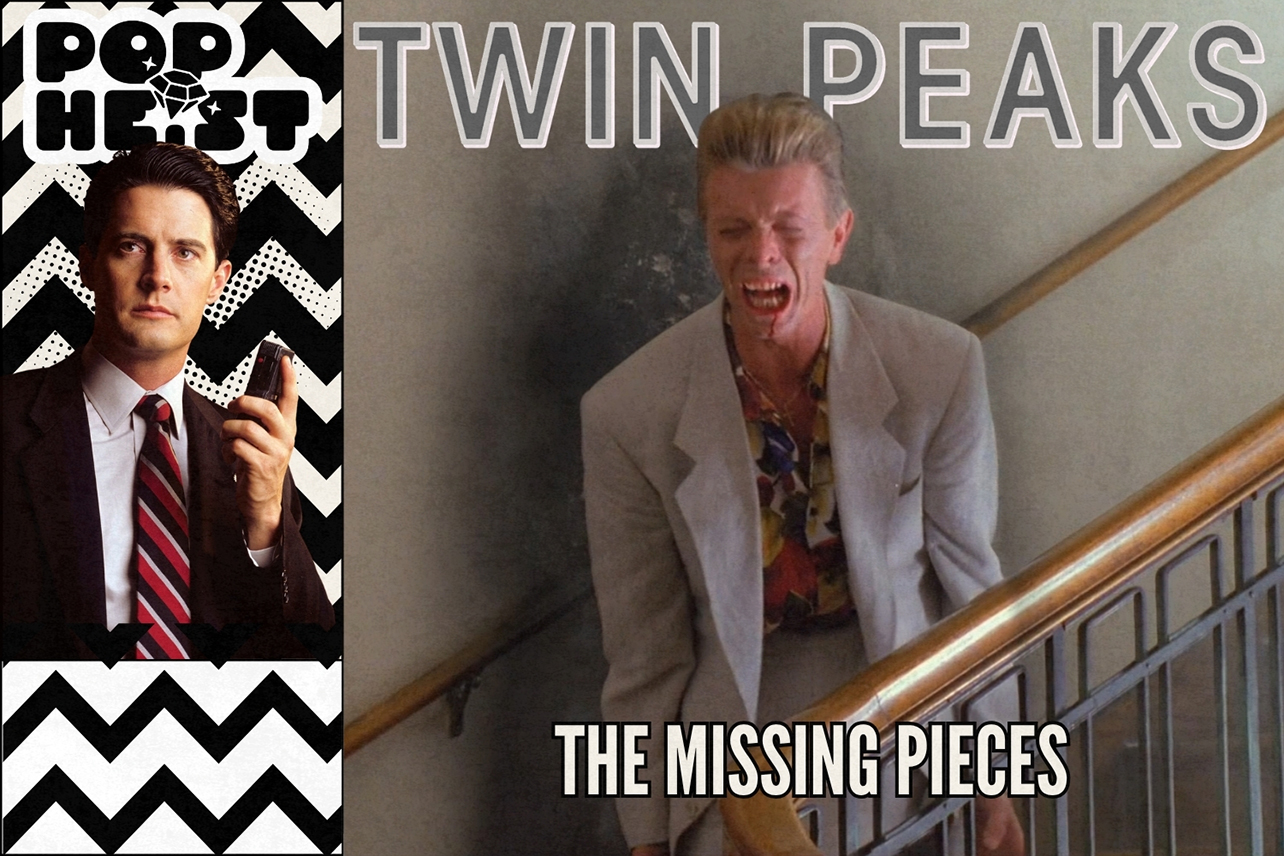
David Bowie screaming

In PRESTIGE PREHISTORY, Pop Heist critic Sean T. Collins takes a look at classic TV shows that paved the way for the New Golden Age of Television — challenging, self-contained series from writers and filmmakers determined to push the medium forward by telling stories their own way.

Twin Peaks: The Missing Pieces
World Premiere: July 16, 2014
Release Date: July 29, 2014
Writers: David Lynch & Robert Engels
Director: David Lynch
Cast: Sheryl Lee, Ray Wise, Mädchen Amick, Dana Ashbrook, Phoebe Augustine, David Bowie, Eric DaRe, Miguel Ferrer, Pamela Gidley, Chris Isaak, Moira Kelly, Peggy Lipton, James Marshall, Jürgen Prochnow, Kiefer Sutherland, Grace Zabriskie, Kyle MacLachlan, Jack Nance, Joan Chen, Wendy Robie, Everett McGill, Warren Frost, Mary Jo Deschanel, Michael Horse, Harry Goaz, Michael Ontkean, Russ Tamblyn, Don S. Davis, Charlotte Stewart, Kimmy Robertson, Heather Graham, Frances Bay, Catherine E. Coulson, Michael J. Anderson, Frank Silva, Walter Olkewicz, Al Strobel, Gary Hershberger, Sandra Kinder, Rick Aiello, Gary Bullock, Vitor Rivers, Chris Pederson, Ed Wright, Kimberly Ann Cole, Stefano Loverso, Carlton L. Russell, Calvin Lockhart, Jonathan J. Leppell, Andrea Hays 


It’s happening again. It’s happening again. It’s happening again. — Sarah Palmer, Twin Peaks: The Missing Pieces

The emergence of The Missing Pieces was our first real sign that it might, indeed, be happening again. It was the first new Twin Peaks material anyone had seen since 1992, when Fire Walk With Me came out. Though it comprises deleted and extended scenes, sometimes with alternate takes, from FWWM, The Missing Pieces is considered canonical. The things that are happening in those missing pieces are really happening.

That’s not to say you’d be able to understand a moment of it if you hadn’t watched Fire Walk With Me first. The Missing Pieces has been edited into a continuous feature-length film, but even in the opening titles themselves, which bill what you’re about to watch as an outtakes collection more or less, no one’s making any pretense that it’s intended to stand on its own. 

That’s reflected in how its story is told. There are no character introductions, no settings established, and much of the plot has been excised, happening in between the scenes we’re watching. Moreover, the scenes are arranged in the order they might have appeared in the original movie, not chronologically — scenes of Leland Palmer’s relationship with Teresa Banks, for example, are shown around the point of the film where he himself thought about them, even though they take place prior to anything else. You’re just dumped into it, with FBI Special Agent Chester Desmond already investigating Teresa’s murder. It’s expected you’ve watched Fire Walk With Me if you want to know who either of those people are or why they matter.

The Missing Pieces is designed to expand on and enhance our understanding of Fire Walk With Me — clearing up certain elements that came out confusing in the finished movie, beefing up the roles of the eccentric FBI agents from its opening sections, reintroducing a number of characters and actors from the original series whose material was filmed but didn’t make the final cut.

Most importantly, it provides a much larger, clearer window into both the lives of the Palmer family and the workings of the Black Lodge, allowing us to know the people this happened to and the things that made it happen more accurately and intimately. As such, it contains some of the most frightening images and moving moments in the entire Twin Peaks oeuvre. They can’t stand alone, exactly, but they do stand apart.


The Missing Pieces begins in medias res, as FBI Special Agent Chester Desmond and Agent Sam Stanley continue their investigation into Teresa’s death. We learn now what it took for them to get ahold of Teresa’s body for further examination: Chester fist-fought the ultra-strong Sheriff Cable, whom we watch bend steel with his bare hands. Of course, Chester can do it too. As Sam is fond of saying, he has his own M.O.

From there we cut back to the Philadelphia office, where we join an in-person conversation between FBI Special Agent Dale Cooper and the elusive Diane (!!!), already in progress. Don’t get your hopes up just yet: We neither see her nor hear her, just Coop on one side of the door of her office, having one side of the chat. We also get to see him have a brief interaction with Kiefer Sutherland’s nerdy Sam Stanley, a real delight.

But the meatiest stuff here is provided by the Thin White Duke. David Bowie’s cryptic cameo as the long-lost Philip Jeffries — seemingly an agent who, like Desmond and Cooper, is part of whatever Gordon Cole’s “Blue Rose” initiative is about — makes his return. Instead of mashing together his dialogue with Gordon, Dale, and Albert Rosenfield with scenes from the meeting of the Black Lodge’s denizens, as was done in Fire Walk With Me, the two elements are separated out and given a fully legible, comprehensible (more or less) treatment. (Albert gets some more good jokes off at Philip’s expense, too.)

Additionally, bookend segments depict Jeffries at a Buenos Aires hotel, receiving a note from a “Miss Judy” ... then reappearing after he vanishes from the FBI office while everyone’s back is turned, screaming in agony with scorch marks on the wall and blood dribbling from his mouth while a porter, who has literally shit himself with fear, asks repeatedly “Are you the man? Are you the man?”

And we get a much better look not only at Jeffries himself — David Bowie’s face is as fascinating at age 45 as it was at 25 or would be at 65 — but at the Lodge entities. The Man from Another Place, aka the Arm, has significantly expanded dialogue during this sequence, as does Bob. The Electrician now also moans about “animal life” as well as “electricity.” The woodsmen in the scene get more time in the spotlight. 

Most of all, we see several distorted closeups on the Jumping Man, the white-faced pointy-nosed red-suited entity who capers and gibbers while holding a stick.

These views are … not pleasant, and anticipate the most famous shot in Lynch’s Inland Empire by nearly 15 years. (I won’t spoil that for you, but if you know, you know.)


Our return to Twin Peaks, which follows the FBI material here as it did in Fire Walk With Me, is very much a return to Twin Peaks. I don’t just mean geographically, I mean tonally, and in terms of the local population. Jettisoning half the cast was one of the chief points of complaint about FWWM; now, they’re almost all back. Nadine and Big Ed Hurley, Eileen and Will “Doc” Hayward, Betty and Major Garland Briggs, Pete Martell, Josie Packard, Dr. Jacoby, Sheriff Truman, Deputy Andy, Deputy Hawk, Lucy Moran, and even Delbert Mibbler, the ancient bank employee,  all return to the screen after their Fire Walk With Me scenes were left on the cutting-room floor. (Ben, Jerry, and Audrey Horne are the biggest exceptions.)

Some of these characters are around only to provide the goofy local color for which the original series was famous — a humorous vibe many critics of FWWM found lacking from that harrowing film. But Big Ed’s relationship with Norma Jennings receives treatment that is both respectful and romantic. We see Norma weeping over her forced estrangement from the man she loves. Later, we watch as the two cuddle and neck in a pulled-over truck while listening to radio, seeing paradise by the dashboard light. (On a much less savory note, Dr. Jacoby’s lascivious interest in Laura and her audiotaped confessions is reinforced when he asks her to “send [him] a kiss.”)

Other original-series characters present in Fire Walk With Me are given more prominent roles here. EMTs wheel a bloody Annie Blackburn through the hospital. She emerges from her post–Black Lodge coma long enough only to issue her instructions to Laura about writing Dale’s fate down in her diary. Mike/Philip Gerard, the One-Armed Man, conducts a candlelight ritual while speaking and moving in the backwards fashion of the Black Lodge.

Bobby’s emotional anguish and Donna’s desire to not be seen as so much of a square are both explored in depth.

On the night of the murder, we watch the Log Lady stare powerlessly up at the moon and weep as she hears Laura and Ronette Pulaski’s distant screams. Margaret Lanterman has always been a lovable character, and a mystical one, but even as such she was primarily funny. Fire Walk With Me and The Missing Pieces build on her tragic backstory to make her the Cassandra who sees but cannot prevent the fire from starting.

And we see Leland Palmer get a call at his home office from Teresa Banks, who has figured out he’s her fellow sex worker Laura’s father. The threat of blackmail or exposure is implicit. The result is now obvious.


The Palmers are The Missing Pieces’ greatest beneficiaries. We get to know Sarah a little better, as a loving, protective, slightly sardonic woman. Sarah has suffered from enough mental health issues that she weeps and repeatedly mutters “it’s happening again” when she realizes the blue sweater she’s missing is the one she’s currently wearing. That word choice is no accident, of course.

We also get a sense of what life at the Palmers’ was like prior to Laura’s discovery of Leland’s dual identity. The answer is, not bad at all! Laura and Sarah’s main issue with Leland isn’t that he’s a menacing abuser, but that he’s a big goofball, who jokes around at times Sarah in particular doesn’t feel is appropriate.

But there’s no way, no way, not to be moved when you see him slowly win them over, then make them laugh, then reduce them to gleeful hysterics when he teaches them how to introduce themselves in Norwegian, as a ploy to impress Ben Horne’s new investors. The three Palmers laugh with genuine happiness, and their love for each other is all but physically visible.

So too is the axe Leland lumbers into the room to uncover, which hangs menacingly behind them the whole time they’re goofing around together. David Lynch doesn’t usually go for this kind of heavy-handed visual metaphor, as his brand of symbolism is elliptical rather than direct. It feels like something out of The Shining, a work to which Twin Peaks is surely indebted. It’s marvelous.


So is what happens with Laura. Above I said that The Missing Pieces contains some of Twin Peaks’ scariest and most powerful moments. Unsurprisingly, Laura is at the center of both.

We learn a lot more about her lifestyle in TMP. She turns tricks for coke on Leo’s truck route. She’s a regular at The Power and the Glory, the dive bar/sex club on the US/Canadian border we’ve previously referred to as The Pink Room. She adores her best friend Donna, who hates her own prudishness, but she resented her for that prudishness too.

Most especially, you can see how the discrepancy between Laura’s need for Bobby as a romantic partner (minimal) and her need for Bobby as a plug (maximal) tears her apart inside. She knows this is a shitty way to be, but she can’t help it, because she’s been driven to it by Bob. Sheryl Lee and Dana Ashbrook’s performance of this awful codependency is beautiful and tragic.

Laura is the heart of The Missing Pieces’ two biggest scares, too. On her last night on Earth, she sneaks out of the house to meet James — just as Leland, fully inhabited by Bob, returns home from working late with the Hornes. She cowers in the bushes, hoping against hope that the shadows protect her, as the Leland-thing stares in her direction, once, twice, before finally going inside. Even though we know exactly how everything turns out, this is still white-knuckle stuff.

Even before that, during the scene from Fire Walk With Me in which we hear Bob tell her he wants to taste through her mouth ... well, we see what that mouth might look like while inhabited by Bob. As Laura stares up at the whirring ceiling fan through which Bob seems to be communicating — recall the Lodge’s repeated associations with electrical currents — we see a closeup of her smiling…and smiling…and smiling…and smiling…and smiling. With uncanny slowness, her familiar grin turns into a terrifying rictus. It’s an incredible horror image, one of David Lynch’s greatest and most upsetting, which is saying a lot.

But there’s reason to hope for Laura yet, and it’s Doc Hayward, of all people, who communicates it to her. Despite his presence at the center of so much of what happens in Laura’s case, and his membership in the Round Table–like secret society the Bookhouse Boys, Will has had little sign of being in touch with the supernatural side of things — not like Coop or Sarah or the Log Lady. 

But as a joke, Will produces a crumpled up piece of paper from his prescription pad, and tells her it’s not a prescription at all. It’s a note to none other than Laura Palmer herself. According to the Doc, here’s what it says:

“The angels will return, and when you see the one that’s meant to help you, you will weep with joy.”

This is a prophecy, of course. We’ve already seen it play out. Perhaps that’s why, when Leland calls and summons Laura home, Doc and Eileen look so uneasy. Perhaps now, more than any other time, they are on the border between the real and the super-real.


That’s where The Missing Pieces exists. The enhanced Black Lodge material alone is enough to sell it as a generator of memorable images. From that meeting above the convenience store, to Philip Jeffries’s torturous teleportation, to the many additional scenes in the Lodge itself, to Laura’s demonic grin, this is a mainline injection of the Lynchian supernatural. 

Lynch neatly sums this up with two nearly identical shot compositions, close to the beginning and the end of the film. First Laura, then Dale, is shown with their face superimposed over the black-and-white zig-zag floor and red curtains of the Black Lodge. If you had to sum up all of Twin Peaks with two images, it would be those.

They’re also symbolic of how hard it is to escape the Black Lodge once you’ve engaged it in battle. Annie is right: As sure as Cooper’s face is meshed with the Red Room, the good Dale is trapped in the Lodge, and he can’t leave. The Arm taunts him about this and everything.

Which brings us to the final scene — chronologically, our last glimpse of Twin Peaks or any of its characters until we return to the town and the people 25 years later in Season 3, The Return. After his return from the Lodge, Cooper, or “Cooper,” smashes his head into the mirror in his hotel room bathroom, and we watch Sheriff Truman and Doc Hayward react. We see “Cooper” pretend to have slipped and knocked himself stupid briefly, allowing the two men to help him to his feet after he lies down on the floor to fake them out.

“I slipped and hit my head on the mirror,” he tells them. “The glass broke when my head struck it. It struck me as funny, Harry. Do you understand me? It struck me as funny.” The words speak of a pun, and the expression on his face is bright, but his voice is strangely robotic, repetitive, uncanny. He sounds like something that isn’t human doing its best to imitate one.

“You’re going right back to bed,” Doc tells him.

“But I haven’t brushed my teeth yet,” the Cooper-thing says, blood streaking down his face from his head injury. By the time he finishes this statement, his eyes are dark. His expression is flat. His tone is menacing. He is not our Coop, not anymore.

The final shot of The Missing Pieces, over which the closing credits play out, is a spoonful of creamed corn, or “garmonbozia.” The last thing we see before Season 3 is the physical embodiment of pain and sorrow. Against it we have the final image of Fire Walk With Me: The angel that’s meant to help Laura Palmer returns, and she weeps with joy. 

So the same project, the same basic set of characters and scenes and settings and storylines, has two endings. One is optimistic, indicative of divine intervention. One reduces everything to food for demons to consume. Good and evil. Black and white. The bright ideal and its dark doppelganger, its shadow self. When we get to Season 3 at last, which of the two will triumph?

WINDOM EARLE: What do you fear most in the world?

GARLAND BRIGGS: The possibility that love is not enough.

Twin Peaks Season 2, Episode 20, “The Path to the Black Lodge”

If you haven't already, consider supporting worker-owned media by subscribing to Pop Heist. We are ad-free and operating outside the algorithm, so all dollars go directly to paying the staff members and writers who make articles like this one possible.

Stay in touch

Sign up for our free newsletter

Related Stories

‘Twin Peaks’ Season 2 Finale Recap: Under the Sycamore Trees

This is the 'Twin Peaks' house style, just maxxed out to a level we’ve never seen before. 

June 15, 2026

‘Twin Peaks’ 2×21 Recap: Long Live the Queen

We have it all now: the who, what, when, where, how, and why.

June 8, 2026

‘Twin Peaks’ 2×19 Recap: Kiss Me, Kiss Me, Kiss Me

It’s the first time death has ever looked silly on this show.

May 25, 2026

‘Twin Peaks’ 2×18 Recap: A Place Both Wonderful and Strange

With only four episodes left in the show’s second season, things are getting truly mystical.

May 18, 2026