

Skip to Content
Prestige Prehistory

‘Twin Peaks: Fire Walk With Me’ Recap: And the Angels Wouldn’t Help You, Because They’ve All Gone Away

The answers are there if you know what you’re looking for.

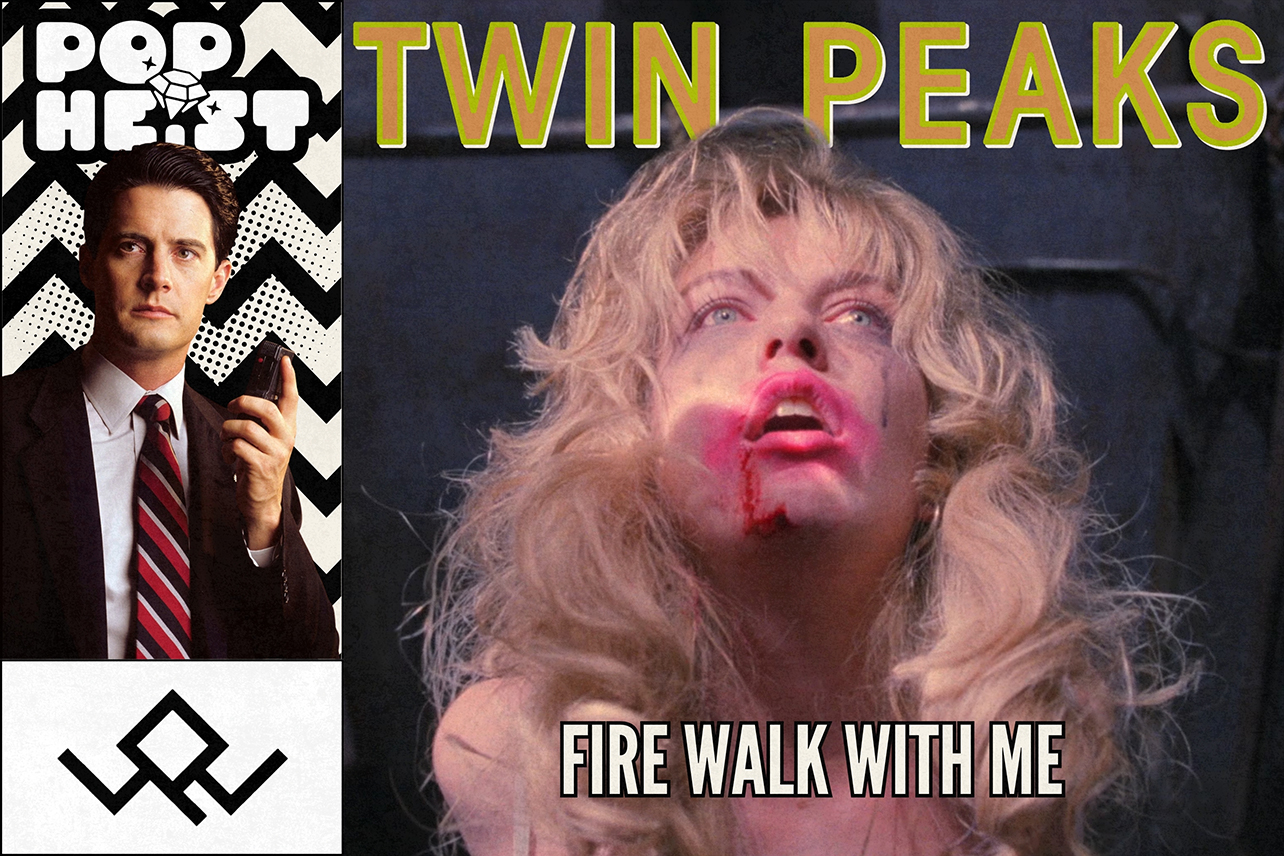
Laura Palmer with blood mouth

In PRESTIGE PREHISTORY, Pop Heist critic Sean T. Collins takes a look at classic TV shows that paved the way for the New Golden Age of Television — challenging, self-contained series from writers and filmmakers determined to push the medium forward by telling stories their own way.

Twin Peaks: Fire Walk With Me
World Premiere: May 16, 1992
U.S. Release: August 28, 1992
Writers: David Lynch & Robert Engels
Director: David Lynch
Cast: Sheryl Lee, Ray Wise, Mädchen Amick, Dana Ashbrook, Phoebe Augustine, David Bowie, Eric Da Re, Miguel Ferrer, Pamela Gidley, Chris Isaak, Moira Kelly, Peggy Lipton, James Marshall, Jürgen Prochnow, Harry Dean Stanton, Kiefer Sutherland, Lenny Von Dohlen, Grace Zabriskie, Kyle MacLachlan, Frances Bay Catherine E. Coulson, Michael J. Anderson, Frank Silver, Walter Olkewicz, Al Strobel, Gary Hershberger, Sandra Kinder, Chris Pederson, Victor Rivers, Rick Aiello, Gary Bullock, Kimberly Ann Cole, Ingrid Brucato, Carlton L. Russell, Calvin Lockhart, Jonathan J. Leppell, Andrea Hays, Julee Cruise, Karin Robinson, Lorna MacMillan


The answers are there if you know what you’re looking for. Leland Palmer met Teresa Banks, his/Bob’s first murder victim, during regular business trips out of town for the Horne brothers. He wasn’t a demonically possessed psychopath during these excursions, it seems, just a run-of-the-mill philanderer. Only after he discovered that a foursome she’d arranged for him with friends in the Pacific Northwest sex trade involved his own daughter, Laura Palmer, did Bob kill Teresa. If a conversation between her and Laura had gone wrong, Leland’s affair with a teenage girl would be outed, and it would all come crashing down. That could not be allowed to happen.

Similarly, Laura’s murder — and the near-killing of Ronette Pulaski, her high-school classmate and sex-worker friend — was not the random impulse of an unknowable supernatural entity. Through a combination of tips from Bob’s fellow supernatural entities, some dangerous and ultimately devastating snooping, and finally sheer force of will, Laura learns that the being that has been sexually assaulting her since she was 12 years old does so using Leland’s body. On the morning of February 23, 1989, Laura tells Leland to stay away from her, and he knows he is in danger again. By the morning of February 24, 1989, Laura is dead.

But it didn’t have to go that way. Unlike Teresa, Laura factored into Bob’s plans in a much bigger way. His hand forced by his unmasking, Leland/Bob tracked Laura and Ronette down after their primarily nonconsensual foursome with Jacques Renault and Leo Johnson in Jacques’s cabin. He abducted the girls and forced them through the woods to that abandoned train car — but not to kill them, or at least not to kill Laura. Bob wanted to possess her, “to taste through [her] mouth,” as he grotesquely put it.

So she put on a magic ring thrown into the train car by Mike the One-Armed Man that forced Bob to kill her instead of becoming her, ending her life but saving her soul. 

If that is an answer — and the answers are already just one small part of the story of Twin Peaks — then answers, clearly, will only get you so far.

hand

A prequel to Twin Peaks the television series, Twin Peaks: Fire Walk With Me is divided into two sections that feel almost like different movies for a while, a technique employed by Lynch’s heroes Alfred Hitchcock in Vertigo and Stanely Kubrick in Full Metal Jacket, and later recycled for Lost Highway and Mulholland Drive. The first stars musician Chris Isaak as FBI Special Agent Chester Desmond, a man whose “MODUS OPERANDI,” to quote his supervisor Gordon Cole (David Lynch), is very much his own. (His men have guns drawn on a school bus when the film opens.)

Chris Isaak

Chet looks like a talented superhero cartoonist’s drawing of a handsome man — Dale Cooper’s Pokémon evolution. He sports a pompadour so large that its peak usually doesn’t stay in camera when he’s shot in close-up. He’s laconic where Coop is enthusiastic, a speak softly and carry a big stick type who doesn’t mind throwing his weight around with the uncooperative local cops, even if that means roughing one up right in the station house.

But like Cooper, whose psychic abilities come into play later in the film when he’s profiling the killer’s next victim, Chester Desmond has one foot in the world beyond. When it comes time to fill Chester in on the case he’s investigating, the unsolved Teresa Banks murder, Gordon employs a strange woman (Kimberly Ann Cole) in a bright red suit with hair to match. Calling her Lil, “my brother’s sister’s girl,” Gordon has her perform a little dance of some kind for Chester and his partner, Bureau forensics expert Sam Stanley (a nebbishy Kiefer Sutherland). 

Lil’s movements, her mannerisms, even her clothes are all coded signals for what the agents need to look out for when they’re working on the case. This includes the blue rose she’s wearing on her jacket, a mystery Chester refuses to explain while they’re on their way to the town of Wind River to investigate.

Lil the dancer

After lengthy run-ins with the foul-tempered local fuzz and the folks at the diner where Teresa worked (a much more depressing joint than the Double R), Chester and Sam wind up at the Fat Trout Trailer Park. Run by a weary-looking sort named Carl Rodd (Harry Dean Stanton, the weary-looking GOAT), it’s where Teresa lived before she was killed. And something is wrong there. A strange old woman covered in soot (Ingrid Brucado) comes to the door, but it seems only Chester and Carl can see her. By the time she leaves, Carl is crying, to Sam’s visible confusion. 

“See, I’ve already gone places,” he says cryptically, thinking of a utility pole outside for some reason. (A utility pole making a whooping sound.) “I just want to stay where I am.”

Chester sends Sam to Portland with Teresa’s body for more thorough tests, but not before he says he’s returning to Wind River. “You’re going back to the trailer park for the blue rose,” Sam concludes. Chester learns that Deputy Cliff (Rick Aiello), one of the asshole cops who were so unwilling to let him take over the case, lives right in the park too.

Then he finds a ring on a mound of dirt underneath the trailer, reaches for it, and apparently vanishes from the face of the Earth.


The shadow of the Liberty Bell tells us we’re in Philadelphia when the action resumes. Cooper comes to Gordon concerned about a dream he’s had about this particular day. When he begins obsessively checking surveillance footage from a hallway camera, we find out why. Even as he watches, it’s as if he’s still out in that hallway…and David Bowie is gliding right past him.

Coop on B&W TV

Bowie appears as Philip Jeffries, an FBI legend who’s been missing for two years. Dressed like a rich American on vacation and speaking in a Southern drawl, he tells Coop, Gordon, and Albert (Miguel Ferrer)that he refuses to talk about “Judy.” None of them have any idea who or what he’s talking about, let alone where he’s been all this time.

So he fills them in. Somehow, he infiltrated, or was invited to, a meeting of the denizens of the Black Lodge, in that room above a convenience store that Mike mentioned during Coop’s dream way back in Season 1. Bob is there, and the Man from Another Place, sitting at a green formica tabletop ladened with a bowl of garmonbozia — apparently the lodge’s name for the creamed corn that Donna Hayward accidentally delivered to the elderly Mrs. Tremond and her psychic grandson in Season 2. They’re both here as well.

There’s a bearded woodsman (Dune and Das Boot star Jürgen Prochnow) and a man who says the word “electricity” (Calvin Lockhart). There’s a jumping man with a flattop haircut, a red suit like the little man’s, a frightening white facemask with a pointy nose, and a stick in his hand. The grandson wears a similar but eyeless verison of the mask with a stick embedded in the forehead; when he peels it away, first he reveals himself, then the face of a monkey.

After getting out however much of his story, Jeffries vanishes while the camera shows us electric lines and telephone wires. Cooper, being Cooper, connects Jeffries’s disappearance with Chester’s and heads off to Wind River and the trailer park, where he learns that a woman and her grandson, the Chalfonts, recently moved away, having taken over their spot from the previous tenants, also named Chalfont. On the windshield of Chester’s car, they find written in red lipstick a familiar phrase: “Let’s Rock.”

Dirty windshield and Coop

The case gives Dale a bad feeling, not least because “it’s one of Gordon’s ‘blue rose’ cases” — presumably the Bureau’s answer to the Air Force’s “Project Blue Book” investigations into paranormal activity, with which the great (and sadly absent) Major Garland Briggs was involved. He knows the killer will strike again. Eventually, he tells Albert his psychic abilities have allowed him to profile the next victim: a blonde, sexually active high school girl with a drug problem who’s currently crying out for help. Albert razzes his old friend that he’s just narrowed things down to half the teenagers in America, but by that point we’ve already met the one.


One year after Teresa’s murder, it is the last week of Laura Palmer’s life. We first see her as we’ve seen countless adults playing countless high schoolers in countless fictional suburbs: strolling down a tree-lined street carrying her books on the way to school, looking dreamy-eyed. 

Laura Palmer leads a double life. Actually, she leads double lives, plural. She is all contradiction. She’s dating football team captain Bobby Briggs and cheating on him with biker James Hurley. She does the Meals on Wheels and she does coke in the school bathroom. She runs crying to her best friend Donna (played now by Moira Kelly) when she needs her, but big-dogs her when Donna tries to get in on Laura’s wild nightlife. 

Laura refuses to let her tag along, and she is furious when Donna follows her to the Roadhouse and sees her picking up tricks with the help of bartender, card dealer, drug smuggler, pimp, bird enthusiast, rapist, and all-around bon vivant Jacques Renault. But she not only relents and takes Donna with them to some Canadian sex club referred to in the credits as the Pink Room – she ensures that Donna drink a roofied beer to get even more fucked up than Laura herself. 

Laura is happily getting eaten out under a table alongside Ronette Pulaski when she sees Donna’s about to have sex too and starts screaming like only Laura Palmer can scream. She seems most furious that Donna was wearing Laura’s own discarded jacket, as though she knows this could make her friend a target for Bob. She has very similar worries about him learning about the existence of James or of Harold, to whom she entrusts her diary when she sees Bob has torn pages from it.

By the morning, Donna’s memories of the night have faded. “I love you, Donna,” Laura sobs, “but I don’t want you to be like me.”

If I were to catalog all the times Laura puts herself down, or says something despairing or fatalistic or cynical to the point of pure nihilism, we’d be here all day. Laura is the homecoming queen, and no one in Twin Peaks hates themselves more. What you are watching are the last sex-and-drug-fueled days in the life of a child whose brain has been completely pulped by the repeated trauma of Bob.


Laura baring teeth

Laura hates it, obviously, but more than that she’s alone with it. Only Harold (Lenny Von Dohlen) knows about Bob, and he doesn’t believe Bob is real, not until she growls “FIRE WALK WITH ME—ME!” at him. Then her face briefly transforms into the corpse paint/black mouth look we briefly saw on Windom Earle at the end of Season 2, and will see again with Leland much later in the film. (This apparently answers the question of whether the Lodge was actively assisting Earle in his efforts.) Her fear of telling anyone who can actually do anything is an echo of the very real fear felt by so many, too many, abuse victims in the real world. She kisses him goodbye — it’s clear he wants more — and leaves her secret diary behind.

Laura is alone with it, that is, until the Tremond-Chalfonts appear to her outside the meals on wheels, warning her that Bob is looking for her diary even now and giving her a picture of a door that will soon trigger a Red Room dream with the Tremonds as her guides. Laura races home to try to catch him in the act. In a drawn-out jump scare that anticipates the legendary Winkie’s scene in Mulholland Drive, Laura slowly opens her door until she sees her attacker, and both of them scream.

She runs outside and hides in the bushes, watching the front door to wait for Bob to leave. The image of her face when she sees who comes out of that door instead will be seared into my memory for as long as I live.

Woman crawling on ground

Here’s where we address the white horse in the room: the performance of top-billed stars Sheryl Lee and Ray Wise as Laura and Leland. They are, without qualification, the two best film performances I’ve ever seen in my life. Even in a series stuffed with gifted actors tasked with doing difficult work and succeeding, there’s nothing like these two. There’s nothing like them anywhere. They touch the sun.

You see it in that scene, when Laura’s horror at her newfound knowledge is so total that she immediately goes into denial again. You see it at dinner, when the Bob-possed Leland terrorizes Laura about how dirty her hands are, then asks about the half-heart necklace she’s wearing from James. “Is it from a lover?” he asks with hugely inappropriate enthusiasm and interest. He begins pinching her cheeks.

“She doesn’t like that,” Sarah says, beginning to cry.

How do you know what she likes?” the Leland-thing growls. 

I don’t get the impression from this scene that this kind of thing is a frequent occurrence in the Palmer household. Whatever the three of them know about what’s going on, this doesn’t appear to be a family with the classic abusive dynamic. It wouldn’t make sense given Bob’s own unique modus operandi.

Palmers

But you can also sense that they can sense something’s off. Sarah smokes like she’s being inhabited by a parasite that consumes nicotine and allows Leland to give her a clearly drugged glass of milk before bed. Leland eventually snaps out of his Bob-trance and comes to Laura’s bedroom, sobbing and telling her how much he loves her. 

Is he aware of what he’s doing? “I thought you always knew it was me!” we hear him say in his own voice during the actual murder, only for Bob to counter with “You know it was me!” Leland’s penchant for a high-school-aged sex worker who he says looks “just like my Laura.” Is that Bob speaking, or merely Bob’s influence on a person who was once decent? Keep in mind, Bob “came into” Leland when he was just “a little boy.” 

It certainly seems he could have done more to stop the attacks from happening, as he was aware of losing time and of hurting Laura’s feelings badly. But if you’ve been mentally raped by a demon since you were a child, and that demon lives inside of you, maybe it doesn’t occur to you to hope for any relief or rescue, for anyone.

At any rate, as Laura, Lee has to play all those different sides, all her splitting and doubling. As Leland, Wise has to play terrifying and terrified, abuser and abused, father and torturer, dad of the year and sleazy business creep and outright demon. He has to convincingly cry about what he’s done and convincingly chase two screaming girls through the woods like an orc in human form, thirsty for blood.

You see all of this, from both of them, in one of the film’s most frightening sequences. Mike the One-Armed Man chases them in his RV as they drive to breakfast, corners them behind a lumber truck at a light, and screams things only we who’ve seen the “formica tabletop” or “the corn ... above the store” can understand. 

Leland screams in panic, revving the engine wildly, seemingly to cover up the telltale smell of scorched engine oil that accompanies the Black Lodge’s intrusions into our world. Laura screams in terror of both the mystery man and of her own father’s bizarre conduct. 

“The thread will be torn, Mr. Palmer!” Mike yells. “The thread will be torn!” Extending his hand to show the magic ring is now on his own finger, he screams one last thing before the cars separate.

“IT’S HIM! IT’S YOUR FATHER!”

Man shouting and showing off pinky ring

Leland finally guns it into a nearby service station lot, desperately trying to collect himself. Did he understand what was happening? Bob sure would have, but how present was he? Laura realizes there’s something familiar about Mike, like she’s seen him before — by now she’s seen the Man from Another Place, and he himself says, he is Mike’s arm — but how could that be possible?

Pressing her luck, she asks if he was ever at home during the day last week, when she saw him come out of the house and first began to suspect him. He denies it, only to “remember” when she says she saw him there herself. Her demeanor changes rapidly after that, but she’s still in denial. Of course she is. Only when she grabs Bob’s head as he rapes her and demands, over and over, “Who are you?” is Leland’s face finally revealed. Laura’s scream is…I don’t think there are words for what her scream is.


That’s the beginning of the end, of course. The next morning she hisses at Leland to leave her alone, and with that, Bob knows. Yet Laura still has to get through the school day; make out with Bobby, the boy she dates but does not love; go on a secret motorcycle ride with James, the boy she loves but pities; and attend Leo and Jacques cabin sex party with Ronette. (And Waldo the bird.)

But she’s allowed to be more than just doomed, and that’s true throughout the whole movie. Her sense of humor is weird, even when she’s not literally laughing at Bobby killing Deputy Cliff in self-defensive instinct during a drug deal gone bad. “I’m gone, long gone, like a turkey in the corn ...gobble-gobble,” she says to James at one point, as serious as a heart attack even though the words are ridiculous. 

Laura with books

Watching her really turn on the charm is unbelievable too. Fucking James at school, then melting Bobby’s anger away with a smile and a few cooed words, she can make people see what they need to see when they look at a girl like Laura Palmer, if only for a while. “So you want to fuck the homecoming queen,” she tells her johns at one point. 

My favorite moment, though, comes that final night as she tries to put on stockings while operating a landline receiver with no hands. She talks into it upside down, she struggles to get her foot in the opening of the stocking, she generally acts like a goofball teenager. Which is still something she is, somewhere in there. We saw a glimpse of her dancing with Donna in James’s video in Season 1. I’m glad to have gotten one final glimpse of it here.


There are some more answers, sort of, about the Black Lodge and how it operates. The ring business takes some doing to figure out: Why would Cooper, who appears to Laura in a Red Room dream, warn her not to take the ring, only for Mike to race against time to ensure she can? At the time, Cooper was only trying to save her life, unaware that her soul was in danger. That was Mike’s job, and he gave her the ring, which had already once marked Teresa for death, to ensure Laura would die free of Bob’s influence. (Hence Leland’s cry of “Don’t make me do this!”)

After killing Laura, leaving Ronette for dead, and dumping Laura’s body in the river, Leland travels to Glastonbury Grove in the Ghostwood and enters the portal to the Lodge. Inside, he separates into two beings, even as his daughter’s body bobs by the big rock near Pete Martell’s fishing spot. Bob stands in the Red Room now, facing his enemy, Mike, and his ally, the Arm. Leland floats in midair — to quote Jacques Renault, he’s “blank as a fart.”

“I want all my garmonbozia,” Mike and the Arm say in unison. The subtitles translate the unfamiliar word: “(pain and sorrow).” Bob transfers the blood from Leland’s clothes to the zig-zag floor. The Arm eats. 

The monkey says “Judy.”

Bob and Leland in Lodge

Some puzzle pieces wouldn’t be put into place for another 25 years, until Twin Peaks: The Return. Who is the mysterious “Judy” to whom both Philip Jeffries and the monkey from the Black Lodge refer? Why does Carl Rodd suddenly tear up and start speaking so mournfully about his life when he sees an image of a utility pole? The woodsman, the strange soot-faced woman, the white horse that appears to Sarah prior to Laura’s death just as it later will before Maddy’s — they’ll all get a light again, one way or the other. 

Most importantly, the ghost (?) of Annie Blackburn appears to Laura, bloody-mouthed and wearing the clothes of Dale’s murdered lover, Caroline Earle. “The good Dale is in the Lodge, and he can’t leave,” she warns Laura. “Write it in your diary.” 

How Dale’s captivity in the Black Lodge is handled, and for how long, and how or whether it ends are questions I’ll let Season 3 answer, or not, in due time. What I’ll say here is that this was the first time I had any reason to hope there might even be an answer. 

Coop in lodge

In my mind I pictured 25 years of Cooper running around possessed by Bob with no one ever the wiser, since he’d have captured the one person most capable of stopping him. From there, there’d be no telling how far the Lodge could take things: FBI Director Dale Cooper, Senator Dale Cooper, President Dale Cooper, nothing but a hollowed-out husk filled with pure evil. (“Who do you think this is there?”) Imagine how much damage such an unperson could do with all that power! (Imagine!!!) Annie’s message to Laura, and the potential that — even though we don’t see her do it, even though no one mentions it during Seasons 1 and 2 — her message could one day reach the right people, gave me hope.


Happy endings are certainly not unheard of in Lynch’s oeuvre, even in some of his most experimental and confounding narratives. (Don’t worry, I won’t spoil which ones, and it’s not as if “experimental and confounding narratives” narrows it down.) But Lynch, co-creator Mark Frost, and co-writers Robert Engels and Harley Peyton went so far out of their way to deliver the downest down ending imaginable with the series finale. (I say “series” because a miraculous revival for a subsequent season was less likely than Lazarus’s at this point in time.) Our hero failed, evil triumphed, and our friends’ efforts and the victims’ deaths were all in vain. Seen properly, Fire Walk With Me is an act of generosity from its creator, switching back on the light at the end of the tunnel he himself had so gleefully dynamited two years earlier.

But it would take many years for the critical consensus to come around. The movie bombed at Cannes (as have so many other classics) and was widely reviled by both critics and audiences, who expected a resolution to all of Season 2’s cliffhangers and got…this. Nothing on the fates of Coop, Audrey, Annie, Pete, Ben, Garland Briggs (last seen being invited to the Lodge by something speaking through Sarah’s mouth). No appearances at all by half the cast, including the entire Sheriff’s Department, the Horne family, the Packard-Martells, Big Ed and Nadine Hurley, Dr. Jacoby, even the Giant.

While I can’t exactly empathize, I can at least understand how this would read as a middle finger. In the context of Lynch’s subsequent string of difficult masterpieces — including The Return, which is simultaneously weirder and much more informative on plot issues than this movie — FWWM no longer feels like such a provocation. But at the time people felt personally aggrieved. 

It is indeed a tough film to watch. Lee and Wise are so present in these characters, their performances layered down into their bone marrow, that watching them is as exhausting as it is exhilarating. Black Lodge or no Black Lodge, this is still the story of a child being first mentally and then physically destroyed by her own father.

Closeup of Laura

As a visual experience, the film is gorgeous but rarely glamorous. The most stunning shots are unexpected ones: Chester Desmond outside Teresa Banks’s trailer at twilight, the purple magic-hour light captured as carefully as a living thing; Laura sobbing in a dimly lit bathroom; the towering signage of a motel sign after sundown. 

Fire Walk With Me is named for a spell chanted by demons and dark sorcerers. Fire imagery rarely shows up on screen — static, electricity, and blue-white flashing light seem to be Lynch’s fixations of the moment here — but it’s all over two of the finest pieces of writing in the entire film, both of which are as grim as you might think.

When Laura goes to the Roadhouse, she’s stopped outside by Margaret Lanterman, the Log Lady, who puts her hand on the girl’s forehead. “When this kind of fire starts, it is very hard to put out,” she says. “The tender boughs of innocence burn first, and the wind rises, and then all goodness is in jeopardy.” With a tender caress, she leaves. It’s actor Catherine E. Coulson’s finest moment in the series. (So far.)

Log Lady and Laura Palmer

The Log Lady’s words about unquenchable flame echo Laura’s own from earlier in the movie. “Do you think that if you were falling in space,” Donna asks her dreamily after school one afternoon, “that you would slow down after a while, or go faster and faster?”

“Faster and faster,” Laura replies, her voice so deeply sad it emerges only as a whisper. “And for a long time, you wouldn’t feel anything. And then you’d burst into fire, forever. And the angels wouldn’t help you, because they’ve all gone away.” Her angel disappears from the picture on her wall on her last morning on Earth.

But hope has already taken wing here. After it’s all over, in the indeterminate time during which Laura and Cooper interact in the Red Room following her death, Coop rests his hand on her shoulder and smiles reassuringly. As well he should: Laura’s angel (Lorna MacMillan) returns, a real being and not a picture on a wall. Bathed in her bright light, Laura smiles and laughs and cries tears of joy. We don’t know how or when, but at last, Laura Palmer is at peace.

I understand coming away from Fire Walk Wtih Me confused, or even frustrated. It is more important that we have been moved. This portrayal of Laura respects her as a person enough to respect every facet of her, including the hardest to look at. Bob “lights [her] F-I-R-E” at times, and the film respects both us and her enough to accept this as part of the human condition. Her inescapable suffering, her profound hopelessness, her destructive acts towards herself and others: Fire Walk With Me honors it all. The catharsis we feel now would be cheap if it hadn’t.

This act of cinematic resurrection from the dead; this placing of the dead girl wrapped in plastic at center stage as a whole human being instead; this last note of grace for a soul now through with suffering — this is one of the greatest and most moving films I’ve ever seen. How can we be sad we didn’t get what we’d hoped for, when hope is exactly what we’ve been given?

If you haven't already, consider supporting worker-owned media by subscribing to Pop Heist. We are ad-free and operating outside the algorithm, so all dollars go directly to paying the staff members and writers who make articles like this one possible.

Stay in touch

Sign up for our free newsletter

Related Stories

‘Twin Peaks’ Season 2 Finale Recap: Under the Sycamore Trees

This is the 'Twin Peaks' house style, just maxxed out to a level we’ve never seen before. 

June 15, 2026

‘Twin Peaks’ 2×21 Recap: Long Live the Queen

We have it all now: the who, what, when, where, how, and why.

June 8, 2026

‘Twin Peaks’ 2×19 Recap: Kiss Me, Kiss Me, Kiss Me

It’s the first time death has ever looked silly on this show.

May 25, 2026

‘Twin Peaks’ 2×18 Recap: A Place Both Wonderful and Strange

With only four episodes left in the show’s second season, things are getting truly mystical.

May 18, 2026

‘Twin Peaks’ 2×17 Recap: I’m Going Through Changes

“She came to me,” Harry says, “and she made everything better.”

May 11, 2026