

Twin Peaks Season 3, Episode 2: “Part 2”
Tagline: “The stars turn, and a time presents itself.”
Airdate: May 21, 2017
Writers: Mark Frost & David Lynch
Director: David Lynch
Cast: Kyle MacLachlan, Joe Adler, Mädchen Amick, Steve Baker, Brent Briscoe, Gia Carides, Catherine Coulson, Neil Dickson, Patrick Fischler, Blathazar Getty, George Griffith, Cornelia Guest, Michael Horse, Nicole LaLiberte, Sheryl Lee, Jennifer Jason Leigh, Matthew Lillard, James Marshall, Walter Olkewicz, Benjamin Rosenfield, Frank Silva, Al Strobel, Jessica Szohr, Jake Wardle, Ray Wise, Grace Zabriskie, Madeline Zima
Musical Guest: Chromatics (Ruth Radelet, Adam Miller, Johnny Jewel, Nat Walker)
In Memory of: Frank Silva
“Do you think that if you were falling in space, that you would slow down after a while, or go faster and faster?”
“Faster and faster. And for a long time you wouldn’t feel anything. And then you’d burst into fire, forever. And the angels wouldn’t help you, because they’ve all gone away.”
—Donna Hayward and Laura Palmer, Twin Peaks: Fire Walk with Me
Our FBI Special Agent is back in familiarly unfamiliar territory. “Part 2” of Twin Peaks’ third season finds Coop, the real Coop, back in the Black Lodge’s iconic Red Room. Cooper spent the first episode in a black-and-white world that seemed more lushly appointed than the surrealist minimalism of the Lodge and its warren of zigzag-floored, red-curtained hallways and chambers. This place remains peopled only with white classical statues (you’ll note one is missing an arm) and the spirits and souls that call the place home, voluntarily or not.
When we join him, he’s sitting with Mike, the One-Armed Man, who appears frozen completely still at first — one of several glitchy visual tricks Lynch will play throughout the episode. “Is it future, or is it past?” he says, a question we first heard him ask in The Missing Pieces. Lynch of course would have known that many viewers wouldn’t have watched that deleted-scenes compilation, so they’d be hearing this for the first time. It’s a reference to a past that, for some, doesn’t exist.
Then Laura Palmer appears, a middle-aged woman now, wearing the same dress she was when we last saw her 25 years earlier.
“You can go out now,” she says.
When Cooper asks if she’s Laura Palmer, she repeats her line from Season 1: “I feel like I know her, but sometimes my arms bend back.” She eventually confirms that she is Laura Palmer, somehow. “I am dead,” she says, “yet I live.” Then she takes her face off, revealing dazzling white light within. It’s brighter even than the glare of the flashlight Deputy Hawk used at Glastonbury Grove, site of the Lodge’s secret entrance, to which both he and the Log Lady’s log have been directed. Presumably, it’s this light the Lodge has been so anxious to extinguish.
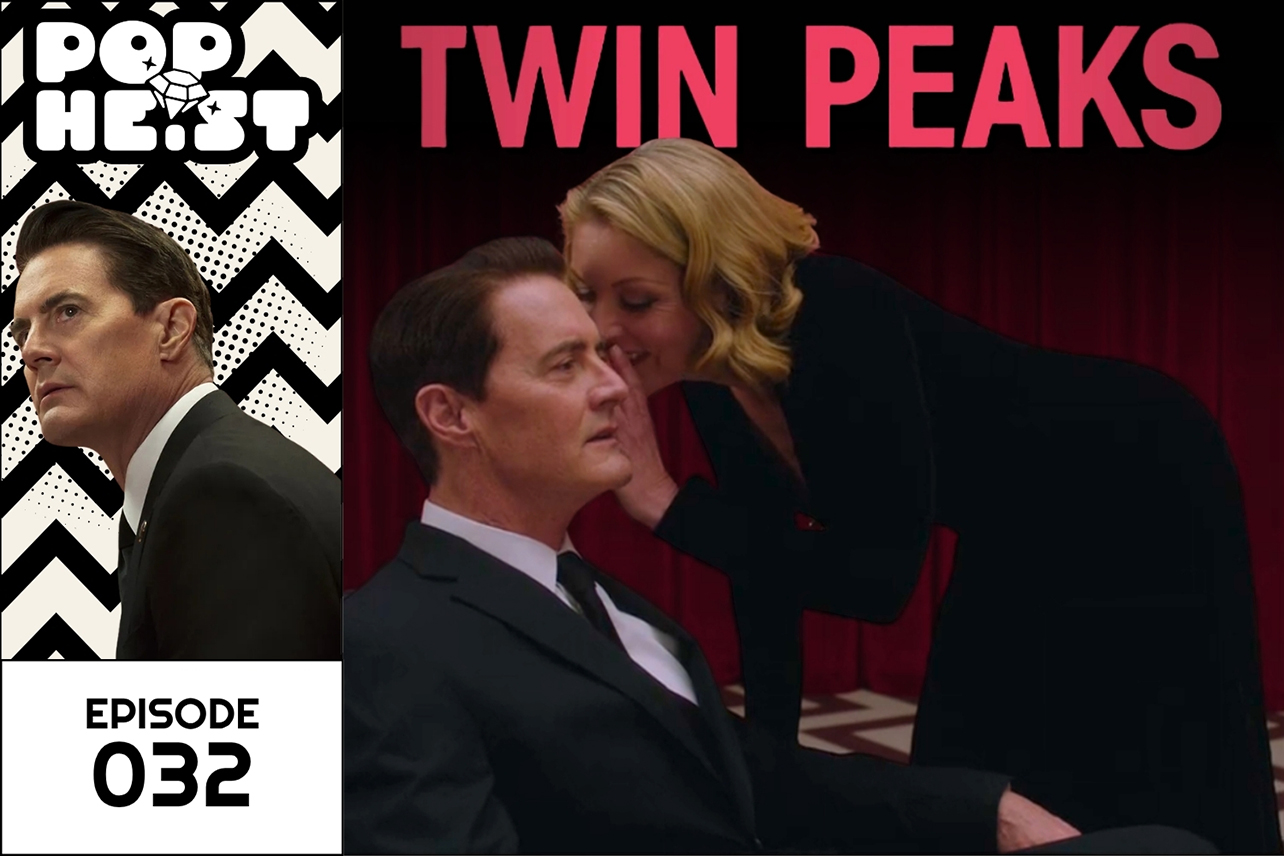
Cooper asks her when he can go, but as she did during Cooper’s dream in Season 1, she rises, kisses him, and whispers in his ear. Whether it’s an answer to his question or not, whatever she says viscerally disturbs him. She then starts to spasm and is sucked screaming out of the room, her soul nightmarishly distorted against the curtains and zigzag floors. It feels like a punishment for her intervention.
The curtains blow, and the white horse Sarah Palmer saw before the murders of Laura and her cousin Maddy Ferguson can be seen in the distance.
Mike returns, in the same position, asking the same thing about the future and past. What does he mean? Through that darkness, the magician longs to see.
Mike then guides Cooper to his counterpart, the Arm. No longer a diminutive Man from Another Place, suited and dancing, “he” is now a tiny tree with a head of viscera atop it, speaking in hoarse whispers and making a grotesque lapping sound rather than the Man’s signature whoop. “The evolution of the arm,” Mike calls this being.
However weird it looks, it’s helpful, as far as it goes. “Remember your doppelganger?” it asks Cooper. “He must come back in before you go out.” Citing the number “253,” it repeats Bob’s name and urgently tells Coop to go.
Cooper makes his way through the labyrinth of the Lodge, eventually encountering a man who appears to be an aged version of the real Leland Palmer. “Find Laura,” Leland pleads.
With this mission in mind, Cooper peels away curtains that lead, improbably, to a vista of an American highway down which his doppelganger is driving at that very moment. It seems as though some kind of switcheroo, or even a leap directly back into our reality and a fight with the doppelganger for control is about to occur.
Then another force intervenes: the Arm’s doppelganger, another tree-thing with its “head” a jaundiced yellow. “Nonexistent!” it screams as it assaults Cooper, tearing up the floor and sending him plunging through the depths of space, shot with terrifying immediacy.
Is it future or is it past? It’s past for the moment, at least in terms of the structure of the show. Cooper suddenly materializes on the roof of the glass box scene in “Part 1,” into which he somehow phases. He floats suspended in the air even as Sam and Tracey talk about the absent security guard and their lattes directly outside, placing this scene mere minutes before their slaughter by the entity from the box. By that time Cooper is gone, having been sucked back out into the starry void by a kind of matryoshka spacetime-continuum warp. It’s hard to explain, but like pornography, you’ll know it when you see it.
Cooper’s material is familiar in look and tone to similar sequences in the original series and Fire Walk With Me. His doppelganger (you can tell he’s evil because he drinks coffee without talking about how damn good it is) is in a hard-R crime-noir world more akin to the seedier elements of Lynch’s feature-film work. He’s a Frank Booth, a Bobby Peru, a Mr. Eddy, and his irises are as black as his soul, or whatever he has instead.
I’ll say right here that Kyle MacLachlan is simply magnificent in this role, terrifying and wholly unique in his malevolence. The doppelganger looks as if all the light inside a normal human has been completely emptied out and replaced with tar. He sounds unbearable when he’s pretending to be happy and uncanny when he actually is. He’s pure darkness. I’m a big fan of Jamey Sheridan’s work in Mick Garris’s 1994 adaptation of The Stand, but if you said that MacLachlan’s Nega-Cooper is the best portrayal of Stephen King’s infernal archvillain Randall Flagg, I wouldn’t argue with you. He is the Dark Man, the Walkin' Dude, the Hardcase, the Man with No Face.
(Dark Coop’s erstwhile confederate Ray, meanwhile, is a great type of criminal-in-a-movie, the kind of semi-cunning idiot who looks at a “man” like the dead-eyed thing sitting across the diner table from him and thinks “I can definitely pull one over on this guy.”)
“Mr. C” seems to have his bloody fingers in a lot of criminal pies. He is deeply involved, for example, in the murders being pinned on the desperate high school principal Bill Hastings. Bill’s wife Phyllis, it turns out, has known about his affair with the female victim all along, because she’s having an affair of her own with Bill’s lawyer, George (Neil Dickson). When she returns home after telling Bill off, however, she finds Mr. C waiting for her, and it’s clear they’ve been in league.
Too late, she realizes he’s there to kill her using George’s gun. He blows a hole in her face at which the camera points with unflinching directness.
It goes much the same later with poor Darya, the associate the doppelganger picked up with her male counterpart Ray last episode. Mr. C, whom they refer to simply as Cooper, is arranging a deal with Bill Hastings’s secretary to receive important geographical coordinates, which she’ll only hand off to Ray. But Ray winds up getting pinched for gun smuggling, or so he says over the phone in the middle of the night, rendering him unable to make the buy…or to participate in their $500K contract killing of Mr. C, which Darya nervously offers to perform herself.
Unfortunately for the lovely Darya, the doppelganger has heard every word of this via her tapped phone. He beats, menaces, and kills her brutally, but not before revealing the thing he wants. Not needs, as he stresses to Ray in a diner, because “I don’t need anything. I want.”
What does he want? It’s represented by a strange black doodle drawn over a scratched-up ace of spades playing card. (One-Eyed Jack’s is a thing of the past, though Mr. C does reference a game being played a la Windom Earle’s lethal human game of chess.) The drawing is a sort of rounded oval blob with two rough, angular limbs or wings protruding from the top. It looks kind of like a skinned chicken doing a little dance…and kind of like the symbol of Owl Cave.
It’s all part of a plan, the doppelganger explains to the terrified Darya. Tomorrow, he’s due to return to the Black Lodge; apparently his sojourn on Earth comes with an expiration date. But he has no intention of going back, and the coordinates appear key to getting out of his obligation.
His plan involves wiring a car (with a listening device? explosives?) and killing the man who does the job, before killing Ray and Darya for double-crossing him on behalf of unknown individuals. It’s not clear if this maneuvering is what causes the Arm’s doppelganger to attack the real Cooper, but it seems as though our special agent will have a hard time coming home as long as this creep is out and about.
Mr. C is also heavily implied to be the man muscling Mr. Todd, a casino boss of some kind in brightly lit Las Vegas. (Another unlikely Lynch cityscape!) This man is played by Patrick Fischler, aka the guy who had the Winkie’s dream in Mulholland Drive, and who has subtly vibrated with that scene’s menace ever since. Once again he’s nervous, seemingly in fear of his life from an unnamed man. This man is forcing him to…do things, things that have his assistant Roger (Joe Adler) deeply concerned for his boss.
“Roger,” Mr. Todd says, “you better hope that you never get involved with someone like him. Never have someone like him in your life.” The wording here, the use of hope and never, is a direct echo of Fischler’s Mulholland Drive dialogue, and it sounds every bit as desperate.
The Lodge is at work in the Hastings case in its own right. Mr. C has a cryptic phone call with someone he believes to be Phililp Jeffries, David Bowie’s vanishing FBI agent character, over some kind of transmitter, but the voice neither confirms or denies his identity. Instead it is hostile, chiding him for his tardiness in getting in touch and for having some kind of meeting with, of all people, Major Garland Briggs.
“I just called to say goodbye,” says the voice, which is unidentified in the closing credits. “You’re going back in together, and I will be with Bob again.” The doppelganger is alarmed to realize he has no idea who he’s actually talking too.
Mr. C recovers quickly enough. He boots up a glitchy computer and logs into the FBI’s computer system, recovering the floor plans for the federal prison where Ray is being held. (The doppelganger believes the gun-running pinch is a front for something else, for what it’s worth.) He then heads to the room next door, where he gives a sultry associate named Chantal (Jennifer Jason Leigh) the job of cleaning up his mess…but not before he fingers her, commenting approvingly on how wet she is. (The episode then cuts to the real Cooper, whom it is hard to imagine speaking that way.)
Finally, we return to Twin Peaks proper. First we see Sarah Palmer, who appears much the worse for wear. She’s alone in her living room at night, chain smoking and drinking alone, watching gruesome nature-documentary footage of lions devouring a live wildebeest. It’s very hard to imagine the empathetic, fragile Sarah we knew in 1989 watching this for more than a second.
Things are much better at the Bang Bang Bar, better known as the Roadhouse. It seems to have blossomed into a bustling live music space since we last saw it, though of course Julee Cruise performed there during the first two seasons. Up on stage are the moody indie dreampop band Chromatics, who perform their song “Shadow” in its entirety like SNL musical guests.
In the audience is Shelly Johnson (is that still her surname?). She complains about her daughter’s lousy choice in men (imagine that!) to several of her girlfriends, including a younger woman named Renee (Jessica Szohr).
Someone from Shelly’s past has got her eye on Renee. Like so many of the characters to whom we’ve been reintroduced, James Hurley wears the years on his gaunt face. He is bald and stubbly and gray now where he once had a magnificent black mane. Shelly explains to her skeptical friends that he may be quiet following a motorcycle accident, but he’s still cool. “He’s always been cool,” she says.
This strikes me as an incredibly generous line, since James (both Hurley and Marshall) has been dunked on relentlessly by the show’s viewers for years. I don’t think it’s deserved at all; neither did Lynch and Frost, which is why this line makes me cry every time.
But there’s a sour note. Shelly seems to be involved with some slick finger-gun type (Balthazar Getty)...and coincidence or not, he pops up right near a guy who can only be, get this, Jacques Renault’s previously unmentioned twin brother??? (According to the credits, his name is Jean-Michel, and yes, he’s played by Jacques actor Walter Olekiwicz.) Somehow I find the persistence of the Renault family even more troubling in its way than the existence of the evolution of the Arm.
Twin Peaks Season 3 may dispense with tradition in many respects. There’s the prestige-TV profanity and violence, for example; Darya’s drawn-out murder in particular is horrifying to watch, and her corpse is staged in insulting fashion.
This episode also introduces another new main title sequence, opening on the mists of the forest with Laura’s face superimposed over it. (She remains at the center of it all.) Kyle MacLachlan is the only actor to receive special billing, and in the closing credits only; everyone else is listed alphabetically.
But the show honors its past in at least one formal respect. Showtime aired the first two episodes of what it billed as Twin Peaks: The Return back to back, effectively creating a feature-length premiere. The two were even screened together at Cannes to a rapturous ovation. (A make-good, I’m guessing, for the hostile reception Fire Walk With Me found at the festival 25 years earlier.) The Season 1 and Season 2 premieres were also two-hour extravaganzas, and still clock in at over 90 minutes even without including ABC’s broadcast-network commercial breaks.
So even though it’s the nature of these reviews to cover one episode at a time, it’s still worth thinking about this episode as the second half of one giant season premiere. In many respects — reintroducing major locations like the Black Lodge and the Roadhouse and filling them with returning cast members, providing additional information on what the two Coopers are up to and why — that is indeed how it functions.
Even without the benefit of that context, though, it’s still an immediate contender for the best Twin Peaks episode of all time. If you argued that the two-part premiere is the best Twin Peaks “episode” of all time, I wouldn’t argue with you. I would, however, assume you haven’t seen the rest of the season. I won’t do this kind of tease often, I promise, but: You haven’t seen anything yet.


