
Skip to Content
Prestige Prehistory

‘Twin Peaks’ Season 2 Finale Recap: Under the Sycamore Trees

This is the 'Twin Peaks' house style, just maxxed out to a level we’ve never seen before. 

Laura in Black Lodge

In PRESTIGE PREHISTORY, Pop Heist critic Sean T. Collins takes a look at classic TV shows that paved the way for the New Golden Age of Television — challenging, self-contained series from writers and filmmakers determined to push the medium forward by telling stories their own way.

Twin Peaks Season 2, Episode 22
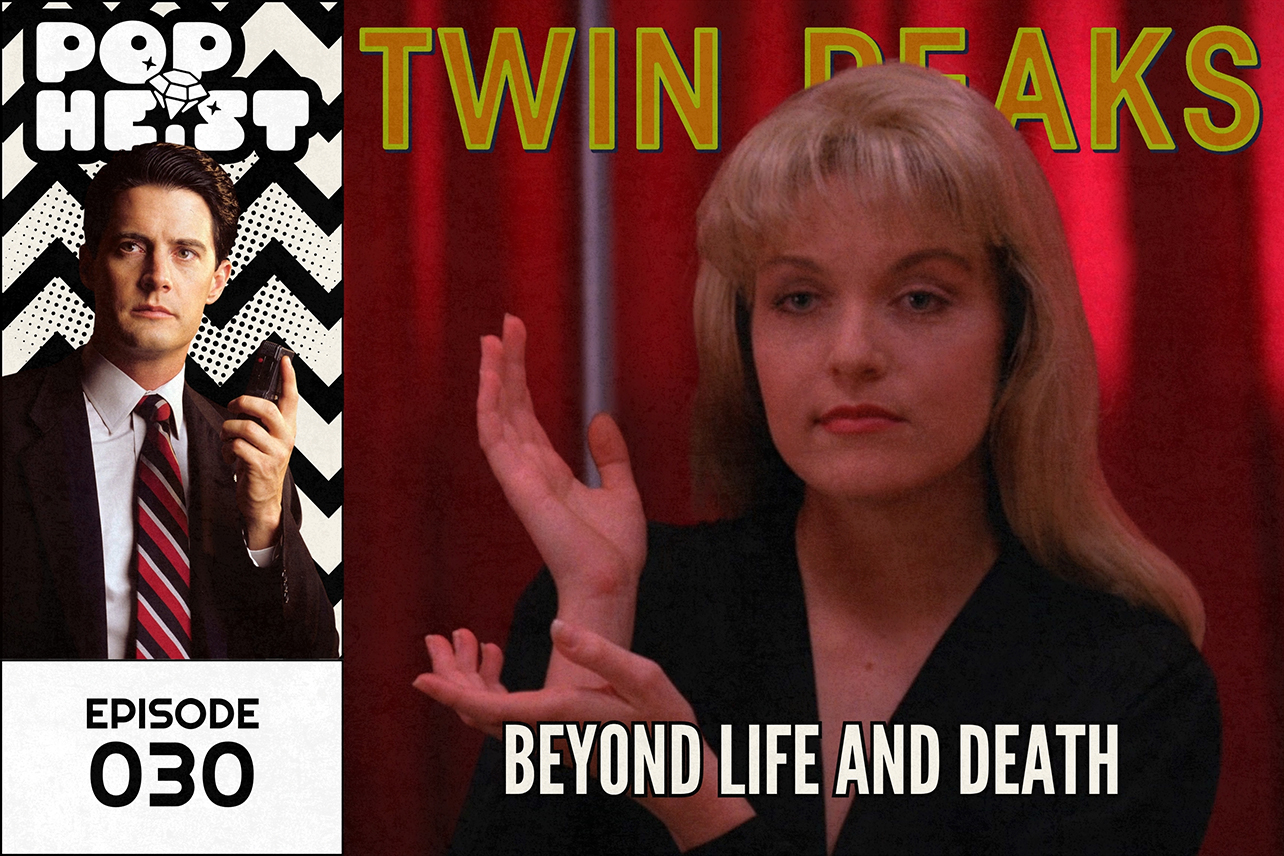
“Episode 29” aka “Beyond Life and Death”
[NOTE: The pilot episode of Twin Peaks is not numbered; this, the 30th episode overall, is officially designated “Episode 29.”]
Original Airdate: June 10, 1991
Writers: Mark Frost, Harley Peyton, Robert Engels
Director: David Lynch
Cast: Kyle MacLachlan, Michael Ontkean, Mädchen Amick, Dana Ashbrook, Richard Beymer, Lara Flynn Boyle, Sherilyn Fenn, Warren Frost, Peggy Lipton, James Marshall, Everett McGill, Jack Nance, Kimmy Robertson, Joan Chen, Piper Laurie, Eric Da Re, Harry Goaz, Michael Horse, Sheryl Lee, Kenneth Welsh, Russ Tamblyn, Heather Graham, Grace Zabriskie, Wendy Robie, Don Davis, Charlotte Stewart, Gary Hershberger, Mary Jo Deschanel, Catherine E. Coulson, James V. Scott, Dan O’Herlihy, Carl Struycken, Hank Worden, Ed Wright, Michael J. Anderson, Frank Silva, Phoebe Augustine, Jan D’Arcy, Andrea Hays, Arvo O. Katajisto, Brenda E. Mathers


“Cooper, you may be fearless in this world, but there are other worlds. Worlds beyond life and death. Worlds beyond scientific reality. My people believe that the White Lodge is a place where the spirits that rule man and nature reside. There is also a legend of a place called the Black Lodge, the shadow self of the White Lodge. Legend says that every spirit must pass through there on the way to perfection. There, you will meet your own shadow self. My people call it the Dweller on the Threshold. But it is said that if you confront the Black Lodge with imperfect courage, it will utterly annihilate your soul.” —Deputy Tommy “Hawk” Hill

“I’ll see you again in 25 years.” —Laura Palmer

“Fire walk with me.” —The Man from Another Place

Man from Another Place saying "fire walk with me"

Nothing can prepare you for the finale of Twin Peaks Season 2. For over two decades it was, as far as anyone knew, the finale of Twin Peaks itself. On television, it is virtually without precedent. Before June 10, 1991, when it aired back-to-back with “Miss Twin Peaks,” only the surreal series finale of Patrick McGoohan’s proto-prestige masterpiece The Prisoner was even in the conversation.

In the oeuvre of David Lynch, who returns to the director’s chair, it is a turning point. The most avant-garde narrative work he’d done since Eraserhead, it marked his full-on entrée into the elliptical storytelling and supernaturally tinged surrealism that characterized not only the show’s prequel film, Twin Peaks: Fire Walk With Me, but also Lost Highway, Mulholland Drive, Inland Empire, and Twin Peaks’ own triumphant return to television in 2017. Of Lynch’s major post-Peaks projects, only The Straight Story — a rare instance of Lynch directing from someone else’s screenplay — played it straight. Everything else is a zig-zag labyrinth of time and meaning. 

As a series finale, it’s a series of controlled demolitions. Storyline after storyline is taken to its logical conclusion, then blown up, in one case literally. Only rarely are these resolutions positive. Lucy and Andy say “I love you” to each other for the first time, Bobby asks Shelly to marry him, Heidi the horny German diner waitress from the pilot (Andrea Hays) makes her triumphant return (as do Lynch’s delightfully silly long takes and high-angled wide shots), and that is about the extent of the good news.

Shelly and Bobby happy

Beyond that, it’s as disaster-driven as the Season 1 finale. After the head injury she sustained during Windom Earle’s attack on the Miss Twin Peaks pageant, Nadine Hurley regains her memories, and her intolerable old personality. She spurns her heartbroken teenage lover Mike Nelson for her horrified husband Big Ed, crushing his hopes for a life with his beloved Norma Jennings. 

Nadine and man on couch in bandages

Donna Hayward packs up to leave home, sick of everyone’s lies. Returning from treating Nadine and Mike, Doc Hayward sees what Ben Horne has done by confessing that he is Donna’s true father and attacks him. Ben strikes his head against the fireplace, leaving him unconscious, Doc screaming, and Donna sobbing.

Audrey Horne chains herself to the vault of the local Savings & Loan to protest their bankrolling of the Ghostwood project.

Audrey handcuffed in bank

When Pete Martell and Andrew Packard use Thomas Eckhardt’s mystery key to open a safety deposit box, they set off a booby-trap bomb, blowing up the bank and presumably everyone in it, from the Lynchian very-old-guy banker (Ed Wright) whose glasses go flying through the air, to the security guard (Arvo O. Katajisto) who receives a phone call and incongruously shouts “It’s a boy! It’s a boy!” just before the explosion. Their fates are unknown.

And then there’s Sarah Palmer, back at last, with a face that has seen too much. Led into the Double R by a cape-wearing Dr. Jacoby, she has a message for Major Briggs, who’s there snuggling with his wife.

“I’M IN THE BLACK LODGE WITH DALE COOPER,” goes the message, which she delivers in a voice not her own. “I’M WAITING FOR YOU.”

The Black Lodge is an un-place. You enter it by stepping around a puddle of scorched engine oil in a circle of 12 small sycamore trees and passing through a red curtain that appears in the air, like something out of a fairy tale. Inside are large red-curtained rooms with a zig-zag pattern on their floors. Some have furniture and statues, some don’t. Some have entities in them, some don’t. They may all be separate instances of the same room, for all we know about how space and time work in the Lodge.

What is apparent is that these rooms are connected by a narrow curtained corridor, through which Dale Cooper repeatedly passes in L-shaped movements that resemble those of a knight on a chessboard. This is, of course, the final play of the game.

Books can and have been written about who and what Cooper sees once he’s inside. The Man from Another Place is there again, talking backwards the way everyone but Dale does. Laura Palmer returns as well, beatific in this afterworld. Both have messages for Coop about the future. “I’ll see you again in 25 years,” Laura says. “When you see me again, it won’t be me,” the little man says. Time will prove them both right. 

Giant and Man from Another Place, one and the same

The Giant is there as well, and the elderly waiter who appears to be his avatar on Earth. “One and the same,” he gently explains.

Maddy Ferguson, “another friend” as the cackling Man puts it, also returns. “Watch out for my cousin,” she tells Dale. It’s unclear if this is a request or a warning.

And there is a singer (Little Jimmy Scott), an elderly Black man who sings of the sycamore trees that grow in Glastonbury Grove. (This is the Arthurian name given to the circle that marks “an opening to a gateway,” as the Log Lady puts it.) His seemingly genderless voice — Scott had a genetic disorder that disrupted his puberty, giving him a voice with an unusual range and sound — provides one of the musical high points of the show, haunting and unforgettable.

Then there are the doppelgangers.

Man from Another Place on zigzag floor saying "doppelganger"

“Doppelganger” is the word the Man’s own “shadow self” uses to tell Cooper what he is encountering. These creatures of the Lodge look like our heroes and villains, only with their eyes weirdly whited out and their pupils demon-green. Laura’s doppelganger mimics the poses and words of the real Laura (“Meanwhile”) and then screams like a banshee.

Laura screaming

Leland Palmer’s doppelganger pops up to tell Dale he didn’t kill anyone. (Emphasis mine.)

Leland in Black Lodge

A doppelganger of Caroline Earle appears, seeming to flicker into existence in place of the spirit of Annie Blackburn, dragged to the Lodge by Windom Earle. Sometimes Annie speaks as though she is Caroline, talking about her murder at her husband’s hands. Sometimes she lays in Caroline’s place on the floor as a dead body next to a badly injured Cooper, recreating the crime scene. 

From this, it seems clear that the Black Lodge reflects the fear and pain on which its denizens feed back at the people who feel it. This ties to the petroglyph, with its drawings of a giant and a little man. Presumably these entities did not appear to members of Deputy Hawk’s tribe as besuited and bowtied white men hundreds of years ago when the petroglyph was drawn. Similarly, Caroline’s doppelganger wouldn’t have appeared to, say, Laura Palmer, who wouldn’t know her. 

The Black and White Lodges — the Giant and his waiter self still seem to me to be benevolent entities from the White Lodge, and the black-and-white pattern on the floor suggests that these rivals exist in some state of cosmic détènte — are psychedelic in the literal sense. Loosely translated, Greek roots of that word mean mind-revealing, the exact way Major Briggs described his dream of the palazzo to his son Bobby. To quote another white wizard, what’s in there is only what you take with you.

The final doppelganger is that of Cooper himself. 

Dale's doppelganger

This gibbering creature enters the scene shortly after Windom Earle finally gets his…at the hands of none other than Bob, the show’s arch-villain. Outraged that Earle would presume to bargain for Cooper’s soul in exchange for Annie’s life — that’s a privilege only the likes of Bob enjoy — the demon tears Windom’s soul from his body in a gout of flame, leaving him a motionless husk. For one brief moment, Bob is on Coop’s side.

Bob destroying Windom's soul

But not for long. Fumbling through the curtain, the Coopelganger runs up to Bob, the two of them cackling like old friends. The creature is similarly friendly with the Leland doppelganger, the pair of them grinning conspiratorially as Cooper flees from his shadow self. The gleeful way these things act, the sense that they’re all in on something you don’t want to believe is even possible, is best described in a letter between two of the real world’s most loathsome monsters: Every day is another wonderful secret.

Bob and Cooper doppelganger laughing

Cooper is afraid, and not just of the Black Lodge creatures or for the safety of the woman he loves. The appearance of the Caroline doppelganger shows he’s afraid of himself — of his failures, his imperfections, his inability to protect everyone he wants to, even those closest to him, those he loves. 

He has confronted the Black Lodge with imperfect courage. His doppelganger catches him. When Cooper is rescued by Sherif Truman, who stood a 24-hour vigil in the woods for his dear friend, and returned to his hotel room in the Great Northern to be treated by Doc Hayward, he is not himself. 

He is Bob.

Dale cracking mirror with head, Bob in reflection

Again, books can and have been written about this. You could pick at almost any individual strand of this thing and keep pulling basically forever. The influence of Stanley Kubrick, for example, feels massive. The not-quite-human entities and not-quite-human space recalls elements of the climaxes of both The Shining and 2001, as does the nonsensical layout of the Lodge’s floor plan. Classical statuary, sinister men in fancy dress, the willingness to sit and let the audience feel unnerved and uncomfortable…all of that is there.

But the interests and obsessions of Lynch, co-creator Mark Frost, and Frost’s cowriters on this episode Harley Peyton and Robert Engels, are in there as well. Strobe lighting, red curtains, backwards speech and movement, cacophonous screaming and laughter, a prominent musical performance, a supernatural cup of coffee (!!!): This is the Twin Peaks house style, just maxxed out to a level we’ve never seen before. 

We’ll be seeing plenty of it soon.

What does this all mean?

One has to keep in mind that the future of the show was in doubt, and even the normally tranquil David Lynch was actively angry at how things were going. He significantly rewrote this episode, revising the Black Lodge/Red Room sequence almost completely and bringing back multiple long-gone characters, from Maddy Ferguson to Ronette Pulaski, among other changes. So there’s a degree to which some of the events of this episode seem out of joint. Doc Hayward back at work the morning after he knocked Ben Horne unconscious for destroying his family, Norma happily flirting with a giddy Big Ed mere hours after her baby sister Annie disappeared — things like that don’t really reward reading into.

And yes, Cooper fails. Annie, we’re told when “Cooper” asks, is fine. (“How’s Annie? How’s Annie? How’s Annie?”) But Cooper obviously isn’t. The Black Lodge is loose on Earth once again. Bob has a new host, one with a badge and a gun, high-level FBI contacts, a friendship with Garland Briggs, an unofficial command position in the local police, and a thorough working knowledge of Project Blue Book, the Bookhouse Boys, and basically every other force arrayed against “the evil in these woods.” 

Given Cooper’s talent and charm there’s no telling how far his career could go from here. Can you imagine what might happen if someone completely evil were put in charge of the FBI, or made it even higher in the halls of power? (Can you???) Dale Cooper is the ideal candidate for corruption. 

Yet there’s so much left to see. Coop and the Lodge are heavily featured in the Laura-centric prequel film Fire Walk With Me, while the show’s third season, set 25 years later (Laura kept her word), is a direct follow-up. I don’t think it’s a spoiler to say much of what we think we know about the world of Twin Peaks and the stories of Laura, Dale, and the Lodge is wrong.

But since this was the end of the line for 26 years, it’s worth thinking about how bold it really is. Nothing is resolved. Everything is up in the air. The forces of evil are triumphant. Our gallant knight has been defeated, his soul stolen or shoved aside. His nobility and brilliance, his open mind and open heart, his fundamental goodness and his willingness to acknowledge when he falls short, were not enough. We learn all this not through straightforward, plot and dialogue-driven screenwriting, but through the most confrontationally bizarre episode of television a major broadcast network has ever aired. We learn it through magic, we learn it through fire, and we are left there to walk alone.

Laura saying she'll see you again in 25 years

If you haven't already, consider supporting worker-owned media by subscribing to Pop Heist. We are ad-free and operating outside the algorithm, so all dollars go directly to paying the staff members and writers who make articles like this one possible.

Stay in touch

Sign up for our free newsletter

More from Prestige Prehistory

Explore Prestige Prehistory

‘Twin Peaks’ 2×21 Recap: Long Live the Queen

We have it all now: the who, what, when, where, how, and why.

June 8, 2026

‘Twin Peaks’ 2×19 Recap: Kiss Me, Kiss Me, Kiss Me

It’s the first time death has ever looked silly on this show.

May 25, 2026

‘Twin Peaks’ 2×18 Recap: A Place Both Wonderful and Strange

With only four episodes left in the show’s second season, things are getting truly mystical.

May 18, 2026

‘Twin Peaks’ 2×17 Recap: I’m Going Through Changes

“She came to me,” Harry says, “and she made everything better.”

May 11, 2026

‘Twin Peaks’ 2×16 Recap: The Beautiful and the Damned

Ge careful which Twin Peaks fans you say the words “pine weasel” around.

May 4, 2026