
While the Masters of the Universe movie might have been a popcorn pleaser, it also became very divisive among the MOTU fandom. The film barely scratched making its money back and seems like an initial loss for Amazon/MGM, which doesn't bode well for the franchise's future. Nevertheless, we can have a little fun and talk about how director Travis Knight planted seeds for what could be in the mid-credits scene.
So, who is the mysterious woman from the mid-credits scene? What do you really remember about the world of She-Ra: Princess of Power? Let's take a quick crash course.
By 1985, Masters of the Universe had become far more than a toy line. What began as Mattel's answer to the fantasy-action craze of the early 1980s had evolved into one of the decade's biggest entertainment brands, complete with bestselling action figures, a hit syndicated cartoon from Filmation, comic books, storybooks, lunchboxes, Halloween costumes, and enough licensed merchandise to dominate toy aisles across North America. As detailed throughout The Art of He-Man and the Masters of the Universe, the franchise had grown into a genuine cultural phenomenon, one that transformed He-Man from a muscular barbarian-inspired toy into a household name.
Success creates opportunity, but it also creates expectations. Mattel wasn't interested in standing still while Masters of the Universe was at its peak. The company wanted to expand the audience and continue building the mythology surrounding Eternia. One of the most obvious opportunities involved creating a heroic female lead who could anchor her own toy line while remaining connected to the larger Masters of the Universe universe.
The result was She-Ra.
Looking back, it's easy to assume She-Ra was simply designed as a female counterpart to He-Man, and on a surface level that's true. Both characters transform through magical swords. Both are connected to the power of Grayskull. Both possess extraordinary strength and serve as champions against evil. But the people developing the character quickly realized that a simple gender-swapped version of He-Man wasn't enough to support an entire franchise. She-Ra needed her own mythology, her own setting, and her own reason to exist beyond being "He-Man's sister."
That's exactly what happened.
One of the key figures involved in developing that mythology was writer J. Michael Straczynski, years before he became known for creating Babylon 5. When asked about the origins of She-Ra and the show's development materials, Straczynski explained, "The original He-Man bible was written in large measure by Larry DiTillio; Larry and I later co-wrote the bible for the She-Ra series. Filmation, being Filmation, never wanted any credits on those docs so I don't know if they survive with or without the credits."
So how do you introduce a brand-new character to the Masters of the Universe mythos to give her the most impact? You give her a movie.
The Secret of the Sword and the birth of Adora
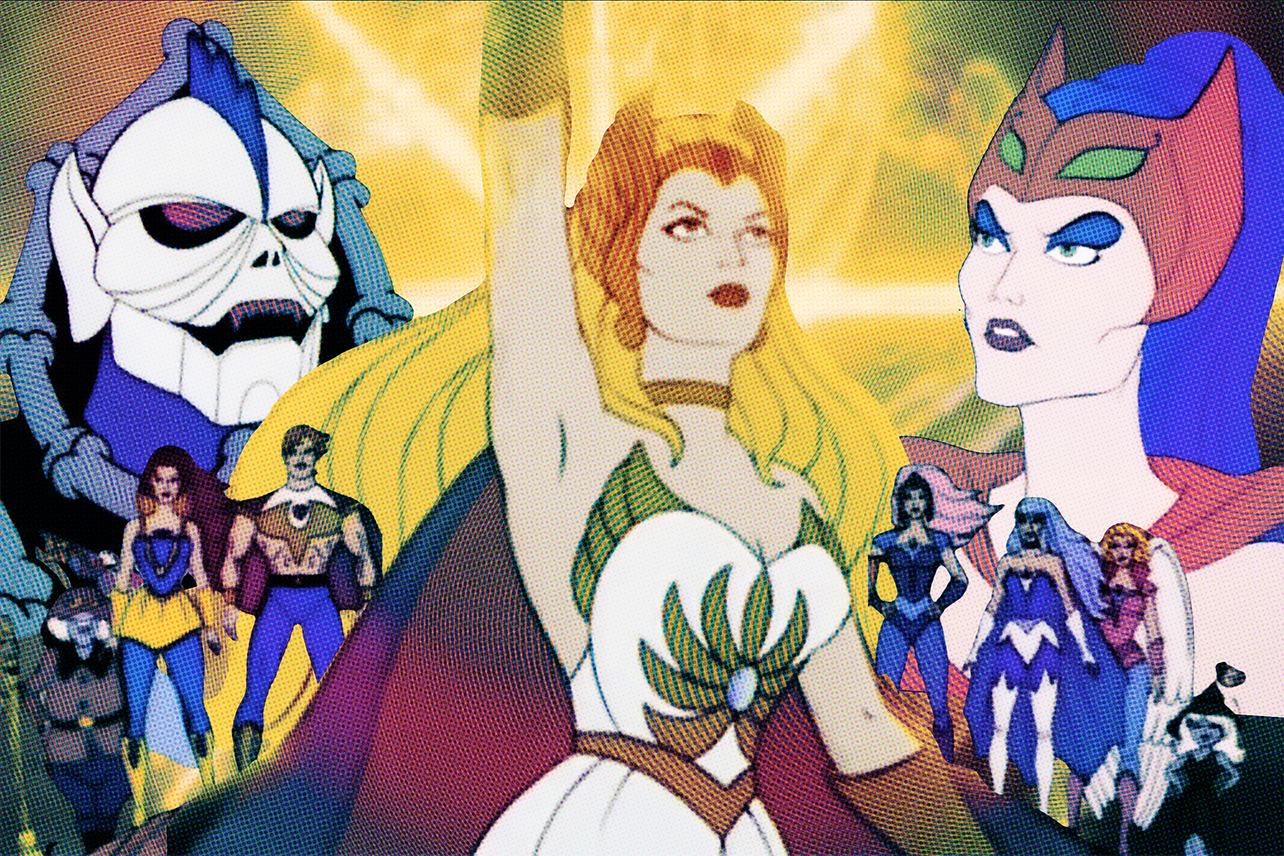
Filmation introduced She-Ra through the 1985 animated movie The Secret of the Sword, also released as He-Man and She-Ra: The Secret of the Sword. It was a full-length animated feature, with the film serving as both an expansion of the Masters of the Universe, er, universe and a launchpad for an entirely new series.
The story begins with a revelation that immediately altered the franchise's mythology: Prince Adam wasn't an only child. Instead, he had a twin sister named Adora.
According to the film, Adora had been abducted as an infant by Hordak and Skeletor during an attack on Eternia. Taken to the distant world of Etheria, she was raised by Hordak within the ranks of the Evil Horde. By the time audiences meet her, she is Force Captain Adora, a capable and respected officer who genuinely believes she's serving a noble cause. Her heroic journey begins when she discovers that everything she has been taught is a lie. For a franchise that often operated in a straightforward good-versus-evil binary, it was a surprisingly effective premise.
Eventually, Adam and his allies locate Adora and reveal the truth about her origins. Along the way, audiences learn another major piece of Masters of the Universe mythology: He-Man's Power Sword has a counterpart. Known as the Sword of Protection, it grants Adora access to the power of Grayskull and transforms her into She-Ra.
The transformation sequence quickly became one of the defining images of the franchise. Adora raises the sword, swearing to fight for the honor of Grayskull, and is transformed into the Princess of Power in front of the Crystal Castle, a golden structure to parallel the Grayskull background behind Adam's transformation.
The film was a success, reportedly earning more than three times its approximately two-million-dollar budget. Filmation later divided the movie into several episodes that served as the opening chapters of the TV series She-Ra: Princess of Power, ensuring that many fans first encountered the story through television syndication rather than theaters. There were also read-along books with cassettes (I still have mine).
Either way, the mythology had officially expanded.
Etheria wasn't Eternia — and that was the point.
One of the smartest creative decisions behind She-Ra involved geography. Rather than simply adding another hero to Eternia, the creators introduced an entirely new world.
Etheria wasn't just another kingdom hidden somewhere beyond Castle Grayskull. It was a separate setting with its own cultures, conflicts, and history. While Eternia often felt like a patchwork of fantasy kingdoms, ancient technology, and barbarian adventure, Etheria carried a different atmosphere. While He-Man and the Masters defended Eternia from the evil forces of Skeletor while protecting the secrets of Castle Grayskull, Etheria was already mostly under Horde control. Adora/She-Ra and the Great Rebellion were the minority — and that distinction changed everything.
As a result, She-Ra: Princess of Power frequently centered on resistance movements, alliances between kingdoms, and efforts to liberate territories controlled by the Horde. The stakes felt different. The stories felt different. Even the visual design often felt very different with the Fright Zone having a more dystopian sci-fi feel instead of Snake Mountain's primeval aesthetic.
Filmation's artists populated Etheria with floating castles, enchanted forests, hidden kingdoms, and bizarre magical creatures. The world was colorful, expansive, and often stranger than Eternia itself. That's saying something, considering Eternia was already home to talking tigers, floating castles, and a villain with a yellow skull for a face.
Etheria quickly developed its own identity, and that identity became one of the franchise's greatest strengths.
Hordak and the Horde
Every successful hero needs a memorable villain, and She-Ra inherited one of the franchise's most interesting antagonists. Unlike Skeletor, who often operated as a scheming outsider trying to seize control of Eternia, Hordak ruled through occupation and intimidation.
The Horde itself was an empire that had entire regions under their control, maintaining factories and military installations.
The Horde's ranks included some of the most visually distinctive characters Mattel ever produced. Catra, Shadow Weaver, Mantenna, Grizzlor, Leech, Scorpia, and others helped create a rogues' gallery that felt separate from Skeletor's crew while still fitting comfortably within the larger Masters of the Universe aesthetic.
Looking at many of those toys today, it's hard not to appreciate just how willing Mattel's designers were to embrace weirdness. A villain with telescoping eyes? Sure. A giant, insect-like energy vampire? Why not? A heavily armored warlord who could transform parts of his body into machinery? Absolutely. Not one, but two villains that you could assemble and disassemble and then combine together? Let's go!
The Sword of Protection
Like He-Man's Power Sword, She-Ra's Sword of Protection became one of the defining symbols of the character.
The weapon serves as the source of her transformation and functions as far more than a simple sword. Throughout the original series, it demonstrates a variety of magical abilities, including deflecting energy attacks, projecting beams of power, and transforming Adora's horse Spirit into the winged unicorn Swift Wind. So on that note, yeah, very similar to how the Sword of Power functioned — but it also featured extra transformative properties.
With simple words, She-Ra could make her sword into different things like a shield, rope, or even turn the blade into a torch. In the Christmas special, we saw a few transformations ("Sword to flame!" "Sword to lasso!") — He-Man could never.
There's also a distinctive focus on where the power is held within the sword. She-Ra's sword channels energy through the jewel (sometimes called the jewel of protection or stone of protection) embedded at its center, allowing Spirit's transformation into Swift Wind to occur through the sword's magical beam. The jewel is the key to such powers of the Sword of Protection as Adora's transformation; if it is damaged, she loses her ability to transform into She-Ra, as seen in the episode "The Stone in the Sword."
The Great Rebellion and the Princesses
Another area where She-Ra distinguished itself involved its supporting cast. The Great Rebellion served as the primary heroic organization opposing Horde rule. Characters such as Bow, Glimmer, Queen Angella, Madame Razz, and Kowl quickly became fan favorites, giving the series a large ensemble that extended beyond its central heroine.
Unlike many action cartoons of the era, She-Ra often emphasized cooperation over individual heroics. Adora might be the most powerful member of the Rebellion, but victories rarely belonged to her alone. Success depended on alliances, friendships, and coordination among Etheria's various kingdoms.
That approach helped make the world feel larger. Etheria wasn't waiting for a single hero to save it since entire communities were actively participating in the fight against the Horde. The idea would become even more prominent decades later when the franchise returned in a very different form.
The strange business of Masters of the Universe canon
Explaining Masters of the Universe continuity is a bit like explaining comic-book continuity to someone new to comics: technically, there is a canon, but in practice it's complicated.
Over the years, different versions of the franchise have told the story in different ways. The Filmation cartoons established one continuity, while toy-packaged mini-comics introduced others. Comic-book publishers expanded, revised, and reinterpreted the mythology, and later reboots often reshaped details to suit new creative visions.
She-Ra's history reflects that same evolution. Some stories emphasize her connection to Eternia and He-Man, while others focus almost entirely on Etheria. In certain versions, the Horde is a vast interplanetary threat; in others, the conflict is smaller and more personal. For dedicated fans, tracing these differences can become a hobby in itself.
What remains consistent are the core elements: Adora is separated from her family, raised by the Horde, discovers the truth about her past, and becomes She-Ra. The details surrounding that journey tend to change depending on who is telling the story.
The Netflix reboot and a new generation
In 2018, Netflix launched She-Ra and the Princesses of Power, a reboot that became one of the most talked-about animated series of its time.
The series preserved the essentials of She-Ra's origin. Adora begins as a member of the Horde, discovers the Sword of Protection, and transforms into She-Ra. Beyond those fundamentals, however, the reboot forged its own identity.
This version of Etheria existed largely apart from traditional Masters of the Universe continuity. References to He-Man and Eternia were minimal at best, and while Hordak and the Horde remained central figures, the show focused on building its own mythology rather than serving as a direct continuation of the original franchise.
That freedom allowed the creators to reimagine the world from the ground up. Character relationships took center stage, storylines developed across multiple seasons, and emotional conflicts carried as much weight as physical battles. Instead of the episodic format common to many 1980s cartoons, the series embraced serialized storytelling and added in a friends to rivals to lovers narrative arc with Adora and Catra.
For many younger viewers, this reboot became the definitive version of She-Ra.
From Princess of Power to LGBTQ+ icon
Few aspects of the 2018 reboot had a greater cultural impact than its willingness to embrace themes that previous versions of the franchise could only hint at.
While She-Ra and the Princesses of Power modernized Etheria's worldbuilding and expanded its cast, its most significant contribution may have been the way it redefined relationships at the center of the story. In particular, the bond between Adora and Catra evolved beyond rivalry and became one of the most talked-about character arcs in modern animation.
For decades, She-Ra had represented empowerment, independence, and heroism. The reboot retained those qualities while broadening what the character could mean to audiences. Adora's journey was still about discovering her identity and choosing her own path, but the series also allowed her to experience love in a way that felt authentic to the story rather than treated as a novelty.
The decision resonated with viewers who had rarely seen LGBTQ+ characters occupy the center of a major franchise rooted in children's entertainment. Rather than existing on the sidelines, queer characters became an integral part of Etheria's world. Their identities were neither hidden nor presented as the sole focus of their characterization. They were heroes, villains, leaders, friends, and family members whose relationships were treated with the same importance as everyone else's.
Catra's evolution played a major role in that success.
The original Filmation series established her as one of She-Ra's most recognizable adversaries, but the reboot transformed her into a deeply layered character whose relationship with Adora became the emotional backbone of the narrative. Their story of friendship, separation, conflict, and reconciliation gave the series much of its emotional weight and ultimately helped define the show's legacy.
What made the approach particularly effective was that it never felt disconnected from the franchise's history. The creators weren't abandoning the core themes of She-Ra, they were building upon them. Adora's compassion, courage, and belief in others had always been central to her character. The reboot simply expanded those ideas for a new generation.
In doing so, She-Ra and the Princesses of Power became more than a successful reboot. It became a cultural touchstone for many viewers who finally saw themselves reflected in a franchise they loved.
The legacy of the Princess of Power
Nearly forty years after her debut, She-Ra remains one of the most successful and enduring characters ever created for a toy-based franchise. That longevity is remarkable in its own right. Countless toy-inspired properties have come and gone since the 1980s, yet She-Ra continues to find new audiences across multiple generations. What began as an extension of Masters of the Universe gradually evolved into a mythology capable of standing on its own. After all, at her core, Adora's story has always been about self-discovery.
Adora learns who she is. She questions the world she was raised to believe in. She chooses her own destiny rather than accepting the one others have chosen for her. Perhaps that is why She-Ra has remained so adaptable. Different generations have connected with different aspects of the character. Some remember her as a pioneering female action hero. Others embrace her as a symbol of empowerment and self-determination. For many modern fans, she has also become an important LGBTQ+ icon — a character whose story helped demonstrate that heroism, identity, and love can coexist at the center of a mainstream fantasy adventure.
That evolution reflects the strength of the franchise rather than a departure from it.
Every era has reinterpreted She-Ra through the lens of its time while preserving the qualities that made her compelling in the first place. The details may change, but the foundation remains the same: a hero who inspires people to be themselves and to fight for a better world.
For a character originally created to expand a toy line, that's a legacy few could have predicted.
She-Ra is a cultural icon in her own right. And nearly four decades later, the Princess of Power continues to prove that her story is far bigger than the franchise that introduced her. Because in the end, the true legacy of She-Ra isn't the Sword of Protection or even the power of Grayskull — it's the honor of choosing to stand up for others and become the hero you're meant to be.
If you haven't already, consider supporting worker-owned media by subscribing to Pop Heist. We are ad-free and operating outside the algorithm, so all dollars go directly to paying the staff members and writers who make articles like this one possible.