

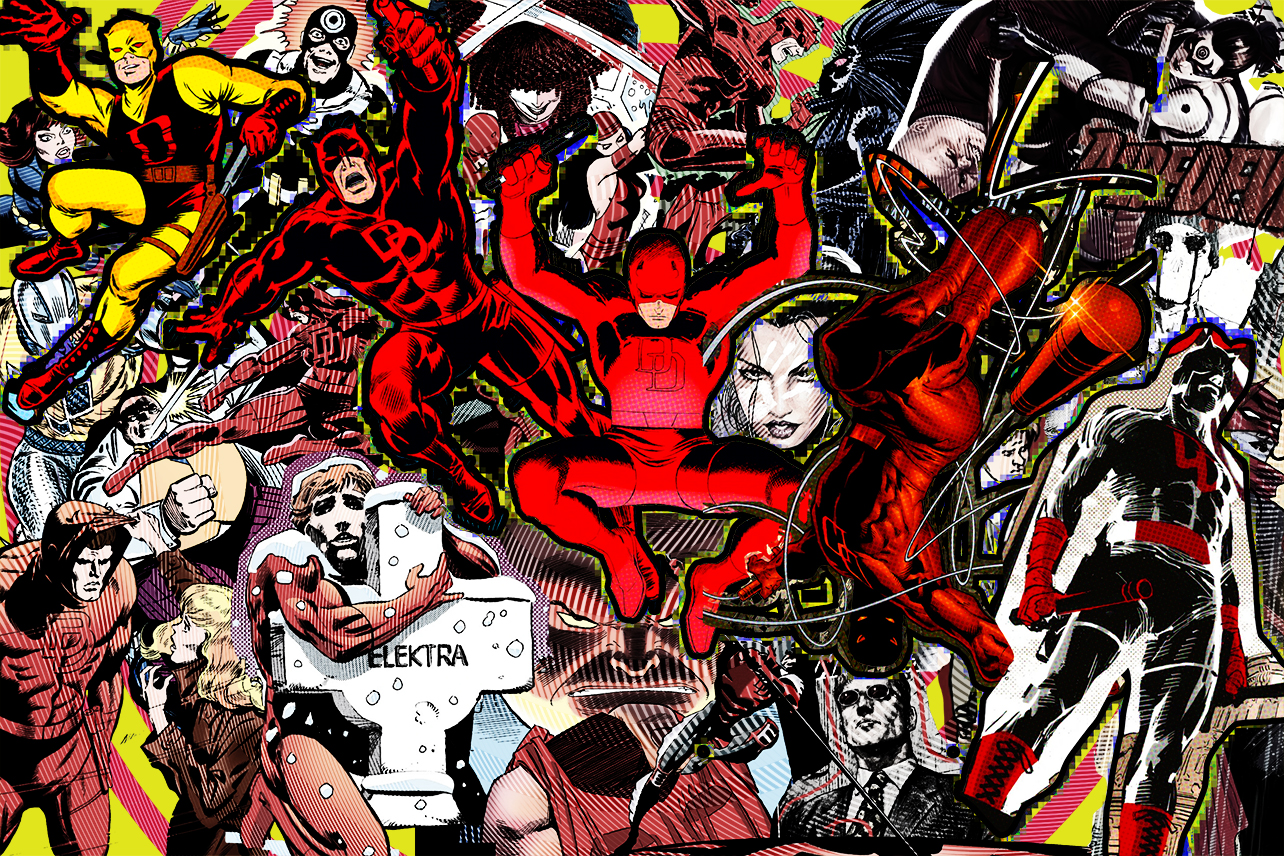
A blind superhero who fearlessly leaps from rooftops by night while practicing law by day is a phenomenal hook for a character, but while Daredevil was one of the founding figures of the modern Marvel Universe and the anchor of an entire subset of superhero streaming series, it took more than a few years for the character to truly click for audiences. After that, Daredevil became a character whose series often served as a vehicle for creators with distinctive visions and voices, making it at various times one of Marvel's most experimental books.
With a new season of Daredevil: Born Again streaming on Disney Plus and a new volume of the comic on shelves now, let's dive into the long and complex history of Daredevil in a brand new Heist Guide!
A Man Without Fear
Daredevil, the superhero identity of lawyer Matt Murdock, first appeared in the aptly titled Daredevil #1 in 1964. Blinded by radioactive waste as a small boy while saving an endangered bystander, Matt Murdock's remaining senses strengthened to compensate for his lack of sight, and he developed a superhuman "radar sense" that gave him echolocation abilities. Studying to become a lawyer, after his boxer father is killed by the mob, Matt adopts the identity of Daredevil to seek justice both in and out of the courtroom.
Trailing the early '60s debuts of such characters as Hulk, Spider-Man and Thor, Daredevil was arguably the last significant introduction of Marvel's Silver Age superhero renaissance. Born of a mandate by publisher Martin Goodman to deliver "another Spider-Man," writer/editor Stan Lee brought in artist Bill Everett (co-creator of Namor the Sub-Mariner in the very first Marvel Comic) to work on the book. But Everett was behind on deadlines, leading the release of the first issue to be pushed back six months, making Daredevil last to the party (with the X-Men were created to fill Daredevil's slot in the summer 1963 schedule).
Daredevil has two distinctive hooks: he's a blind superhero, with the same accident which blinded him giving him the abilities that enable him to be a superhero. And he's a lawyer who moonlights as a crime-fighting vigilante. Those two primary contrasts — the blind daredevil, the criminal lawyer — are what make Daredevil a fascinating character, and lie at the heart of his best stories — but it took awhile to get there.
Just another Spider-Man
True to his origins as "another Spider-Man," early Daredevil stories tend to read like Spider-Man-lite adventures, both featuring bombastic, wise-cracking, street-level superheroes with angst-filled secret identities. Both have definitional tragedies that drive them, with Daredevil's deceased father "Battlin'" Jack Murdock serving a similar inspirational role in absentia as Spider-Man's Uncle Ben. And like most of Marvel's Silver Age heroes in the early goings, Daredevil pines after a love interest, in his case Karen Page, secretary to Matt Murdock and his law partner/best friend Foggy Nelson, with Matt unable to believe someone like Karen could ever love a blind man. Alongside the typical parade of colorful foes, such as the Purple Man, the Owl, and Stilt-Man, Daredevil's book featured the kind of whacky hijinks of many Silver Age stories; an extended plotline early in the run involves Matt creating a second false identity, that of his twin brother Mike Murdock, whom Matt presents as the real secret Identity of Daredevil before "killing him off."
As a result of the fairly rote plots, the highlight of early Daredevil stories are the artists. Wally Wood, John Romita (whose work on Daredevil would lead to him succeeding Steve Ditko on Amazing Spider-Man) and Gene Colan all make significant contributions to the book. Colan in particular stands as one of the definitive Daredevil artists, drawing over 75 issues of the series and giving the young series a moody, noir-ish aesthetic that both stands in contrast to the character's more bombastic personality at the time and presages the darker tones that would come to define the character.
Going West
Writer Gerry Conway took over Daredevil with issue #72 in 1970. In issue #86, he wrote Karen Page out of the series (she wouldn't return to the book in a regular capacity until the "Born Again" story in the late '80s). And in issue #87, Conway resettled Matt in San Francisco alongside Black Widow, an Iron Man villain turned Avenger whom the writer had brought into Daredevil after her serial in Amazing Adventures (also written by Conway) had been cancelled. Together, Daredevil and Black Widow would effectively co-star in the series, operating as both a crime-fighting and romantic pair, with Black Widow sharing title billing.
Their presence on the West Coast made them unique amongst the principally New York-centric Marvel superheroes (and would create a precedent — "go West!" — for future creators who wanted to shakeup Daredevil's status quo) but sales on the book — never one of Marvel's top sellers — continued to decline.
By 1975 and issue #125, new writer Marv Wolfman jettisoned Black Widow and moved Daredevil back to his traditional setting in Hell's Kitchen. He also made two key introductions: Heather Glenn, a new love interest (the inspiration for the character in the Born Again MCU series) and the villainous Bullseye, who would go on to become one of Daredevil's chief foes. Though writer Roger McKenzie brought a darker, more horror-tinged sensibility to the series, Daredevil continued to struggle to find a unique identity amongst the Marvel pantheon, and as the 1970s drew to a close, the series — one of original books from the Silver Age boom — was selling closer to cancellation numbers than ever before. On the strength of a story in Spectacular Spider-Man guest-starring Daredevil, a young artist was brought onto the book by editor Denny O'Neil at the suggestion of Editor-in-Chief Jim Shooter: Frank Miller.
Frank Miller
No single creator has had a greater influence on Daredevil — the character and the series — than Miller. Originally working with McKenzie before assuming both writer and pencilling duties, Miller centered and expanded the darker tones in Daredevil's DNA introduced by creators like Colan and McKenzie. In the process, he gave Daredevil a tonal and thematic identity that made him distinct amongst the Marvel superheroes: de-emphasizing the superhero tropes, Daredevil became a crime comic.
Under Miller, nearly everything that defines Daredevil as a character to a modern audience was either introduced or canonized. Matt Murdock being Catholic had been implied before (notably by Jenny Blake Isabella in Daredevil #119), but Miller made it a central plank of his characterization. Daredevil had always fought crime as a superhero, but under Miller, crime became a dirtier, more insidious foe, manifested by the adoption of Spider-Man villain Wilson Fisk, the Kingpin of Crime, as Daredevil's central antagonist. Under Miller, Daredevil became less a smiling acrobatic do-gooder and more of a tortured anti-hero, part of a wave of darker anti-hero characters that came to dominate superhero comics throughout the 1980s.
In addition to embracing the noirish, hard-boiled and morally-ambiguous tones of crime fiction, Miller also infused the sensibilities of East Asian martial arts into his stories, experimenting with panel layouts and page construction as he transposed the visual language of martial arts to the comic book page. Prior to Miller, Daredevil had always possessed the same kind of vague martial abilities of most street level superheroes, with something of an emphasis on boxing thanks to his deceased father having been a boxer. Miller made Daredevil a full-fledged martial artist, establishing his childhood training under his sensei Stick and creating the villainous ninja clan the Hand for Daredevil to fight. From this focus on martial arts Daredevil's doomed love interest Elektra was born (in fact, much of what the original Teenage Mutant Ninja Turtles comics are parodying is Miller's Daredevil; a young Matt Murdock even cameos in their origin, with the radioactive material which granted him his powers being the same material which mutated the turtles).
Miller transformed Daredevil from a second tier (at best) superhero book into a kinetic blend of crime fiction and martial arts storytelling, with a complex, guilt-ridden, captivating protagonist at its center. Sales improved, removing the risk of cancellation. While future creators would occasionally zag away, the tropes and tones of Miller's run became the default setting for Daredevil stories, the thing to which all future Daredevil stories, either in concert with or opposition to, were responding, including all of Daredevil's future live-action adaptations.
The Devil of Hell's Kitchen
Frank Miller eventually left Daredevil — and Marvel — to pursue creative freedom at rival DC Comics, but he returned in 1986 for "Born Again", an eight issue story running in Daredevil #226-233, with David Mazzuchelli providing pencils for Miller's script. In addition to inspiring the title of the MCU series, "Born Again" reintroduced Karen Page after her long absence, now a junkie who sold her knowledge of Daredevil's secret identity for drugs. When this information reached Kingpin, it led to the systematic dismantling of Matt Murdock's life. His bank account gets frozen, his girlfriend dumps him, he's framed for bribing a witness, loses his law license, and when Foggy is able to stop him going to jail as Kingpin intended, Kingpin has his house blown up instead before attempting to drown him. Having torn the character down, Miller and Mazzuchelli end the story on a triumphant note, as Matt survives Kingpin's attack, rediscovers his faith, and resumes his role as Daredevil while reuniting with Karen.
Much as Miller took something previously established — Matt's Catholicism — and expanded on it, the modern conception of Daredevil as "the hero of Hell's Kitchen" came out of "Born Again." Daredevil had long operated in that neighborhood previously, but it — and Daredevil's relationship to it — becomes much more of a recurring element under writer Ann Nocenti, who became the regular writer after "Born Again" (in a fun "roads not taken" scenario, writer Steve Englehart was originally going to take over the series after "Born Again," and put Matt back on the West Coast with Black Widow, having him join the West Coast Avengers; instead, he penned a single issue under a pseudonym and Nocenti took over).
Nocenti rendered Hell's Kitchen as a poor, destitute, crime-ridden neighborhood, where its put-upon people are protected by a guardian Daredevil. How accurate this was to the Hell's Kitchen of 1980s New York is irrelevant; this is the conception of Hell's Kitchen and Daredevil's relationship to it that became the default representation for the character. Nocenti, a writer with a lot to say who often crafts characters — especially villains — to serve as mouthpieces for or foils of particular social or psychological issues, continues the street-level crime fiction focus of Miller while also introducing themes of feminism into the world of Daredevil, a crackling contrast to the raw machismo of the tonal status quo established by Miller. Similarly, the defining artist of Ann Nocenti's run is John Romita Jr., son of Silver Age artist John Romita. Romita's style has a classical superhero sensibility to it, something which also injects a fun contrast with Nocenti's more inward-looking and socially-conscious stories.
The 1990s
Like many classic heroes of the Silver Age, the 1990s were not terribly kind to Daredevil. After setting the record for the longest continuous run as a Daredevil writer, Nocenti cedes to the series to DG Chichester, who along with artist Lee Weeks culminated Matt Murdock's post-"Born Again" rebirth with "Fall of the Kingpin" in Daredevil #296-300, in which Matt gets his revenge on Kingpin by dismantling his criminal empire (in true serial storytelling, it's not the end of Kingpin, of course). From there, Daredevil becomes embroiled in a complicated, multi-part story, "Fall from Grace," which sees the return of Elektra and in which Daredevil, in the fashion of the times, receives a new armored costume. After his secret identity becomes public knowledge, Matt fakes his death and assumes the civilian identity Jack Batlin. While "Fall from Grace," like many of the "make superheroes created in the 1960s kewl for the '90s" stories of the time, hasn't aged well, the idea of Daredevil's secret identity becoming public and causing problems would return again.
Before long, however, the original red suit would return, and with it, a renewed emphasis on the original, lighter, more swashbuckling tone of the pre-Miller series. This de-emphasis of the darker Miller themes that had dominated the book was part of a broader effort on the part of writers at Marvel in the late '90s to, if not reject, at least downplay the edgier, "kewl-er" sensibilities of the '80s and '90s in favor of something more classically superhero. In the context of Daredevil, this also established a tradition, much like the idea of Daredevil "going west," in which extended runs which emphasized the more Miller-ian aspects of the character would often inspire a counterpoint run which focused on the character's pre-Miller Silver Age sensibilities.
Miller himself also returned to the character in the 1990s, penning a five issue limited series Daredevil: The Man Without Fear, featuring art from Nocenti's collaborator, John Romita Jr. A "Year One" kind of story in which Miller furthered some of the retcons to Matt Murdock's past he initially introduced during his run on the main book, Man Without Fear offered an extended look at Matt's pre-Daredevil time, working later additions to the series like Elektra and Kingpin into his backstory. Taking further inspiration from crime writers like Mickey Spillane and Walter Mosely, Miller wrote the story as a blueprint for a proposed TV series. While that didn't come to pass, the look of a pre-Daredevil Matt Murdock donning a black fighting suit with a black bandana around his head and eyes would be adapted into the early seasons of Netflix' Daredevil series.
Marvel Knight
The 1990s also saw the solidification of a practice in comics which would grow dominant in the 21st century: the "cancelling" of long-running series, followed by a subsequent relaunch of the book with a new #1 issue. For Daredevil, this trend came in 1998, when the series was relaunched as part of the new "Marvel Knights" imprint. The Marvel Knights imprint saw Marvel outsourcing the creation of comics for four of their characters, including Daredevil, to the independent Event Comics company, run by artists Joe Quesada and Jimmy Palmiotti. Event Comics recruited filmmaker Kevin Smith to write the introductory Marvel Knights arc of the new Daredevil series, with future Marvel Editor-in-Chief Quesada on pencilling duties.
While still considered in-continuity, the Marvel Knights books were slightly-edgier than standard fare, and accordingly, Smith channeled the Frank Miller tone for a story which saw Daredevil trying to protect a child who may be the anti-Christ. Karen Page is murdered by Bullseye before the true villain — Spider-Man foe Mysterio — is revealed, after which Daredevil leaves the villain, who is dying of cancer, to commit suicide. While Mysterio would later return, Karen has remained dead since that story. Quesada's art on the story was much-celebrated (and has aged better than Smith's story), with several images from it homaged directly by later live action adaptations.
Following Smith's story, writer/artist David Mack contributed a seven part story which saw the introduction of Echo, an Indigenous and Latina superhero who, in parallel to Daredevil, is deaf. But arguably more important than the introduction of Echo is the colleague Mack brought on to co-write the next arc of the series: indie comics crime writer Brian Michael Bendis. Assuming full authorship of the series with Daredevil (vol. 2) #26 alongside artist Alex Maleev, Bendis is to Daredevil's 21st century canon what Frank Miller was to it in the '80s and '90s, the creator whose take on the character all subsequent stories are reacting to in one way or another.
Like Miller, Bendis presented Daredevil as first and foremost a crime book, with his verbose, dialogue-heavy style and an industry-wide emphasis on "decompressed" multi-part stories (the better to be packaged into collected editions for the suddenly-booming reprint market) often led to whole issues without Daredevil appearing in costume or throwing a punch. Maleev's subtle, impressionistic style was perfectly suited to Bendis' approach, presenting the colorful confrontations between hero and villain, when they occurred, in muted tones that emphasized composition and tone over kinetic action.
A key element of Bendis' run also involved the issue of Daredevil's secret identity. The secret identity — a bedrock trope of superhero storytelling in the Silver Age, often driving much of the interpersonal drama and psychological investigations of the story — was increasingly viewed as a passé trope in the early 21st century, a relic of simpler storytelling. To that end, Bendis made the public reveal of the connection between Daredevil and Matt Murdock a major plot thread in his run, using it to explore matters of ethical conduct and legal complications and push Matt to the breaking point as he desperately fights to preserve his dual identities. By the time Bendis left the series — having eclipsed Nocenti as the longest tenured writer in the history of the series at the time — Matt Murdock was in jail, and the book's existence as an ongoing Miller-ian noir crime saga was cemented.
Push and Pull
As with Miller before him, since Bendis' departure, most subsequent creators on the series have structured their run either as continuations of Bendis' approach, or in opposite reaction to it, resurrecting the old "light/dark" handoff which first arose in the 1990s. Combined with an industry-wide shift in which series runs are widely defined first and foremost by their writers (a trend driven in part by the rise of Bendis) and a cementing of the "cancel a series, relaunch it with a new #1" publishing approach, Daredevil's post-Bendis existence can largely be defined, to a greater extent than some other characters, by a recurring churn of concrete creative directions led by specific creators.
Ed Brubaker — another writer with a background in indie crime drama — succeeded Bendis, picking up right where he left off with Daredevil in prison, continuing the series' focus on crime and "shit on Matt Murdock" story beats. In 2009, he gives way to Andy Diggle, who doubles down on the darkness and dials up the martial arts/ninja elements of Miller's run for "Shadowland," a story in which a demon-possessed Matt Murdock assumes control of the Hand, using the ninja clan to enforce order as the ruler of Hell's Kitchen.
In 2011, the series relaunched with a new #1 written by Mark Waid, a veteran writer with vast knowledge of comic book history and a penchant for modernizing Silver Age stories and tropes. Waid reacted to the darkness of "Shadowland" and its ilk by once again embracing the character's pre-Miller, '60s swashbuckling vibes, an effort aided spectacularly by artist Chris Samnee, who combined classical Silver Age looks with modern storytelling. In a relaunched fourth volume of the series in 2014, Waid even moved the character back to San Francisco.
But a year later, the series is relaunched again, with a fifth volume penned by Charles Soule. Himself a lawyer, Soule brought a level of verisimilitude to the legal aspects of his stories to a degree unlike any previous writer. He also swung the pendulum back from "Silver Age superheroism" towards "gritty noir drama," returning the character to New York, re-establishing his secret identity, and having him battle the serial killer Muse. It is also during Soule's run that Kingpin becomes mayor of New York, making it a major influence on Daredevil: Born Again.
New relaunches and creative directions followed. Chip Zdarsky oversaw a pair of volumes beginning in 2019 and 2022, in which Matt Murdock went to jail after accidentally killing a thief, passing the Daredevil mantle to Elektra. This in turn leads into the "Devil's Reign" event, in which Kingpin attempts to outlaw superheroes in New York (more Born Again inspiration). In 2023, Saladin Ahmed launched the eighth volume of Daredevil, focusing on Matt's faith.
Now, with the second season of Born Again streaming on Disney Plus, a ninth volume is set to debut, with Stephanie Phillips at the helm, only the second time a woman will regularly write the adventures of Daredevil. The solicits are promising a new status quo for the series, something never before seen, as well as a new villain with the religiously-weighted name of Omen, suggesting that while Phillips may be trying to break out of the "Miller-ian crime saga"/"neoclassical swashbuckling superhero" back-and-forth by doing something new, she will still be presenting a Matt Murdock consistent with earlier presentations. Thus, the "something old, something new" experimentation will continue, the thing which, more than ninjas or secret identities or religious angst, has come to define the character over his long publishing history.
If you haven't already, consider supporting worker-owned media by subscribing to Pop Heist. We are ad-free and operating outside the algorithm, so all dollars go directly to paying the staff members and writers who make articles like this one possible.