

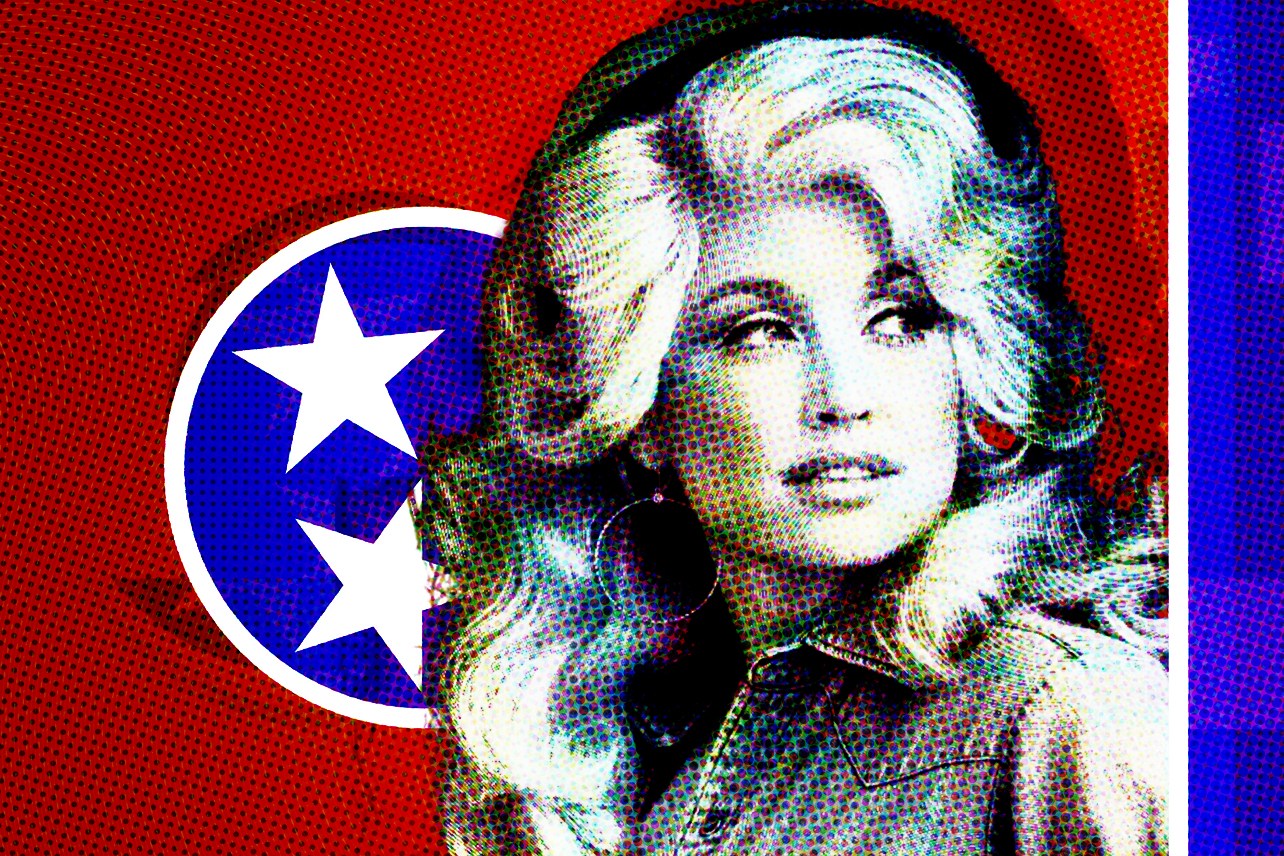
September 1967. My mom, twelve years old, is forced to watch The Porter Wagoner Show. I say "forced" because, well, there was only one TV in her tiny house in Red Boiling Springs, Tennessee. My mom loved the Rolling Stones. Her mother — Granny, to me — watched everything related to country music (and, 20 years later, she'd add professional wrestling to the mix). What my mom didn't know at the time is that she was witnessing a head-to-toe, heart-to-soul makeover of Southern culture courtesy of that girl right there, just 21 years old, the one with the big hair and bigger bosom. All of the South would be made over by a 5' tall blonde named Dolly Parton.
My mom did not like country music. I was not raised listening to country music. The reason why, despite my being born and raised in Tennessee, stems back to my granny making my mom watch all those syndicated singin' shows. I get it: The Porter Wagoner Show was to my mom as a kid as UT Vols football games were to me as a kid. But even growing up in Tennessee, I still knew Dolly Parton. Duh. But it's not until right now, in the tragic event of her untimely passing (any time is untimely for Dolly to go), that I'm trying to grasp with what Dolly Parton means to me, to my family, to my home state, to the South, to the world.
Being a Tennesseean, generally, sucks. The politics are terrible, the bad actors are continually in office, and the only headlines that break nationally are the ones that make me feel unwelcome in the state where my entire family still lives. And then there's Dolly Parton, an unstoppable force of nature (still unstoppable, even in death, just you wait) who essentially carried the entire soul of the South on her tiny li'l shoulders for decades. If the bad guys were acting up, there was Dolly, donating to COVID vaccine research or funding a few children's hospitals or championing literacy one book, one kid at a time. When that made the news, I could finally feel some pride. But what is it about Dolly Parton that speaks to me?
As a Tennesseean, even one who was actively anti-twang, I have a Dolly story. I was a TV production major and, being 40 minutes outside Nashville, that meant that all my professors were hired to do video production for every major country music event. Thus, they all had a hundred or so students eager for extra credit upon which to throw grunt work. For the afternoon of the 2004 CMA Awards, I was tasked with driving a golf cart to and from the stars' bus parking lot and the Grand Ole Opry. On my way to the parking lot, there, coming towards me in another golf cart, was my TV production nemesis, the nitpicking contrarian whose hand stayed raised, driving with a small-yet-statuesque figure in the passenger seat, an unmistakable silhouette, clad in white rhinestones and topped with big blonde hair. It was Dolly Parton, obviously. That's the story. It was just wild to me, and my classmates, that of all the people that got to drive Dolly in a golf kart, it was that guy. I did not say this story was profound. I'm just saying I, like all Tennesseans, have one.
But what I'm realizing, while writing, is that Dolly was more than just a goodwill ambassador for all things deep-fried. She was the South, in a way that cannot be expressed properly through words. Just talking to my mom, having to tell her of Dolly's sudden passing, I realized — how many summer weekends did I spend doing downright silly stuff in Pigeon Forge, a goofy and gritty tourist trap of a town filled with go-karts, arcades, and bumper vehicles on land and water? Pigeon Forge is a hop, skip, and a jump from Dolly's hometown, and it became home to Dollywood. Only Dolly Parton — a marketing genius with a whole lot of taste, maybe not always good taste, but a lot of it — could turn a chunk of the Smoky Mountains into the inspiration and setting for everything from Christmas albums to Hallmark movies.
But that ain't it either. I mean, there is the fact that she made a "generational and transformational" donation to what is now called Dolly Parton Children's Hospital. That is the hospital that, in August 2017, saved my youngest nephew's life after a near-fatal jet ski accident. Dolly's legacy ensures that hospital will continue to save lives.
And that's close to it, right there, but I didn't realize that was the same hospital until I talked to my mom this afternoon, after Dolly departed. My mom had plenty to tell, too, because she just paid a visit to Dolly's Tennessean Travel Stop two months ago on the eve of its grand opening. She got to see the buffet, the ice cream parlor, and the upstairs bathroom. My mom, the same person who rolled her eyes at that busty blonde on TV nearly 60 years ago, was all revved up about Dolly Parton's new gas station.
And that's it. Dolly has a hold on me, and likely a hold on a lot of others, because she will forever be the personification of what it means to be a true Southerner.
Dolly is my mom, both women from Tennessee towns with populations under 500 who pushed through unimaginable adversity, clawing their way out of poverty and into a life they could be proud of. But, then, Dolly is also my dad — that thoroughly Southern spirit, a mischievous twinkle in their eye, a laugh that filled any room, and a warm, welcoming presence. I hope Dad gets to meet Dolly now.
I haven't lived in Tennessee in 20 years (and 5 days), but I feel Dolly in me too. The attention-seeker, the performer, the host, the queen — and I hate that it's taken her leaving this plane of existence for me to see that. I'm from Tennessee, and that means I have Dolly in my DNA. And if I have any hope for the South, it's knowing that everyone else from Tennessee has her spirit in them too. Because the things that Dolly Parton stood for, the things she did, the art she made, the legacy she leaves behind — they're as Southern as sitting on a porch drinkin' sweet tea and watching the bug zapper.
Dolly was brave when she didn't have to be, stepping out of a star's shadow to find her own spotlight. And when Dolly earned a lot, she gave a lot back. She was gracious, gregarious, and generous — when she said, "Bless your heart," she meant it. That's a Tennessee that I can be proud of. That's the Tennessee that I see in my history, in my parents, in me — and that's the Tennessee that I would like to show the world, if I can only muster some of Dolly's strength. But it can be done and it has to be done, because Dolly Parton is finally, finally, getting the rest she deserves.