

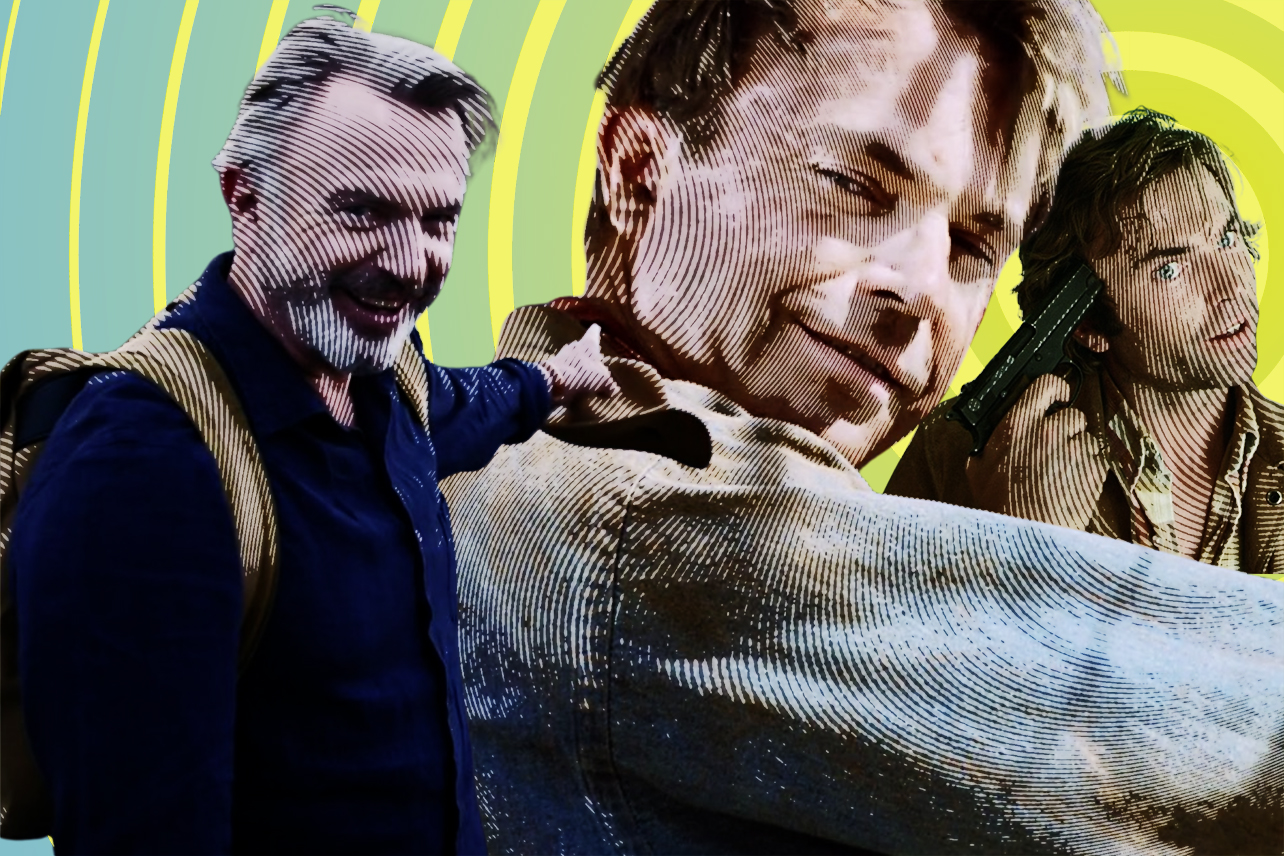
Sam Neill was curious. Always curious. About his craft, about his passions, about his animals, about his land, about himself, definitely about his fame. That's the unifying theme of his body of work, a never-ending, unassuming, insatiable curiosity — and that ultimately made him one of the greatest character actors to ever live.
People in my profession dread days like these, when our most deeply personal pop culture connections are forcibly severed, leaving us emotionally vulnerable — and then being expected to mold that vulnerability into a eulogy ASAP. I think about these days often, and I have thought about it in regards to Sam Neill — what's the word I'm looking for — doubly often? Daily. Near daily.
I can't easily corral all of my feelings about Sam Neill, the man and the craftsman, into one eulogy. In the grand scheme of my own life, Sam is a towering figure, a formative, consistent presence for 33 years. But if I had to sum up this beautiful man in one word, after spending ninety minutes behind the wheel and mentally grappling with all of this, I would say, "Curious."
Sam Neill's filmography is bizarre, the cumulative result of an actor who never chased fame or even recognition. Sam's filmography is instead the result of a series of choices, sometimes deeply personal choices, that say so much about the man. Sometimes Sam wanted to put all of his hard-earned credibility behind a small New Zealand production (2009's Under the Mountain), and sometimes Sam probably just wanted to take a trip to China (2011's The Dragon Pearl). And then, sometimes Sam found roles that challenged him as an actor (1993's The Piano), found him working alongside absolute legends (1988's A Cry in the Dark), and, well, there's the one that catapulted him to international superstardom as a middle-aged, kid-hating, tech-wrecking, deeply unmarried paleontologist who somehow stumbled into the status of "action hero." But all of those choices telegraph his curiosity — his overall vibe of, "What's that?" and "Eh, why not?"
To get back to that "personal" and "vulnerable" business, my love of Sam Neill started when I saw Jurassic Park in the theater when I was nine. I've written about this at length before, but the TL;DR is: Sam Neill was my first ever celebrity crush. I was a nine-year-old boy who realized that he liked looking at cantankerous Dr. Alan Grant more than he liked looking at anyone else. And this didn't go away with 1994's The Jungle Book or TV commercials for 1997's Event Horizon, nor 1999's Bicentennial Man. So, I mean, I knew I loved Sam Neill a decade before I knew I was gay.
There are types of celebrity crushes, surface-level ones, or ones that pass as phases. But I don't know how I — nor anyone — could have had just a casual, fleeting crush on Sam Neill. And when Sam Neill took to Instagram in the late '10s, sharing the exploits of his prestigiously-named farm animal friends, the world at large caught up to me.
And then the pandemic hit. And I decided to watch every Sam Neill movie and TV show, as a way to cope with the ever-worsening world. So in-between clips of a sequestered Sam strumming his ukulele and reciting poems, or making comedic "short films" with his socially-distanced celebrity pals, I got to know a lot more about the man himself via his — here's that word again — bizarre filmography.
Sam Neill never sought out to be an actor. He was a shy kid — so shy that when another kid at his school with the name "Nigel" told him that he was going to be "Sam" from now on, Sam didn't argue. He became "Sam" ("Eh, why not?"). So what could get Sam Neill into film? Why did he start acting? Because a crew set out to make the first feature-length 35mm film completely produced in New Zealand. Sam, the proudest and most curious New Zealander ever, wanted to be part of that. 1977's Sleeping Dogs stars Sam in his first lead role, and his first significant role, as an everyman standing up against a rising fascist movement in New Zealand. The film earned rave reviews, kickstarted New Zealand cinema, and acted as Sam's calling card for years, landing him several pivotal roles.
And thus, Sam Neill became an actor. And what an actor he became. He leapt from Sleeping Dogs to My Brilliant Career (1979), an Australian period drama that cast Sam as the gorgeous, romantic leading man to Judy Davis' uninhibited, force of nature lead (she who desires the titular brilliant career).
And then, thanks to his performance in Sleeping Dogs, he was cast as the protagonist of Possession.
Possession (1981) is the kind of movie that, if you haven't seen it, I cannot tell you about. That's because the primary draw of Possession is figuring out Possession. It is a film that makes you feel insane, a horror movie where the scariest thing just might be the scar it's leaving on your mind. In this film, Sam Neill pushed himself far beyond any boundaries he presumed he had, turning out a performance that was sweaty, despondent, manic, and unhinged. It just might be his best performance ever. It is, undoubtedly his most performance ever.
Sam Neill talked about depression a lot during the pandemic. Who didn't? But as the months wore on, this became a regular feature of Sam's Instagram presence, him waking up and checking in. Now, a lot of celebrities did that, but I don't know how many of them were Boomers, let alone male Boomers. Men of his age didn't use Instagram, nor did they talk about feelings. Sam, who was new to all of this mental health stuff, would later advocate for mental health organizations. Curiosity leading to action.
And it's in that headspace that I first watched Possession, deep in the pandemic, on an increasing dosage of anti-depressants. I've written about this before, but Sam's turn in Possession gave me something I didn't know I needed: an avatar for whatever malevolent force burns inside of me, the one that stokes my rage and strangles my spirit. The shot of Sam, fully-clothed and drenched in sweat, writhing on his bed, drunk on a cocktail of despair and fear — as my personal life has cratered, found new bottoms to hit, that image stays in my mind. That performance stays in my mind.
Possession is the opening chapter of a subsection of Sam Neill's oeuvre — one that I call Mad Sam. Through watching Sam in Possession, and such films as the HBO original drama Fever (1991), the horror masterpiece In the Mouth of Madness (1994), and the confounding erotic thriller Irresistible (2006), I got to ... cut loose, is I guess the term. It was the contradiction that Sam embodied, the contrast of a man looking like that behaving that madly. It's further evidence of Sam's curiosity as a performer, one who never shied away from a good scream, from just going there, clawing his way out of the restrictions placed on the average man when it comes to feeling.
But Sam's horror bonafides were not limited to Possession. Possession found Sam at the start of his career, and there is a rawness to his presence that the film wields like a knife — especially in scenes against the inhuman and otherworldly Isabelle Adjani. 1994's In the Mouth of Madness, however, found Sam at the height of his career and pre-Instagram cultural cache — and Sam played the role to the hilt.
John Carpenter's In the Mouth of Madness was not a success when it came out, but it quickly earned cult classic status. The final image of the movie, of Sam in hospital scrubs, covered in hand-drawn crosses, munching on popcorn with a manic smile stretched across his face, is something of a meme. In it, Sam plays the coolest insurance investigator ever, clad in a smart sport coat, skin-tight jeans, and cowboy boots. He's rakish, surly, and just so damn sexy. He's an insurance investigator!
But while investigating a claim from a literary agency, Sam's character discovers that reality is not what it seems, and it leads him to the film's other big moment: his bus scream. A soul-searing, guttural klaxon erupting from his head, one almost pushed beyond recognition with agony. It's a career-defining moment.
Mad Sam is, I discovered, one side of a coin. The other side, as most profoundly evidenced in the exceptional docuseries The Pacific with Sam Neill (2018), was — well, I never named it, and "Glad Sam" is reductive. The other side of this coin encompasses Sam's heart, where he kept it, where he put it, what he locked inside of it. This is where his curiosity extended beyond his movie selection process. The Pacific found Sam, of all people, retracing the voyage of 18th century British explorer Captain Cook, touching down on the Pacific islands that Cook "discovered." But what this docuseries does is flip the point of view around from Cook to the indigenous people who existed long before a white guy landed on their shores, and highlight the lives of their descendants.
Of everything he did, everything in his filmography, The Pacific feels like the clearest look at who Sam Neill was. It puts his whole life in perspective even, like how he insisted that his science officer in Event Horizon (1997) wear a New Zealand flag on his flight suit, but one with the aboriginal flag in place of the Union Jack.
And this is what cuts into my heart, the thing that wrecks me up and down, the thing that kept me coming back to Sam Neill the man even though I know that what celebrities put out for public consumption is heavily curated and frequently misleading. But through that Instagram feed and work like The Pacific (and also 1995's Cinema of Unease, a doc Sam directed about the history of New Zealand film), Sam Neill consistently showed that he still wanted to learn about the world. More than that, he wanted to be active. He was outspoken about indigenous rights, environmental causes, and progressive politics — again, as a man in his seventies. He posted Pride content and supported the queer community, which ... well, meant a lot to me.
Overall, through his quiet life, quirky online bits, wide-ranging filmography, and his personal, casual workwear style of dress, he presented a radical, classic-yet-modern version of masculinity that every single male-identifying person can strive to. Sam presented as a man who was confident but not cocky, who worked his job, followed his passions, asked questions, and never stopped learning.
Days like today, tasks like this — I have to acknowledge that they come hand-in-hand with the other perks of this career. As a pop culture journalist, I of course wanted to interview Sam Neill. It became a mission of mine during my seven years at my previous outlet. And wow, did I try — every movie release, international and domestic, every TV series debut, every VOD release, I tracked down every publicist and tried to work something out. I am experienced and professional enough to know that an interview is not my chance to go full MTV FANatic. But after watching 50 entries in his filmography, I had questions for him about his body of work, the through lines I saw. I kept coming close to an interview, only to have it not work out.
Until it did. Thanks to Peacock's Apples Never Fall, of all things. In early 2024, I got to have a Zoom call with my ... well, my favorite man. The first thing he said to me ... was a question, him wanting to know more.
"Brett, you’re in a very interesting room. I, however, am in a hotel room with nothing that means anything to me, but you seem to be surrounded by things that mean a lot to you... Is that mostly movie stuff?"
I brought my notion of his curiosity, how unique it was and how it's informed his career, up to him ... which, admittedly, caused him to remark, "Thank you very much. You know a lot about me. That’s great!" But on this topic, he said:
"Look: I hate that people always say the older you get the more conservative you get. I think that’s bullshit, you know, and I would hate that to be true of me. I’m always learning and that’s one of the reasons I love my job. I am always working with new people. There’s always something to learn from them. I get very drawn to different countries and there’s always something to learn from a different culture."
This interview meant the world to me, to be able to connect with a man whose work caused me to investigate and understand a lot about myself. And I got to make him laugh a few times. This was the last interview of mine that my dad got to see, before he passed away unexpectedly 12 days later. There's a lot to untangle there, but that's for my therapist.
But — I got to talk to Sam Neill about this curiosity, his open-eyed and open-hearted approach to life and his work. And then I asked Sam about what was next for him.
Um, well, to use a cricket analogy: I still want to puts more runs on the board. Maybe that’s a baseball analogy. On the scoreboard, you know? I need to put some more runs on the board. And I think just quietly, I’m probably — I’m not saying I’m any good, but I’m better than I was, put it that way. And so the older I get, the more chance there is of me putting in a halfway decent performance. [Laughs]
Sam, you did it.