

This was originally self-published on July 19, 2024, one day after Bob Newhart's passing and 114 days after my father's sudden passing. It's published here, on April 9, 2026, three days after the sudden passing of my cat, my daughter, Deloris.
It’s a bizarre feeling being a celebrity’s “I immediately thought of you” person. On the one hand, it’s an honor to be even mentally tangentially associated with a living legend. But on the other hand, you usually don’t find out how many people associate you with a legend until their legendary life ends. That’s me with Bob Newhart. I’ve received easily a hundred texts, DMs, comments, and phone calls offering condolences over the loss of a man I met once — but it’s humbling and an honor to be the “immediately thought of you” guy for a man like Bob Newhart.
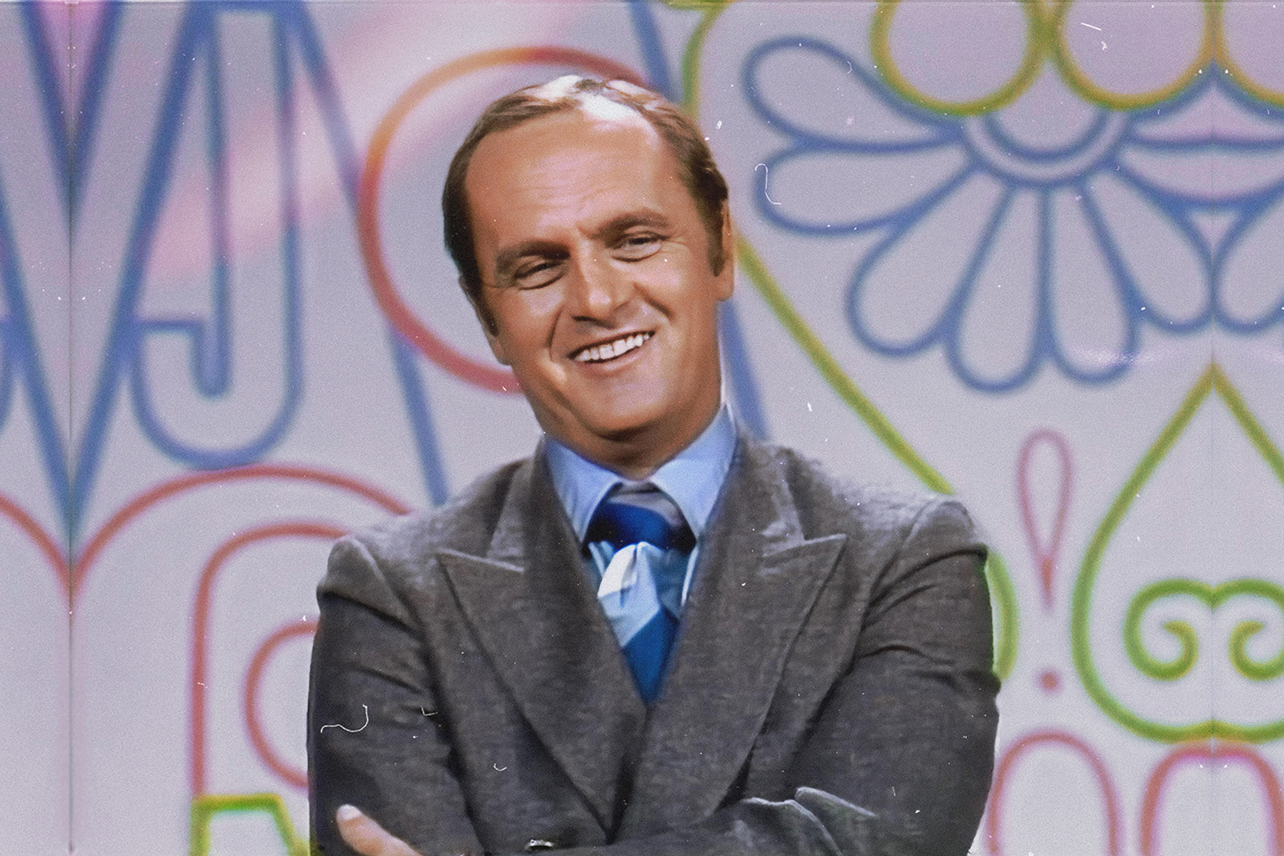
And I know why I’m that guy for Bob. I’ve written a lot about The Bob Newhart Show for work. I’ve podcasted about episodes of that series along with Newhart, Bob, and George & Leo. I spent the heyday of Twitter replying to every other tweet with a Bob GIF — Bob scoring a strike on Celebrity Bowling or grooving to the music on Laugh-In. I catalogued every single thing the man wore on his ’70s sitcom, and applied what I learned to my daily life; yes, the vintage ID bracelet I bought on eBay does just so happen to have “Bob” inscribed on it (a lucky score). And of course there’s the epic tale of how I met Bob in 2017 and, briefly, became sporadic email penpals with the man over the following years. First he emailed me through his secretary, and then he just started hitting me up from his own personal AOL account via his iPad to thank me for whatever Bob Newhart-related thing I’d just written. I know why everyone associates me with Bob Newhart. But no one really knows why I associate myself with Bob Newhart, because it’s been too personal, too complicated, and just plain too much to sort out. But…
Bob Newhart was a father figure for me — and he remains one. Throughout my life, at first subtly and much later overtly, he’s been the man I turn to when I need… something. Truly, just anything — a laugh, inspiration, style guidance, commiseration, a hug. I always turned to Bob. And I could never write about this, nor could I really talk about it with anyone other than my husband, because I already had a dad. And as much as I loved and found comfort in rewatching “Last TV Show” or “Caged Fury” or “Bob Has to Have His Tonsils Out, So He Spends Christmas Eve in the Hospital,” that comfort never overtook the feeling of guilt that I was seeking out all of this comfort from a fictional TV man rather than my own father.
My dad died three and a half months before Bob, and — well, I can’t hurt his feelings anymore by sharing all this. That was always my fear, that I would hurt him even more by saying out loud that I found a masculine role model outside of our home, zip code, decade, and reality. But death does something to our memories of a life lived: it provides an ending and, retroactively, a context for everything that came before. I mean, look no further than the Newhart finale for an example of what I’m getting at. Freed from the anxiety of what’s to come, you can look back on all that was as a complete series — a 48-disc DVD box set of memories. And now I have that with Dad and Bob.
I now know that my dad gave me everything he could — everything he could fathom to give a son that absolutely defied all of his expectations. I think about how Dad probably spent the traumatic years it took for me to finally arrive dreaming of playing catch, going to Braves games, working on that orange Bug that sat in our driveway for years, getting a daughter-in-law and having even more grandchildren. And then here I come: an indoor kid, allergic to the world and transfixed by the glow of television (as long as it wasn’t playing a ball game). I didn’t give him what he wanted, at least that’s how I always felt. And I initially thought that he — well, all of the men in Tennessee — weren’t able to give me what I needed: a male role model.
Bob Newhart — or, rather, Bob Hartley — did. And I do use the names interchangeably, because for all intents and purposes, Bobs Hartley and Newhart feel inextricably intertwined in demeanor, humor, and even style. All that jewelry Dr. Hartley wore? That was Bob’s jewelry. And I took to him immediately. I remember the Nick at Nite ads for The Bob Newhart Show cracking me up. I remember squeezing in TV Land’s weekday airing of episodes right before I had to drive to MTSU for classes. I named my college radio show The Bob Newhart Show. Bob became this… figure in my life.
Late 2016 and into 2017 was not a good time for… literally anyone. That was more or less the beginning of our Everything Is Terrible All The Time era, one that we are definitely still in. And I, like I always did in college, returned to The Bob Newhart Show. That viewing — probably the first since I came out of the closet — hit me hard. That’s where it all clicked: Bob Newhart/Hartley was the man I wanted to be. He also was the man I was/am: anxious, impatient, neurotic, oddly charismatic, a people-pleaser and tantrum-thrower. He was a professional man with a career who wore suits and lived in a city and had a spouse who could put him in his place. He’s who I wanted (and still desperately want) to be. And where I saw all of my more… dramatic traits in Bob Hartley, I also saw the kind of traits I aspire to have — traits that are evident in everything Bob Newhart the man ever did. The way he carried himself: confident but never showy, masculine but never macho, assertive but never mean, funny but never domineering, and just overall kind. I have a temper. I have anxiety and depression. I worry about being too much and I beat myself up for not being enough. At my worst, I’m suppressing a chaos inside of me that I wish I could quell… so I could project the kind of presence that Bob Newhart projects. This is why I have had pictures of Bob Newhart as my wallpaper on my work laptop or on my phone, or just photos of Bob around my home office. I literally look at them when I’m feeling volcanic.
In retrospect, which is all I have now that my father figures are gone, I can see the traits my father passed down to me. My dad was a people-pleaser and a little impatient, easily frustrated. He only lost it during UT Vols games, where he would stand in front of the TV for a solid two hours, throwing his hat, stomping, and shouting the kind of expletives that aren’t expletives but they sure do pack the same punch. This frightened me as a kid. It’s why I spent my weekends in my bedroom watching a lot Nick at Nite. But it took my dad’s funeral for me to really get who he was. It took seeing the line of people, the broken hearts, the overwhelming positivity, for me to get that my dad gave me my best trait: my dad was a uniter of people. The family gathered around him, naturally, magnetically, without him asking for it. He was just the kinda guy that people wanted to be around, and when I’m at my best, I think that’s what I bring too. And it’s why I love The Bob Newhart Show’s Season 1 Christmas episode, because it features Bob bringing all of his lonely patients together on Christmas Eve to sing carols and feel the warmth of family, fleeting as it may be in their case (and also ethically dubious, considering he’s their psychologist). I saw this trait in Bob Hartley, but I never saw it in my dad because I spent the last few decades in another state. I couldn’t congregate around my dad with everyone else because of plane ticket prices. It took a funeral for me to feel the love that I imagine my dad felt daily, everywhere he went, so commonplace that he probably never knew that what he had was uncanny.
And then there’s the big one. When my dad died, I fell apart, screaming on the ground, my husband’s arms around me as I kept repeating, “I’m a failure. I let him down.” At his funeral, seeing his body, I fell into the casket, head in his chest, saying those same things, apologizing for the grand failure that my Inner Saboteur (©RuPaul) tells me I am daily. I wasn’t the son he wanted. I was the son he got — and I’m a faggot who lives in New York City and votes democrat. I could never reconcile this feeling of failure. I’m proud of who I am, but I worried that he wasn’t proud of me. This was the wedge in our relationship that we never acknowledged — except for that one time in 2003 that my copy of “Entertainment Weekly” arrived with the naked Dixie Chicks on the cover and dad threw it on my living room floor and told me that he was afraid he “raised me wrong.” To his credit, my dad treated me the same throughout my entire life (Dixie Chicks blowup notwithstanding). He dealt with my homosexuality on his own time, in his own head, whenever I wasn’t around. He shook Seb’s hand when they met and never had a bad thing to say about him. Life went on after I came out to my family in 2011, and that was made easier by the fact that I was in the city and they were in the country.
In 1976, The Bob Newhart Show aired an episode titled “Some of My Best Friends Are…” In it, Mr. Plager, a recurring patient of Bob’s played by Howard Hesseman, comes out of the closet to the therapy group. Everyone is startled because it’s 1976, even Bob, who performs a few of the “oh no the homosexual is standing behind me I better turn around” gags that haven’t aged well. But later, when Bob’s neighbor Howard starts making cracks about “sissies” after seeing Bob in an old tuxedo and a frilly shirt. Bob calls Howard, his best friend, a jerk. He tells Howard that “sissy is a very derogatory term. They like to be called gay.” When Howard starts to back out the door, Bob continues: “Howard, all I’m trying to say is we’re going to have to try to change our attitude a little bit. It’s just that kind of Dark Ages thinking that have kept them in closets all these years.” And when the group decides to “vote the gay guy out,” Bob stands firm. Mr. Plager stays. And when it’s just Bob and Mr. Plager alone in Bob’s office, Bob reassures Mr. Plager by putting a hand on his shoulder and looking him straight in the eye: “Mr. Plager, I know things are rough right now, but we’re going to see this thing through. You’re not going to be alone. I’m going to be with you all the way.”
This is an episode of television written by the show’s creators, David Davis and Lorenzo Music, along with Patricia Jones; directed by the legendary James Burrows; and starring mild-mannered Bob Newhart, possessor of a button-down mind — and it unequivocally stands up for gay rights in 1976. I don’t know Bob Newhart’s personal politics, but the fact that he did this episode at a time when it really wasn’t en vogue — this is what I wanted from my dad. Watching Bob comfort Mr. Plager, it’s Bob Hartley talking to me in 2017 when I was more or less estranged from my family. And even when all was forgiven and reunited, I still — I wanted to hear my dad say those words. Bob did it, and it gets me every time. And now my dad can’t do it.
Both of these men’s stories are told. I’ve read them both. And what I can see with my 20/20 hindsight vision is that… I have one father, a man that I know in my soul did his best by me. He didn’t get to watch me do sports, but he was there for every play and marching band performance. He handed the family’s 50 pound camcorder over to me so I could make movies. He took me to the movie theater seemingly every week, giving me the passion for pop culture and comedy that is now my entire personality, TBH. He was born in 1955 to parents that grew up in the Great Depression. He wasn’t shown the kind of open-hearted, intimate, touchy-feely love that we now associate with parenthood. He gave me what he got and more. He worked himself to the bone to make sure that I could have cable and DVDs and all the other junk that now adorns my home office walls. And where my dad fell short, in the cracks that he couldn’t see because he was busy supporting a family, Bob Newhart filled in. Bob taught me how to dress. Bob helped me see my own shortcomings. Bob gave me a TV couple living in a big city without children, therefore giving me the only example of a healthy TV relationship that mirrors my own. And Bob, via a nearly 50-year-old TV episode, put a hand on my shoulder, looked me in the eyes, and let me feel a paternal acceptance that I didn’t get from my dad because I don’t think my dad knew how to find the words. They made a great pair — and honestly, looking back at it all, Dad and Bob actually don’t feel so different at all. I mean, I did get a lot of Dad’s clothes.
I’m who you think of when you think of Bob Newhart, and all of this is what I think of when I think of Bob Newhart.
If you haven't already, consider supporting worker-owned media by subscribing to Pop Heist. We are ad-free and operating outside the algorithm, so all dollars go directly to paying the staff members and writers who make articles like this one possible.