

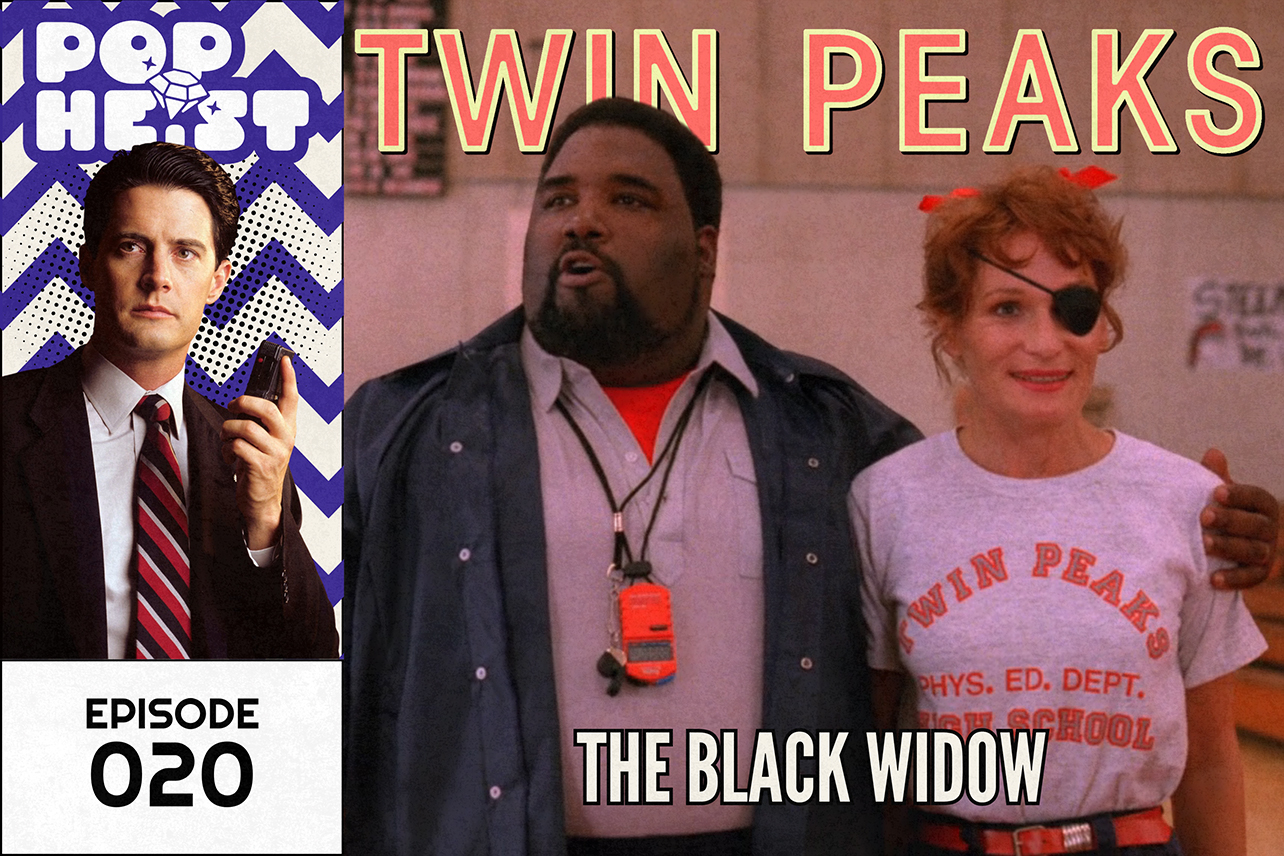
In PRESTIGE PREHISTORY, Pop Heist critic Sean T. Collins takes a look at classic TV shows that paved the way for the New Golden Age of Television — challenging, self-contained series from writers and filmmakers determined to push the medium forward by telling stories their own way.
Twin Peaks Season 2, Episode 12
“Episode 19” aka “The Black Widow”
[NOTE: The pilot episode of Twin Peaks is not numbered; this, the 20th episode overall, is officially designated “Episode 19.”]
Original Airdate: December 12, 1990
Writer: Harley Peyton & Robert Engels
Director: Caleb Deschanel
Cast: Kyle MacLachlan, Michael Ontkean, Mädchen Amick, Dana Ashbrook, Richard Beymer, Lara Flynn Boyle, Sherilyn Fenn, Warren Frost, Peggy Lipton, James Marshall, Everett McGill, Jack Nance, Kimmy Robertson, Joan Chen, Piper Laurie, Harry Goaz, Michael Horse, Ian Buchanan, James Booth, David Duchovny, Robyn Lively, Tony Burton, Wendy Robie, Don Davis, Charlotte Stewart, Tony Jay, Gary Hershberger, Annette McCarthy, Nicholas Love, Ron Taylor, John Apicella, John Boylan, Joshua Harris, Geraldine Keams, Molly Shannon
It took a few episodes, but it’s safe to say it now: As of the twelfth episode of Twin Peaks Season 2, Twin Peaks Season 2 has officially begun.
Depending on how new to the show you are, you may or may not know that its second season has a historically poor reputation. By now the whole Twin Peaks saga — the original run, the prequel film Twin Peaks: Fire Walk With Me, and Season 3, aka Twin Peaks: The Return — is so beloved, as is its co-creator and primary director David Lynch, that you may hear Season 2 badmouthed less often than it used to be.
Speaking personally, I think people lump together the entire Laura Palmer saga in their heads as “Season 1,” then lump everything after that (plus the “Mr. Tojamura” thing, perhaps) together as “Season 2.” Even then, a lot of the things people love about Twin Peaks happen after Laura’s murder is resolved. You’re never going to hear anyone complain about post-Laura Season 2 because it introduced Denise Bryson or the concept of the Black Lodge, that’s for sure.
Other than that, though? When people use “Season 2” pejoratively, this episode is rooted almost entirely in the storylines they’re talking about. James’s film-noir road trip. Nadine’s high school wrestling career. Andy, Lucy, Dick Tremayne, and the devilish Little Nicky (Joshua Harris). The widow Milford and her siren-like power over every man who lives in a town already inhabited by, well, the female cast of Twin Peaks. Ben Horne becoming a Confederate sympathizer during a psychotic break.
Well, everyone knows these Twin Peaks Season 2 storylines suck. What this review presupposes is…maybe they don’t. Written and directed by one of the series’ A-teams — Harley Peyton, Robert Engels, and Caleb Deschanel — it makes a strong opening case for some of the show’s most maligned material.
James Hurley, for example, finds himself falling into the role of a classic noir patsy. He finally kisses his mysterious, beautiful, obviously randy client Evelyn Marsh, mere moments before her rich, abusive husband Jeffrey (John Apicella) returns home from one of his “business trips.” Meanwhile, James also gets an earful about Jeffrey’s cruelty from Evelyn’s angry, alcoholic brother Malcolm Sloan (Nicholas Love), who received a job as chauffeur when Evelyn received her own job as Jeffrey’s wife.

It’s a humiliating, infuriating arrangement, one that forces Malcolm to listen powerlessly when Jeffrey mercilessly beats Evelyn once every couple of weeks. (She does things like crash his fancy cars in impotent retaliation.) Though he’s held back at her request, the brother has vowed to kill the husband someday. After a night listening to Jeffrey scream at Evelyn from his room above the garage, it seems likely James sympathizes.
Since he fled Twin Peaks just after Maddy Ferugson’s murder, James has no idea that both she and her cousin Laura were killed by a member of their own family. But he’d sought to escape the curse he felt surrounded him in Twin Peaks, and look where he is now: falling for another beautiful blonde being abused by a man who’s supposed to love and care for her, with murder once again on the table. This isn’t some meaningless side quest. For James, this is the whole story.
It’s a bit tougher to make a considered case for Nadine’s combined super-strength, amnesia, and unquenchable thirst for Donna Hayward’s meathead ex-boyfriend Mike Nelson. (No relation to the guy stuck on the Satellite of Love with his robot pals.) I mean, there’s no getting around that it’s goofy as hell. That said, I think I’m up to the challenge: Nadine’s plight provides a parodic lens through which to look at the raging hormones that have caused so much trouble for every teenage character on the show, up to and including Laura Palmer herself.
Twin Peaks has always been able to laugh at itself. Remember that terrible soap opera Invitation to Love that served as a show within the show during Season 1? Nadine, meanwhile, began as Big Ed’s shrewish wife, obsessed with drapes. Setting her up as the Bazooka Joe comic version of the Love and Rockets characters who populate the rest of Twin Peak High School is a solid bit. Plus, actor Wendy Robie is obviously having a whale of a time wearing gym uniforms and jumping/breaking the bones of high school athletes. I say we let them have this.
Little Nicky, meanwhile, is worth viewing in context. Again, is it goofy as hell to throw what Dick Tremayne might refer to as “a spanner” in the works of his love triangle with Lucy and Andy, in the form of a child who might be cursed and/or possesses evil magic powers? You bet. But the filmmakers are very clearly aware of this. Dick and Nicky wear matching shearling-trimmed denim jackets and shorts when the boy uses his telepathy or mutant hex ability or whatever to nearly crush Tremayne under his own car. The soundtrack reads as sinister, but the costuming is pure comedy.

Then there’s the indelible image we get when Dick tells Andy he thinks the child “may in fact be the Devil ... or at the very least, homicidal in the first degree.” Andy pictures Nicky dressed like the Devil with the flames of Hell roaring around him, via an image superimposed right on his noggin. It’s a visual technique never before used on the show, for the simple reason that it looks ridiculous. I can’t imagine anyone making this episode felt otherwise. They dressed a kid up in a Halloween devil costume, for crying out loud!

All this comes up in the same episode that introduces the idea that Lana Milford, the blushing bride of local newspaperman Dougie Milford, is cursed and/or possesses evil magic powers as well. We hear her before we see her, screaming as she runs down the halls of the Great Northern in a beautiful white nightgown and robe. It’s an echo of the girl we hear and see run screaming through the quad as news of Laura’s death hits the high school, and it’s got that touch of the light surreal that characterizes much of the show’s best comedic stuff. (I still think of Coop, Harry, and the llama.)
Lana’s running because her husband Dougie has died in flagrante. His brother, Mayor Dwayne Milford, may have hated him for decades, but he’s touchingly devastated by his death, and wants his widow strung up for “witchcraft” for fucking him to death. It seems a silly theory, until you watch how man after man falls under her spell — not just goobers like Dick and Andy (which makes Lucy pretty pissed), but cool customer Deputy Hawk and the extremely tied-down Doc Hayward and Sheriff Truman to boot.

Keep in mind that elsewhere in this episode, we deal with a storyline that’s much more serious, and central to the overarching plot: Major Briggs’s disappearance. First, Harry receives a visit from Colonel Calvin Reilly (Rocky co-star Tony Burton), sent in by the Air Force to investigate the major’s disappearance. He seems to know an owl was present at the scene of the vanishing before Coop even confirms it, and he reveals that those “deep-space transmissions” containing messages about Coop and the owls emanated not from elsewhere in the galaxy, but from right there in the woods near town.
“I can tell you this,” the Colonel says to Harry and Cooper. “His disappearance has implications that go so far beyond national security, the Cold War seems like a case of the sniffles.” Here at last the show confirms something it had been hinting at for some time: the presence of Briggs and Cooper, apparently two of the United States’s most extraordinary servants, at the site of Laura’s murder is no coincidence. Whatever is out there is up to something big.
I’m not saying Little Nicky and the widow Milford warrant the same kind of supernatural consideration as, say, the sudden reappearance of Major Briggs in his living room wearing old-timey pilot regalia, like he’d just soared out of the Bermuda Triangle. (He warns his wife that everything is not okay, as thunder roars and the light from his white owl lamp flickers.)

I’m saying that if you lived in Twin Peaks, you might believe an unlucky kid was the devil in disguise, or that an unlucky woman used witchcraft to beguile and bedevil the menfolk. Neither of these characters seems likely to be the reincarnated Bob, but they’re not totally out of place in a world where Bob lives, either.
I can even get behind Ben Horne’s sudden sympathy for the Lost Cause. Not the iconography the show uses, of course; the Confederate battle flag was all over American pop culture years, but that doesn’t make its presence here any less unpleasant. But let’s say you’re Benjamin Horne: real-estate swindler, illegal casino and brothel owner, drug dealer, murderer, and human trafficker of teenage girls. The fact that he apparently had sincere feelings for one of them, Laura Palmer, is probably the nicest thing you can say about the guy. I suspect learning Laura was killed by his close friend, her own father, brought on the grief he put aside to keep up appearances when her death was first discovered.
But yeah, let’s say you’re that guy. You’ve gotten the “making monuments out of the furniture” stage of your breakdown out of your system, and you’re ready to move on to a) collecting and arranging miniatures of B) Civil War soldiers. This lands you in not one but two communities of niche weirdoes simultaneously. (As a niche weirdo of a different sort, I’m allowed to say this.) Even while he does this, he still has Bobby Briggs spy on his old hitman, Hank Jennings. Knowing all of that about Ben Horne, which side of the Civil War do you think he’d pick? Honest Abe’s?

There’s an important postscript for Bobby’s espionage. Audrey (whom Bobby seems pretty into at this point!) steals the photos he took and gives them to Agent Cooper. They reveal a conspiracy between Hank, his father-in-law Ernie Miles (Denise susses him out as the weak link and flips him instantly), French-Canadian druglord Jean Renault…and Royal Canadian Mounted Police Sergeant King, the guy falsely accusing him of stealing the cocaine the Mounties were using for a bust. Couple that with the traces of cocaine Coop finds at the conspirators’ cursed-seeming meeting spot, Dead Dog Farm, and he and Denise now have the evidence they need to clear his name.
But Audrey’s the one who seems the happiest with this encounter, and not even because her evidence has helped her hero escape prosecution. This time, she only has eyes for Denise. “They have women agents?” she says, disbelievingly; her face melts into a big goofy grin, and she starts stumbling over her words. She holds Denise in awe, plain and simple, and she plants a kiss right on Coop’s mouth seemingly more to thank him for exposing her to a potential new future for herself than because she’s still hot for him.
“Exactly how old is that girl?” Denise asks, not disapprovingly.
“Denise,” says a confused Coop, “I would assume you were no longer interested in girls.”
Then Denise gets off a line for the ages: “Coop, I may be wearing a dress, but I still pull my panties on one leg at a time if you know what I mean.”
“Not really,” Coop replies good-naturedly. But you get the sense he’d be genuinely interested to learn, you know? That’s what makes Dale Cooper so special: his wide-eyed enthusiasm for new and unique ideas and experiences, and his whole-hearted love for all the people who make those ideas and experiences possible, from Tibet to Twin Peaks.
If you haven't already, consider supporting worker-owned media by subscribing to Pop Heist. We are ad-free and operating outside the algorithm, so all dollars go directly to paying the staff members and writers who make articles like this one possible.


