

Skip to Content
Prestige Prehistory

‘Twin Peaks’ Season 2 Premiere Recap: The Mind Revealing Itself to Itself

It’s not so bad as long as you can keep the fear from your mind.

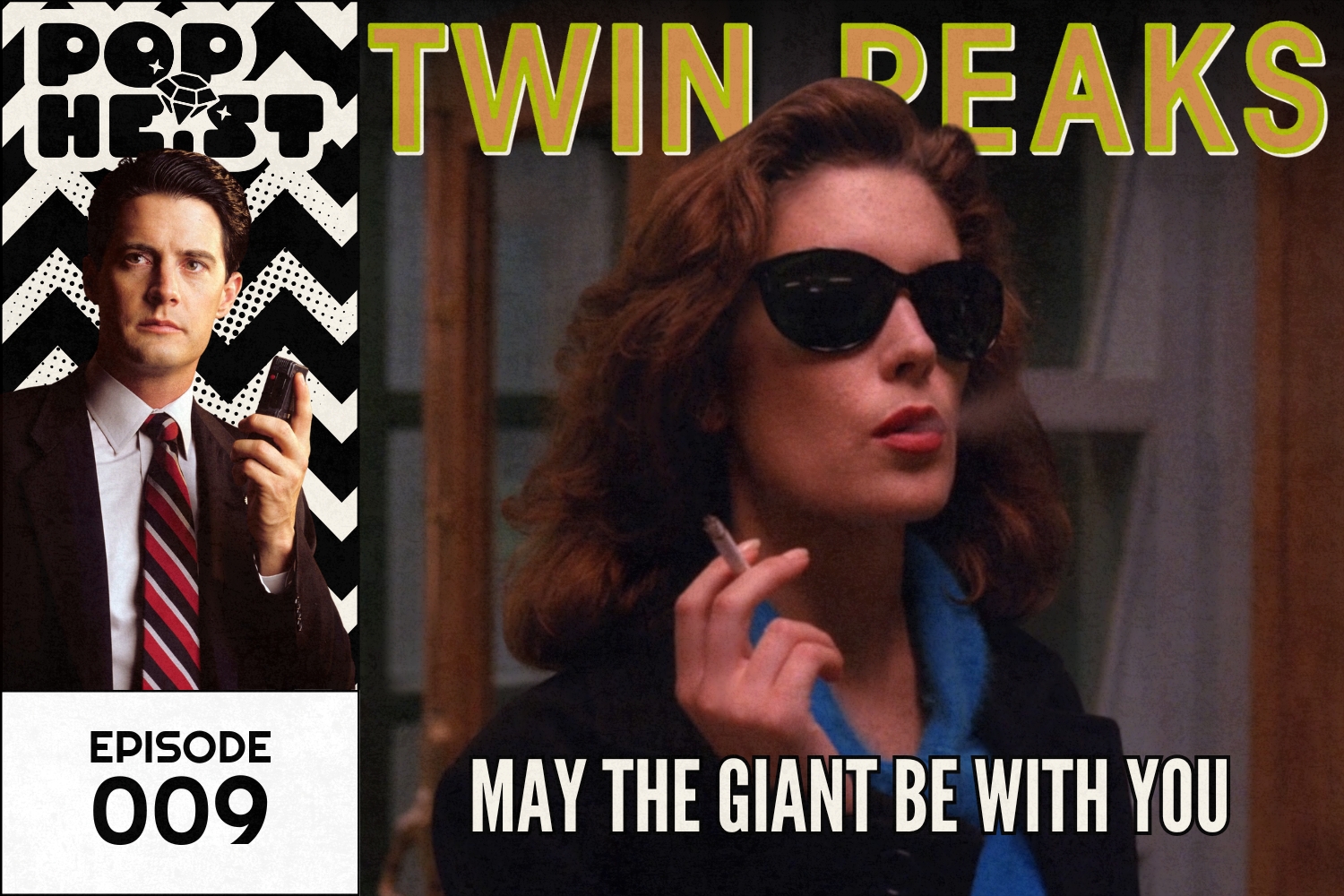
Donna smoking

In PRESTIGE PREHISTORY, Pop Heist critic Sean T. Collins takes a look at classic TV shows that paved the way for the New Golden Age of Television — challenging, self-contained series from writers and filmmakers determined to push the medium forward by telling stories their own way.

Twin Peaks Season 2, Episode 1
“Episode 8” aka “May the Giant Be With You”
[NOTE: The pilot episode of Twin Peaks is not numbered; this, the ninth episode overall, is officially designated “Episode 8.”]
Original Airdate: September 30, 1990
Story: David Lynch & Mark Frost
Writer: Mark Frost
Director: David Lynch
Cast: Kyle MacLachlan, Michael Ontkean, Mädchen Amick, Dana Ashbrook, Richard Beymer, Lara Flynn Boyle, Sherilyn Fenn, Warren Frost, Peggy Lipton, James Marshall, Everett McGill, Jack Nance, Kimmy Robertson, Ray Wise, Joan Chen, Piper Laurie, Eric Da Re, Harry Goaz, Michael Horse, Sheryl Lee, Russ Tamblyn, Grace Zabriskie, Chris Mulkey, Miguel Ferrer, David Patrick Kelly, Wendy Robie, Don Davis, Victoria Catlin, Mary Jo Deschanel, Catherine E. Coulson, Al Strobel, Carel Struycken, Phoebe Augustine, Mak Takano, Jessica Wallenfels, Alicia Witt, Hank Worden, Mark Frost, Frank Silva


If you called Twin Peaks Season 2, Episode 1 one of the greatest season premieres of all time, you’d be telling the truth. You’d also be lying by omission.

I love Desmond’s debut down the Hatch at the start of Lost Season 2 (a show whose creators never made any bones about the debt they owed Twin Peaks). I love the knife’s-edge suspense between Walt, Jesse, Mike, and Gus at the beginning Breaking Bad Season 4. Shit, I love Sam drinking and whoring his way through getting left at the altar by Diane to kick off Cheers Season 3. But to compare these excellent episodes of television to these revolutionary 90 minutes is to damn what Mark Frost and David Lynch did here with faint praise. Those episodes have surprises, shocks, bittersweet laughs. This episode has the waiter, the Giant, Leland’s musical numbers, Audrey Horne’s prayer, Gersten Hayward’s recital, Major Briggs’s vision, Laura Palmer’s murder. They are not the same.

When people toss the word “Lynchian” around, it’s usually either as a very specific subgenre of surrealism, or as a way too broad synonym for “weird.” But the opening scene of this episode is a whole different flavor of Lynch, one every bit as important to his overall project. FBI Special Agent Dale Cooper, you’ll recall, was shot three times at point-blank range by a still-unidentified assailant to end Season 1. (We learn from the insufferable but brilliant Agent Rosenfield, back on the scene to bully everyone within the Twin Peaks city limits, that his would-be assassin was of average height, hardly narrowing it down.) When we rejoin Coop this episode, we can see that only one of the bullets penetrated his body, right where he’d lifted up the bulletproof vest he’d been wearing beneath his shirt while undercover at One-Eyed Jack’s. He was hunting for a pesky wood tick, you see; the bullet found the little bugger, and his torso, instead.

At great length, an elderly room service waiter (Hank Worden) slooooooooooooooooooooooooooooooooooooooooooooooooooowly delivers Cooper a glass of warm milk, hangs up the phone on a panicked Deputy Andy rather than call a doctor, and gives Coop — whose reputation apparently precedes him among the staff, if the waiter’s nearly giddy repetition of “I heard of you!” is any indication — several encouraging thumbs up and eye winks before shuffling away. The waiter also has him sign the room service bill. (Gratuities are included.) 

Waiter

Experiments in comedic tedium like this have been a Lynch hallmark since Eraserhead. I’d argue that on Twin Peaks in particular, as we’ll see later this episode with Leland Palmer, they’re a form of proto–cringe comedy, predating Steve Coogan and Armando Ianucci’s creation of Alan Partridge in 1991, Garry Shandling and Dennis Klein’s The Larry Sanders Show in 1992, and Mike Lazzo and Keith Croffod’s Space Ghost Coast-to-Coast (the most Peaksian of these early examples) in 1994. Scenes like these (fire) walk the fine line of boredom, discomfort, and silliness. It’s astonishing to think that in this case, they’ll lead to the absolute horror we see at episode’s end.

What follows is Lynchian in the more traditional sense. Both at this point and when a partially healed Coop returns to bed the next night, our special agent is visited by a spectral giant (Carel Struycken).

Giant

Accompanied by a ringing sound on the soundtrack and claiming to represent a mysterious “we,” this...entity gives Cooper a series of cryptic clues. They include:

  • There is a man in a smiling bag
  • The owls are not what they seem
  • Without chemicals, he points
  • Leo locked inside hungry horse — there’s a clue at Leo’s house
  • Don’t search for the answers all at once — a path is formed by laying one stone at a time
  • One person saw the third man — three have seen him, yes, but not his body — only one known to you, ready now to talk
  • You forgot something

The Giant also notes, in the voice of a concerned doctor, “You will require medical attention,” but that goes without saying. And he takes Coop’s ring, which is indeed missing from his finger the next morning when he records what he fears might be his final words for his assistant Diane back home. (Coop’s dying wishes include treating people more respectfully, cracking the Lindbergh case, sitting on a pleasant hilltop, “making love to a beautiful woman I have genuine affection for,” and getting the Dalai Lama and the Tibetan people their country back. He also describes getting shot in a bulletproof vest as feeling like getting a bowling ball dropped on your chest from nine feet up, an image that’s stuck with me for decades.)

By the end of the episode, several of the Giant’s clues have panned out. There is a man in a smiling bag: Jacques Renault, killed in his hospital bed by Leland Palmer, then sealed in a body bag later left out to dry in the shape of a grinning mouth. And there is one person who’s seen the third man who sexually assaulted Laura the night of her death and left copious amounts of his own rare blood type behind: Ronette Pulaski, the murderer’s surviving victim, who emerges from her coma at the end of the episode. 

She emerges into a nightmare. Accompanying Ronette’s thrashing, traumatized return to the waking world are glimpses of those final few minutes within the abandoned train car where she and Laura were attacked and Laura was killed. They’re like nothing we could possibly have seen coming. Amid flashes of light, Laura screams like a banshee, her face contorted into an evil grimace, her eyes discolored, her teeth jagged and decayed. In these shots she’s reminiscent of no one so much as Regan MacNeil in The Exorcist, possessed by a demon determined to make a mockery of the whole human race.

Laura enraged

Jacques Renault and Leo Johnson are nowhere to be found in this flashback. They parted company from Laura and Ronette before they were brought to that train car. Moreover we learn that Leo was in a holding cell in Hungry Horse, Montana (hence the Giant’s clue) the night that the serial killer’s first victim, Teresa Banks, was killed; whatever Leo was up to, however many bodies he’s got on him, this rules him out as a suspect in Laura’s murder. Laura’s secret boyfriend, James Hurley, also concludes that Leo is not the brutal “mystery man” Laura refers to as lighting her “F-I-R-E” in her final tape for Dr. Jacoby. Rather, James connects that cryptic statement to an even more bizarre “poem” about fire that Laura kept reciting near the end of her life. It seems safe to assume James means the “fire walk with me” poem from Coop’s frightening dream near the beginning of Season 1. 

“Do you wanna play with fire, little boy?” James quotes Laura as saying to him after her poem was over. “Do you want to play with Bob?” For James, this was merely one of countless whacked-out things Laura said; he took no notice of it until he heard the word “fire” spelled out on her tape and put two and two together. 

But for us, this is a sign that Cooper’s frightening dream early in Season 1 wasn’t symbolic, it was clairvoyant. The man we see bashing the disfigured Laura to death in the flashback, then howling and screaming in a distorted voice, wracked by some unidentifiable emotion — rage? pain? grief? fear? triumph? all of the above? He is indeed Bob (an uncredited Frank Silva), the long-haired man we saw last season, reciting menacing poetry in Coop’s dream and lurking behind Laura’s bed in Sarah Palmer’s vision. 

It would be a vindicating moment for Coop, and for we who believe in Coop, if it weren’t presented as a visit from Hell. After an initial tableau that shows us Bob crouched over Laura’s corpse at the crime scene, we next see Bob running full-tilt at us through an unidentified corridor — to my eyes, it looks like the Sheriff’s Department — and practically right into the camera. Laura’s hideous face, Bob’s horrible cries…what in God’s name happened in that train car? What happened to Laura Palmer?

It almost feels as though Laura’s energy gets distributed across the other girls of Twin Peaks in this episode. Trapped at the casino-brothel One-Eyed Jack’s, Audrey uses a mask to just barely fend off the owner’s advances before he’s called away. Unfortunately, the owner is none other than her father, Ben Horne. Being chased around a bed while cooing breathily “I’m shy” in order to avoid being groped by your own horned-up cigar-smoking father…I’d hate to see Dr. Jacoby’s therapy bills for this one. At any rate, one can assume Laura herself was once subject to Ben’s affections, too.

Audrey in brothel, with father

Not that Audrey is out of the woods when Ben exits, summoned by Jerry to deal with the consequences of their muscle, Hank Jennings, failing to kill their other muscle, Leo Johnson. She’s subsequently kept prisoner by Blackie, the manager — secretly a junkie being coerced into obedience by Ben and his brother Jerry, who doubles as her supplier. Blackie threatens Audrey if she refuses another client; the high schooler goes to bed praying to her Special Agent for rescue. Considering how Coop’s dreams work, attempting to connect with him psychically is not a bad idea: The note she left in his room alerting him to her whereabouts is the thing the Giant warns him he’s forgotten about in one of his clues.

Laura’s cousin Maddy, meanwhile, begins seeing the kinds of visions both Laura and her mother Sarah have been known to have. After recounting a dream about seeing a bloodstain on the carpet of the Palmers’ living room from the exact place where she’s then sitting — the dialogue is very similar to the “Winkie’s dream” scene in Mulholland Drive — she then sees it while wide awake. 

Seemingly just to shake off the feeling of the dream, Maddy ditches her big eyeglasses. She also donates a pair of Laura’s sunglasses to Donna, who begins adopting a cigarette-smoking femme fatale persona that feels like a collection of cues and tics she collected from both Laura and Audrey. Donna swears Maddy to secrecy about their involvement in the fake-Laura plot that helped get poor sentimental Dr. Jacoby attacked last episode. Donna subsequently smolders her way into the Sheriff’s department in order to bite an intimidated James Hurley’s finger through his cell bars. (He’s briefly jammed up by the coke Bobby Briggs planted in his gas tank last episode, but he’s out before the end of the episode.) She even takes over Laura’s Meals on Wheels route after receiving an anonymous note advising her to look into the program.

For his part, Dr. Jacoby really does seem to have been nothing more than an eccentric who cared about Laura a lot, and who stole James’s half of her heart necklace “as a keepsake,” just as he claims. He tells Coop that Laura led a double life, and that he believes she deliberately sought death at her killer’s hands. Like Coop, he can’t identify the person who attacked him the night before, though he can identify a smell the stranger carried with them: “Oil. Scorched engine oil.” Not gasoline, like what the cops find all over Leo’s coat, tying him to the mill arson, but something else.

Much of the rest of the episode can be summed up using Lucy as our guide. When Coop comes to in the hospital after Harry, Hawk, and Andy rescue him from his hotel room floor, Harry has his receptionist give Coop the update:

  • Leo Johnson was shot: He’s in a coma now; his would-be assassin, Hank Jennings, has no idea he was spotted by Bobby, whom Leo was trying to kill when he got plugged, or that Coop has deduced the presence of a third party at the scene.
  • Jacques Renault was strangled: Leland, the smiling bag, we covered this.
  • The mill burned: Comatose Leo’s coat proves he lit the match; the fire — covered by a TV reporter played by co-creator and writer Mark Frost — clears the way for Ben Horne’s development project.
  • Shelly and Pete got smoke inhalation: Both of these sweet angels survived the fire last episode and wind up in the hospital, enduring its absolutely revolting feud and thinking about the people they love. For Shelly, that’s Bobby, who admits to her and to himself that he loves her too. For Pete, believe it or not, that’s Catherine: “She was plain hell to live with, plain hell, but…once, there was a little bit of heaven there too.”
  • Catherine and Josie are missing: As far as the Horne boys are concerned, this is all for the good. Josie skipped town to Seattle to avoid suspicion, we learn from Hank, a trip that Pete says she took all the time in order to go shopping. Quite a coincidence, then, that an unnamed, ponytailed tough guy from her native Hong Kong is at the Great Northern, looking for her. Catherine, meanwhile, is presumed dead, her body burned up in the intense heat of the fire — another loose end Ben is happy to see tied up, though he’ll miss her in his sleazy way.
  • Nadine is in a coma from taking sleeping pills: Courtesy of her husband, Big Ed, we learn the whole sob story behind the Ed/Nadine/Hank/Norma love quadrangle. Ed and Norma had gone steady for years, until Norma ran off with Hank one weekend. Devastated, Ed married Nadine on a whim, only to learn Norma had no real interest in Hank after all. During Ed’s honeymoon, he accidentally shot Nadine’s eye out, too, but she’s never held it against him. 

There are still a few loose threads to pull at. On the same day that the existence of Bob, Coop’s nightmare man, seems to be proven, another figure from Cooper’s dream returns: the one-armed man known as Mike in the vision and Philip Gerard in the waking world. He shows up at the sheriff’s office to sell Harry shoes, but when he turns from talking to Lucy, he’s grinning like a man possessed. 

There’s a lot of that going around. The morning after killing Jacques Renault, Leland Palmer stuns his wife Sarah and niece Maddy by performing the song “Mairzy Doats” — with his hair turned bone-white overnight. In the same way he once danced uncontrollably, he now seems driven by the desire to smile and sing uplifting songs. He gets the Horne boys dancing on desks and doing the worm along with him, that’s how infectious his glee is.

Leland singing

Until a dreadful moment at the “Hayward Supper Club,” a sweet little get-together staged by Donna’s kid sisters Harriet and Gersten (a young Alicia Witt, already seen as Kyle MacLachlan’s kid sister in Lynch’s Dune) for their family, the Palmers, and Maddy. Dressed in her fairy princess costume from the school play, Gersten shows off her skills as a pianist, while Harriet recites a moving poem about Laura’s legacy among those who loved her. Leland gets in on the action by performing a rendition of the old religious tune “Get Happy,” growing more and more manic until he collapses. 

It’s impossible not to feel for Leland here — despite the cheery front he’s putting on, it’s clear Jacques’s murder brought him no real closure or catharsis for his daughter’s murder, and he may even be worse off than before. But his behavior is brutal on his wife, Sarah, whose brief dalliances with calm and happiness are repeatedly derailed by his mania. Without intervention by Doc Hayward or Dr. Jacoby, it’s not clear this rift will ever heal.

There are two last things I’d like to cover before we close the book on this extraordinary episode of television — the best since the series premiere, the most perfectly calibrated between upsetting, confounding, hilarious (Deputy Andy steps on a loose board that hits him in the face like Daffy Duck, the Log Lady sticks a wad of gum on the wall of her diner booth so she can drink her coffee, and I swear they left in a take where Hank and Jerry repeat a couple of lines about Leo chopping wood indoors verbatim just because it’s funnier that way), and absolutely terrifying.

The first is something Coop says to Diane as he lies on the floor, bleeding out. “All things considered,” he tells her, “being shot is not as bad as I always thought it might be, as long as you can keep the fear from your mind. But I guess you could say that about almost anything in life: It’s not so bad as long as you can keep the fear from your mind.”

The second is something Major Briggs, the Air Force airman whose work in town is classified, says to his scoundrel son Bobby after bumping into the kid at the Double R diner. Bobby has just confessed his love to Shelly, but he seems less elated and more confused about the crossroads he’s come to — the death, the violence, the pain, the deception. Knowing little to nothing of any of this, Major Briggs calls Bobby over to his booth, offers him a slice of pie, and then delivers the following speech. I’m typing up in its entirety, because it’s my favorite speech in television history.

“Bobby, may I share something with you? A vision I had in my sleep last night, as distinguished from a dream, which is mere sorting and cataloguing of the days events by the subconscious. This was a vision, fresh and clear as a mountain stream, the mind revealing itself to itself. 

“In my vision, I was on the veranda of a vast estate, a palazzo of some fantastic proportion. There seemed to emanate from it a light, from within this gleaming, radiant marble. I’d known this place. I had in fact been born and raised there. This was my first return, a reunion with the deepest wellsprings of my being. 

Wandering about, I noticed happily that the house had been immaculately maintained. There had been added a number of additional rooms, but in a way that blended so seamlessly with the original construction one would never detect any difference.

Returning to the house’s grand foyer, there came a knock at the door. My son was standing there. He was happy and carefree, clearly living a life of deep harmony and joy. We embraced, a warm and loving embrace, nothing withheld. We were, in this moment, one.

My vision ended, and I awoke with a tremendous feeling of optimism and confidence in you and your future. That was my vision of you. I’m so glad to have had this opportunity to share it with you. I wish you nothing but the very best in all things.”

As Bobby, two-timing Bobby, coke-slinging Bobby, James-framing Bobby, Ed-punching Bobby, maybe-killed-a-guy Bobby, that Bobby, listens to his father, he cries. He replies to his father’s statement “That was my vision of you” by asking “Really?”, eyes wide, tear-streaked face hopeful, in the voice of a kid who truly can’t believe anyone would ever be this kind to him, that he’d ever deserve to have anyone be this kind to him.

Bobby Briggs

Even with Shelly, he could only bring himself to say “I guess I love you too,” like saying it with his whole chest would invite disaster — as it did with Laura, as it nearly did with Shelly already.

But when he shakes his father’s hand and says “Thank you, Dad” at the end of this exchange, he’s willing himself to believe that somewhere in his future, all his anger and pettiness and pain will go away. There he’ll be, in a warm and loving embrace with the man who raised him, happy at last, the fear gone from his mind. I guess you could say that about almost anything in life: It’s not so bad as long as you can keep the fear from your mind.

If you haven't already, consider supporting worker-owned media by subscribing to Pop Heist. We are ad-free and operating outside the algorithm, so all dollars go directly to paying the staff members and writers who make articles like this one possible.

Stay in touch

Sign up for our free newsletter

More from Prestige Prehistory

Explore Prestige Prehistory

‘Twin Peaks’ 1×07 Recap: The Gambler

It’s all fun and games until you come face to face with one of Laura Palmer’s attackers.

December 22, 2025

‘Twin Peaks’ 1×06 Recap: The Cabin in the Woods

Anything can happen in a town like Twin Peaks ...

December 15, 2025

‘Twin Peaks’ 1×05 Recap: All These Friends and Lovers

As befits a soap opera, love — good and bad — is in the air.

December 8, 2025

‘Twin Peaks’ 1×04 Recap: Dancing at the Funeral Party

Let’s look at the complicated, contradictory lives of the people in and of Twin Peaks.

December 1, 2025

‘Twin Peaks’ 1×03 Recap: Red Rooms

This episode is everything 'Twin Peaks' can be. It’s sexy, sleazy, and soapy, unabashedly so, yet...

November 24, 2025