

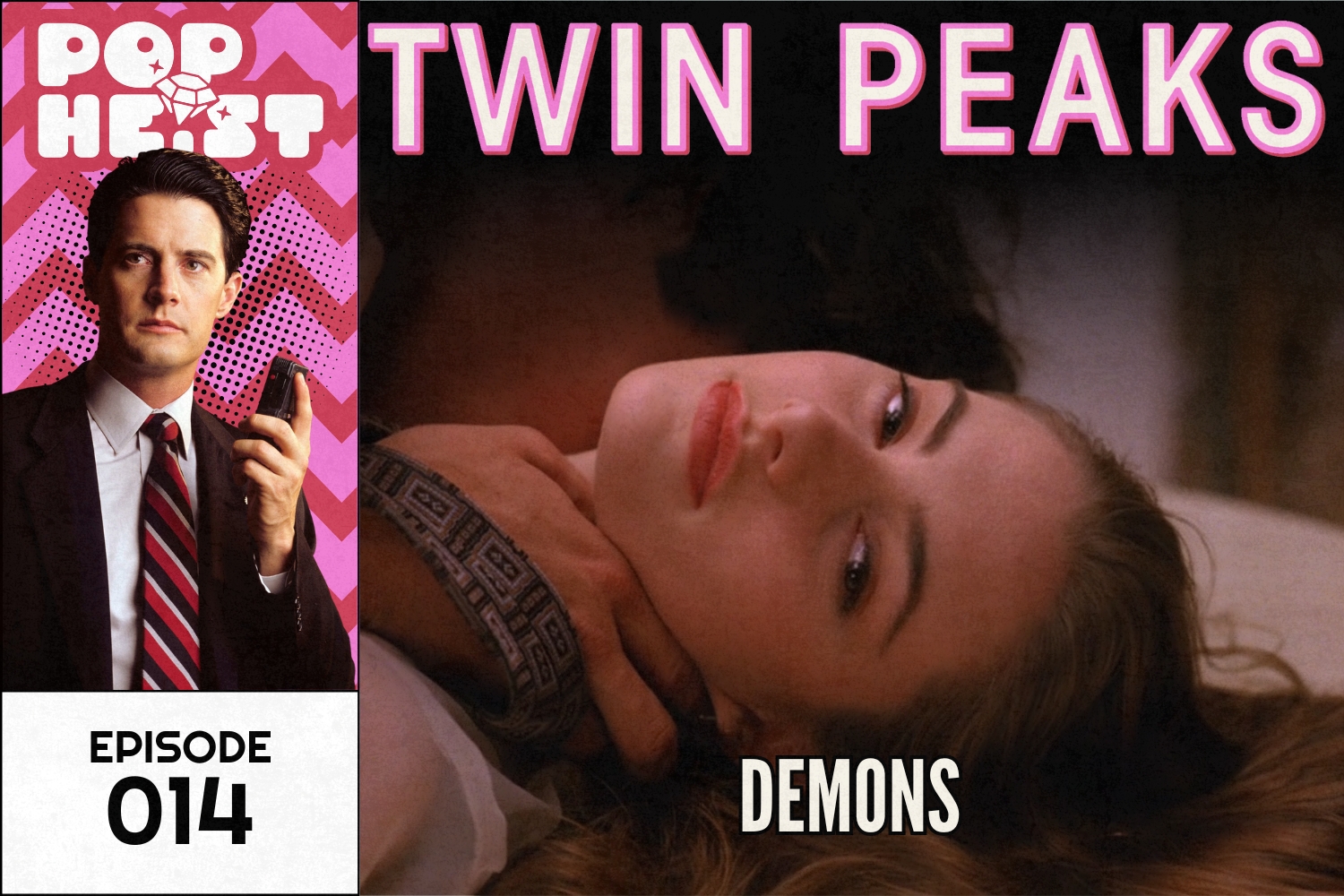
In PRESTIGE PREHISTORY, Pop Heist critic Sean T. Collins takes a look at classic TV shows that paved the way for the New Golden Age of Television — challenging, self-contained series from writers and filmmakers determined to push the medium forward by telling stories their own way.
Twin Peaks Season 2, Episode 6
“Episode 13” aka “Demons”
[NOTE: The pilot episode of Twin Peaks is not numbered; this, the fourteenth episode overall, is officially designated “Episode 13.”]
Original Airdate: Nov. 3, 1990
Writer: Harley Peyton, Robert Engels
Director: Lesli Linka Glatter
Cast: Kyle MacLachlan, Michael Ontkean, Mädchen Amick, Dana Ashbrook, Richard Beymer, Lara Flynn Boyle, Sherilyn Fenn, Warren Frost, Peggy Lipton, James Marshall, Everett McGill, Jack Nance, Kimmy Robertson, Ray Wise, Joan Chen, Harry Goaz, Michael Horse, Sheryl Lee, Lenny Von Dohlen, Ian Abercrombie, David Lynch, Wendy Robie, Fumio Yamaguchi, Al Strobel, Mak Takano
There will be no burying of the lede here — or the lead in the case, as it were: Laura Palmer’s killer is at the Great Northern Hotel. Right now, at this very minute. He is Bob, the mystery man from all the dreams and visions, the man on the wanted poster, the man Leland Palmer remembers from his childhood, the man Laura alluded to in her messages and diary entries.
Only he’s not a man at all: He is “an inhabiting spirit,” not unlike Mike, his reformed partner and now his nemesis. When his experimental medicine is withheld, the one armed, mild-mannered, and pitifully panic-stricken shoe salesman Philip Gerard becomes this strange alter ego named Mike once again. He says that Bob, that grizzled, gray-haired being, isn’t visible to everyone.
Mike tells the lawmen assembled to hear his story that only “the gifted and the damned” may see Bob’s true face. But whatever human face he might be wearing, Mike says its physical owner has been close for nearly forty years, and is now in a great wooden house with many rooms, all identical, inhabited by different souls.
Agent Dale Cooper recognizes the place he calls home immediately. The killer is in the Great Northern. “Without chemicals, he points.”

Who are our suspects, then? Ben Horne, Laura’s erstwhile pimp, is overseeing operations at his hotel as usual. We know he’s capable of at least ordering murders. We know he has a taste for teenagers. And he’s got his fingers in every other crime within a 100-mile radius of Twin Peaks, so why not this one too? Ben has been a logical suspect from the start.
So is Leland Palmer, Laura’s disturbed father. Leland’s back on the job as Ben’s legal adviser in an unofficial capacity, telling him the best way to slow-walk the land deal with the Icelanders so that his brother Jerry, now in Tokyo, can determine if the offer from the strange visitor from Mr. Tojamura’s Japanese consortium is legit. It’s admittedly sharp lawyering.
But his behavior is weird. After petting an obtrusive stuffed arctic fox, its fur as white as his own hair, in Ben’s office, Leland pockets the fur that comes loose from his touch. Later, he performs “Getting to Know You” from the musical The King and I like he’s the Great Northern’s lounge act, not its lawyer. Ben’s exasperated reaction when he hears Leland rock the mic is priceless. But what if Leland’s musical outbursts hide a much deeper and darker, perhaps even demonic, derangement?

Pete Martell, of all people, is on the scene too. He pops up out of the blue, rather dramatically, turning from the hotel bar to identify the origin of the song Leland’s singing. We’ve learned by now that Pete has completed the deal and sold his share of the mill to Josie, who’s selling it to Ben, and he seems at loose ends. In fact, he comes across as half in the bag — though who can tell with Pete? That’s the beauty of a Jack Nance performance. Regardless, Pete was the man who first found Laura’s body.
The incongruously present Pete struggles to make small talk with Mr. Tojamura, who’s watching the Leland situation from the bar himself. Now, this guy is obviously some other guy in disguise, but who? Everyone’s initial theory was that he’s that influential, incognito restaurant critic, but his offer to get in on Ben Horne’s land deal would appear to put that one to bed.
Who does that leave as a candidate for the man behind Mr. Tojamura? In this episode, Coop gets another cryptic letter from his old, insane partner, Windom Earle — the notation for an opening chess move. Tojamura could be his gambit (though Earle was apparently institutionalized during the Teresa Banks and Laura Palmer killings, ruling him out as the murderer). Coop alludes to Audrey’s plight being the second time he endangered someone he cared about during a case, a bit of backstory that feels deliberately introduced with Earle in the air.
Meanwhile, Catherine Martell’s body was never found; she’d have an interest in the land deal, as does Mr. Tojamura, but the killer was almost certainly male. New Renault brothers keep cropping up like toadstools, so perhaps one is wearing a mask. Or maybe beneath that make-up lurks the true face of Bob. Tojamura does mention being familiar with the “fire” of Nagasaki, a shockingly serious reference point. Is this the “fire walk” of the poem?
(Side note: In The King and I, actor Yul Brynner wears yellowface to play the King of Siam; this feels like a reference to Mr. Tojamura’s obvious, dubious Japanese-businessman disguise.)
Though we don’t see her, we know that by now Audrey Horne is back home at the hotel as well. (It’s hard to imagine she’s a suspect considering the nature of Laura’s murder, but I suppose we can’t rule anyone out if demonic possession is involved.) Rescued from Jean Renault at One-Eyed Jack’s by Coop, Harry, and Hawk, she’s brought back to the Bookhouse, where she caresses Cooper’s hand as he holds it to her face. He was literally the answer to her prayers.
For his part, Ben seems more immediately concerned with the retrieved ransom than the daughter he was ransoming. It’s just as well: After seeing him slobber all over his own daughter while she was masked up at the brothel, watching him try to comfort her when she’s seen him at his worst is almost physically painful to endure. Does he read between the lines when Audrey tells him she saw a lot, an awful lot, at One-Eyed Jack’s?
Of course, those are just the players that we know about. Jean Renault’s escape from One-Eyed Jack’s, for example, is pointedly mentioned during Coop’s conversation with Ben about Audrey’s rescue. That puts him in play.
Meanwhile, there’s a newcomer to town: FBI Regional Bureau Chief Gordon Cole. Played by David Lynch himself, Gordon is a role that would come to define how people hear the great director in their heads even now.

The reason is simple: He’s extremely hard of hearing, and more or less shouts everything he says in the exact same broad midwestern accent. He’s constantly making comical mistakes of interpretation. (“Gordon, I hope you haven’t been waiting too long.” “I didn’t just get here! I’ve been waiting the whole afternoon to see you!”) He pronounces “chihuahua” “chee-wow-wow.” He’s an extremely lovable guy right off the bat, the diametric opposite of Albert Rosenfield.
But it’s Albert whose comments are relevant here. Though he won’t be sent back to Twin Peaks, the forensics expert says he retrieved strands from an expensive vicuna coat from the hallway outside Coop’s door after he was shot. That gunman is still out there, and Bob would make a logical candidate for a would-be assassin. What kind of demonically possessed psycho killer has the scratch for that kind of fur, though?
We feel closer than ever to a resolution of Laura’s case. Indeed, it must be noted here that we are soon going to find out who killed Laura Palmer. ABC executive Bob Iger, whom you may know for his marvelous stewardship of Marvel, Star Wars, Pixar, and Disney “live action” over the last few years, was an instrumental force in getting Twin Peaks on the air…until he ordered creators Lynch and Mark Frost to uncover the killer when their initial plan was to keep the mystery going for as long as they could. Such is the mind of an executive. Will we ever fathom their depths?
Regardless, the show must go on all across town. Bobby and Shelley get their first real taste of what being home care providers for the insensate Leo Johnson is really going to be like, when their health care guy (Seinfeld standout Ian Abercrombie) reveals that their insurance checks will be a mere 14% of what they expected. Shelley had to quit her job at the Double R for Bobby’s big idea. Now what?
Well, there’s some good news here. Even though they’re a couple of dopes who now have to play nursemaid to a man who will murder them both the moment he wakes up, Bobby and Shelley are still — how shall I put this — young, dumb, and full of cum.

They stage a big dumb welcome-home party for Leo, with party hats and sunglasses and kazoos and copious amounts of booze. As always, their rapport is almost alarmingly sexy. (Shelley wearing Bobby’s necktie is one of the hottest things I’ve seen on this show so far.)
The two even start to go at it on the table right in front of Leo; he is still alive enough to put a scare into Shelley when he moves. Then falls face-first into the cake, so the scary moment has passed…for the time being.
Something even scarier befalls Donna and Maddy. The episode picks up right where the previous one left off — in the orchid-strewn home of Harold Smith, who’s threatening the girls with a rake over possession of Laura’s diary.

His sense of betrayal is so profound that it seems to have induced something approaching a full mental break. The girls escape with James’s unexpected help, leaving Harold behind with Laura’s secret diary and his own demons.
The incident helps all three kids realize some important things. Donna and James are still very much in love with one another. James and Maddy’s thing was just his residual feelings for Laura getting triggered by their resemblance; both Maddy and James address and accept this with surprising maturity. With that, Maddy says goodbye, telling James that now that Laura is truly gone, she can go back home to her own life.

Josie Packard doesn’t have that kind of breathing room. She’s being ordered around — and fucked, it should be noted — by her “cousin Jonathan,” now posing as her “assistant, Mr. Lee.” Whoever he really is, he wants Josie out of town immediately, even if it means failing to collect on the mill swindle and her side deal with Ben Horne. A certain Mr. Eckhard will make it all worth her while, he assures her with a sneer.
In the meantime, however, she manages to get her money out of Ben after all. He signs over Tojamura’s $5 million check to her when she threatens him with a dead man’s switch that will lead investigators to copious evidence of his criminality, just as he’s promised to do to her to try to muscle her out of her money. In this game of chicken, Ben blinks first.
In his own way, so does Harry. When Josie tells him she’s leaving town for good, he tells her he loves her, twice, to no avail. Given the passion we’ve seen them display it’s hard to believe this word has never come up before.
And for the first time, Nadine’s mad one-sided romance with Big Ed Hurley generates some heat of its own. Convinced she’s back in high school with her parents out of town, she overpowers and pounces on Big Ed, straddling him as she realizes they don’t need to go park somewhere in the middle of nowhere to neck when they have the house to themselves. Ed appears completely flummoxed by all this, understandably
There’s room for silly business like this in Twin Peaks for sure. It’s part of the charm. But we’re now getting ever closer to the pulsating black heart of the story — the force of sheer malevolence that claimed Laura Palmer’s life. As such, even the simplest lines that touch on this mystery take on an awesome power. When Mike describes Bob as “the parasite,” attaching himself to human hosts and feeding on their fears and carnal pleasures, it’s like hearing Max Von Sydow talk about the thing inside Regan in The Exorcist.
“He is Bob, eager for fun,” Mike says. “He wears a smile. Everybody run.”
This dialogue moves me to the point of tears, not of sorrow or joy, but awe. A great and terrible thing is at hand.
If you haven't already, consider supporting worker-owned media by subscribing to Pop Heist. We are ad-free and operating outside the algorithm, so all dollars go directly to paying the staff members and writers who make articles like this one possible.


