

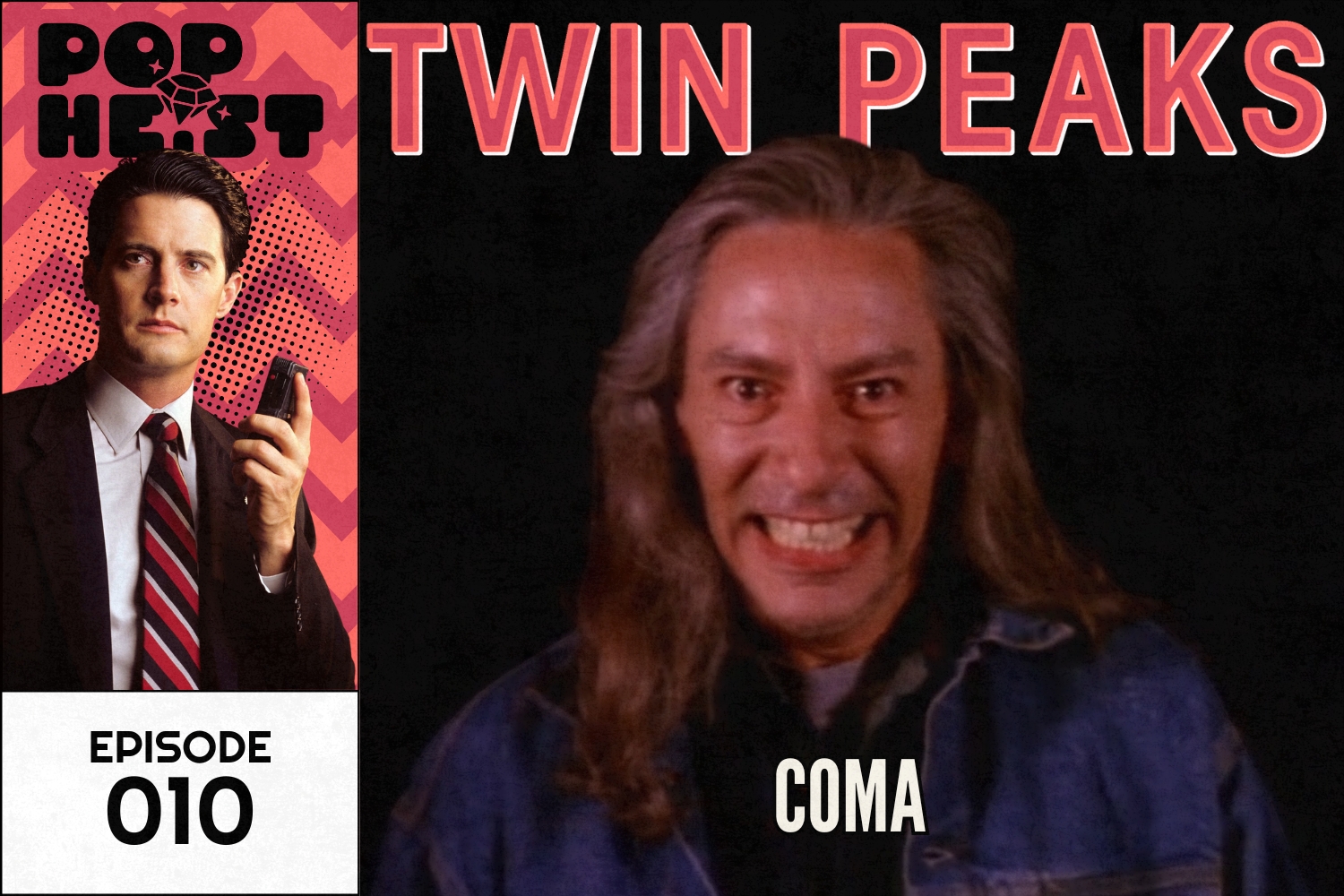
In PRESTIGE PREHISTORY, Pop Heist critic Sean T. Collins takes a look at classic TV shows that paved the way for the New Golden Age of Television — challenging, self-contained series from writers and filmmakers determined to push the medium forward by telling stories their own way.
Twin Peaks Season 2, Episode 2
“Episode 9” aka “Coma”
[NOTE: The pilot episode of Twin Peaks is not numbered; this, the tenth episode overall, is officially designated “Episode 9.”]
Original Airdate: October 6, 1990
Writer: Harley Peyton
Director: David Lynch
Cast: Kyle MacLachlan, Michael Ontkean, Mädchen Amick, Dana Ashbrook, Richard Beymer, Lara Flynn Boyle, Sherilyn Fenn, Warren Frost, Peggy Lipton, James Marshall, Everett McGill, Jack Nance, Kimmy Robertson, Ray Wise, Joan Chen, Piper Laurie, Eric Da Re, Harry Goaz, Michael Horse, Sheryl Lee, Russ Tamblyn, Grace Zabriskie, Chris Mulkey, Miguel Ferrer, David Patrick Kelly, Wendy Robie, Don Davis, Victoria Catlin, Don Amendolia, Frances Bay, Grace Zabriskie, Catherine E. Coulson, Carel Struycken, Phoebe Augustine, Mak Takano, Austin Jack Lynch, Frank Silva
The motorcycle parked outside the Palmer house lets you know who’s inside. James Hurley and his girlfriend Donna Hayward have come to visit Maddy Ferguson, the out-of-town cousin of their beloved friend Laura Palmer. In fact, they’ve come to record a love song, using a tape recorder, an old-fashioned microphone, and James’s acoustic guitar. While Maddy and Donna sit side by side on the floor and coo their dreamy backing vocals, James takes lead. His tremulous voice sings a song called “Just You,” which sounds like something you might have slow-danced to at the 1961 Spring Fling.
Donna’s mistake is believing that the song is for her. It might have been when he wrote it. It might even have been when he started singing it. But as the song continues, the dynamic shifts. As Maddy’s eyes seek out James with increasingly obvious hunger, and he responds by looking back at her instead of Donna, Donna’s own eyes grown desperate, pleading, and finally tearful. Eventually it’s too much, and she gets up and runs off.
“I’m trembling, James,” she says when he comes to comfort her. “You made me.” It’s true, but not in the heated way she intends it to sound. The thought of losing James has rocked her.
Maddy just sits there looking uncomfortable for this bit.
Then something happens. As she looks absently into the depths of the Palmer family’s first floor, a man emerges into view. Slowly he approaches, crawling over the sofa, scrambling over the coffee table, staring straight into the camera until he’s right in our faces. Maddy screams uncontrollably, even as Donna and James rush to her side to comfort her. She’s seen Laura’s killer. She’s seen Bob.
These few short minutes of screentime begin with a song so sugary sweet it passes through camp and back around into to dead-serious sincerity. There’s just no denying the passion and pain in the glances exchanged between the three singers. Add in Donna’s attempt to kiss James back into loving her and you’ve got something desperately romantic, in line with the star-crossed relationships of Blue Velvet or Mulholland Drive. But then, after some brief comic relief courtesy of Maddy’s third-wheel awkwardness, comes what remains one of the scariest shots ever aired on television: Frank Silva’s Bob, coming for all of us.

This sequence shows how vast an array of moods the term “Lynchian” contains. This whole episode follows suit. Directed by David Lynch himself, it displays the filmmaker’s full range of styles, tones, even genres. That’s right, Dune-heads, there’s honest-to-god science fiction in this one!
The sci-fi comes in via Major Briggs, Bobby’s sagacious, good-hearted military-man father. Though the Major can’t tell Coop the nature of his work for the government, he can reveal that it involves monitoring radio-wave transmissions from deep space — and that those transmissions suddenly broadcast a message the night Cooper was shot. “THE OWLS ARE NOT WHAT THEY SEEM,” the readout says, echoing the words of the Giant in Coop’s post-gunshot dream. “COOPER COOPER COOPER COOPER COOPER.” The insistence of that repetition makes me uneasy.
This entire exchange between Briggs and Cooper only happens because the Log Lady’s log somehow knew the Major had a message, and needed to be encouraged to deliver it. Meanwhile, “the owls are not what they seem” appears to receive additional confirmation in a subsequent dream of Cooper’s, showing an owl superimposed on the face of Bob as the mysterious killer crouches behind Laura’s bed. The strength of that simple visual effect is shocking.

Bob is all over this episode. Leland Palmer, whose disastrous return to his job as Ben and Jerry Horne’s counsel is driving the brothers crazy, recognizes Bob from Deputy Andy’s sketch on the wanted poster. Leland says Bob was a neighbor of his grandfather’s, whom he met when he was a little boy. Ronette Pulaski, who’s out of her coma but non-verbal, reacts to the sketch in a thrashing panic. Bob is our killer, alright.
But what is he doing in Cooper’s dreams, for the second time? Why did both Sarah and Maddy have visions of him skulking around the Palmer home when the killing took place in that train car in the woods? Are they in danger the same way that Laura, who is also said to have had visions, was in danger, and knew it for a week or two before she died? Whatever the answers, when you add up all the clues from this episode alone, it appears inarguable that Laura’s murder was, at least in part, supernatural in origin.
Maybe that’s the lens through which we should view a new pair of Twin Peaks residents. Acting on the anonymous note she received encouraging her to look into the Meals on Wheels program Laura volunteered for, Donna takes over her route and meets a bedridden old woman, Mrs. Tremond (Frances Bay, who’d later battle Jerry Seinfeld over a marble rye), and her quiet, besuited grandson (Austin Jack Lynch, David’s lookalike son).
There’s something…off about these two. Mrs. Tremond reacts with something between anger and fear when she discovers creamed corn in her meal — which her magician grandson somehow teleports from the plate to the palms of his hands without Donna noticing a thing. While Mrs. Tremond denies knowing Laura well, she suggests contacting an agoraphobic neighbor, Harold Smith, who’d been Laura’s friend on her route. (Harold calls her back to arrange a meeting later in the episode.)
“J’ai une âme solitaire,” the boy says. Loosely translated from French, it means “I am a lonely soul.”
“She seemed like a very nice girl,” Mrs. Tremond tells him after she leaves.

One of Lynch’s hallmarks on Twin Peaks is to stick his camera in an upper corner of some weird room and then just let it roll, forcing you to inhabit some odd, uncomfortable space for a while. In this episode he does it not only with Mrs. Tremond’s house, but at One-Eyed Jack’s, and to a totally different effect.
Determined to get to the bottom of Laura’s potential employment at the place and connection to her father, Audrey Horne literally chokes it out of Emory Battis, the sleazy manager of Horne’s Department Store. “I’m Audrey Horne,” she informs him, extension cord around her neck, “and I get what I want.” Hell yeah.
Battis tells Audrey that her father owns the store, the casino/brothel, basically everything, and that he’s fully aware of the trafficking operation because he personally samples all the girls — including Laura Palmer, who only worked there for a weekend before her cocaine addiction got her fired. “Laura always got her way,” Battis sneers. “Just like you.”
It’s an awful revelation. It prompts Audrey to risk placing a tearful call to Coop back at the Great Northern. (Remember, he still hasn’t found the note she left alerting him to her whereabouts, which got knocked under his bed the night of the shooting.) Unfortunately, she’s cut off before she can tell him where she is by Bettis and his partner in the prostitution ring, Blackie, who eye her with bad intent.
But before any of that happens, we see what Battis is into. It involves being tied up bindfolded in a supine position, arms and legs bound to the ceiling, toenails painted and drying with little cotton balls between them, while a woman in what can only be described as an erotic cowgirl costume endlessly vacuums the floor. The vacuum is key to the fantasy, apparently, as his hilarious fury when Audrey turns it off makes clear. All of this is shot from a remove just like the Tremonds’ place, but the result this time around is comedy, not creepiness. (Well, okay, a little creepiness, just of a different kind.)

Now that the mopping up from the Season 1 finale cliffhangers is more or less over, this second episode of Season 2 has a little time to introduce some new wrinkles to the plot moving forward. We learn arch-criminal Hank Jennings was once a do-gooding Bookhouse Boy and one of Sheriff Truman’s closest friends. We learn Andy reacted so poorly to news of Lucy’s pregnancy because he knows he can’t have children.
Ben Horne is so busy deciding whether to use the mill’s stolen records, both real and fake, to make the place look like it was failing (easier to purchase in the short term) or thriving (easier to sell in the long term) that he only just now bothers to alert Coop to his daughter’s disappearance. Cooper is a lot more broken up about it than Ben is, that’s for sure. Bobby talks Shelly into taking her comatose husband home to care for him so they can live large on his disability payments. (I’m pretty sure that’s not how that works, not least of all because Leo’s eyes are beginning to open already.)
Mysterious figures keep lurking on the margins. That mystery man in the Great Northern who was looking for Josie now has his eye on Coop. Someone calls the Sheriff’s Department looking for Harry but refuses to say who they are. And Cooper’s irascible but razor-sharp colleague Albert warns him that his old partner, Windom Earle, has escaped a mental institution and disappeared. Does he have anything to do with the other two mystery men, I wonder? Dots do tend to get connected in Twin Peaks.
Amid all this business, between the big swing-for-the-fences scenes, Peyton and Lynch make the time to draw out the sweetness and silliness of the show. Major Briggs is such a stand-up guy, for example: He agrees with the Log Lady that his medals and rank insignias are meaningless, since “achievement is its own reward,” and he laments to Cooper that the classified nature of his work is a constant reminder that “Any bureaucracy that functions in secret inevitably leads to corruption.” Truer words, Major Briggs, truer words.
And right before Harry and Dale show Ronette the sketch of Bob, there’s a solid minute of cringe comedy as the two men struggle to adjust the height of the stools they want to sit on to conduct their interview. It’s funny in a way that’s fully decades ahead of its time — and it makes us lower our guard for the knockout punch to come. No show has ever done it better.
If you haven't already, consider supporting worker-owned media by subscribing to Pop Heist. We are ad-free and operating outside the algorithm, so all dollars go directly to paying the staff members and writers who make articles like this one possible.


