

Hamnet
Writers: Chloé Zhao, Maggie O'Farrell
Director: Chloé Zhao
Cast: Jessie Buckley, Paul Mescal, Emily Watson, Joe Alwyn
For those of us who saw and championed Jessie Buckley after her breakout role in Scottish musical drama Wild Rose seven years ago, Chloe Zhao’s Hamnet can be considered dividends paid. Her work in Hamnet, an adaptation of Maggie O’Farrell’s novel of the same name, is a tidal wave; a titanic, spirited expulsion of grief that raises the water of everything else around her. And it must do, since the majority of Hamnet is in desperate need of being lifted out of its watery humdrum, overwrought stupor.
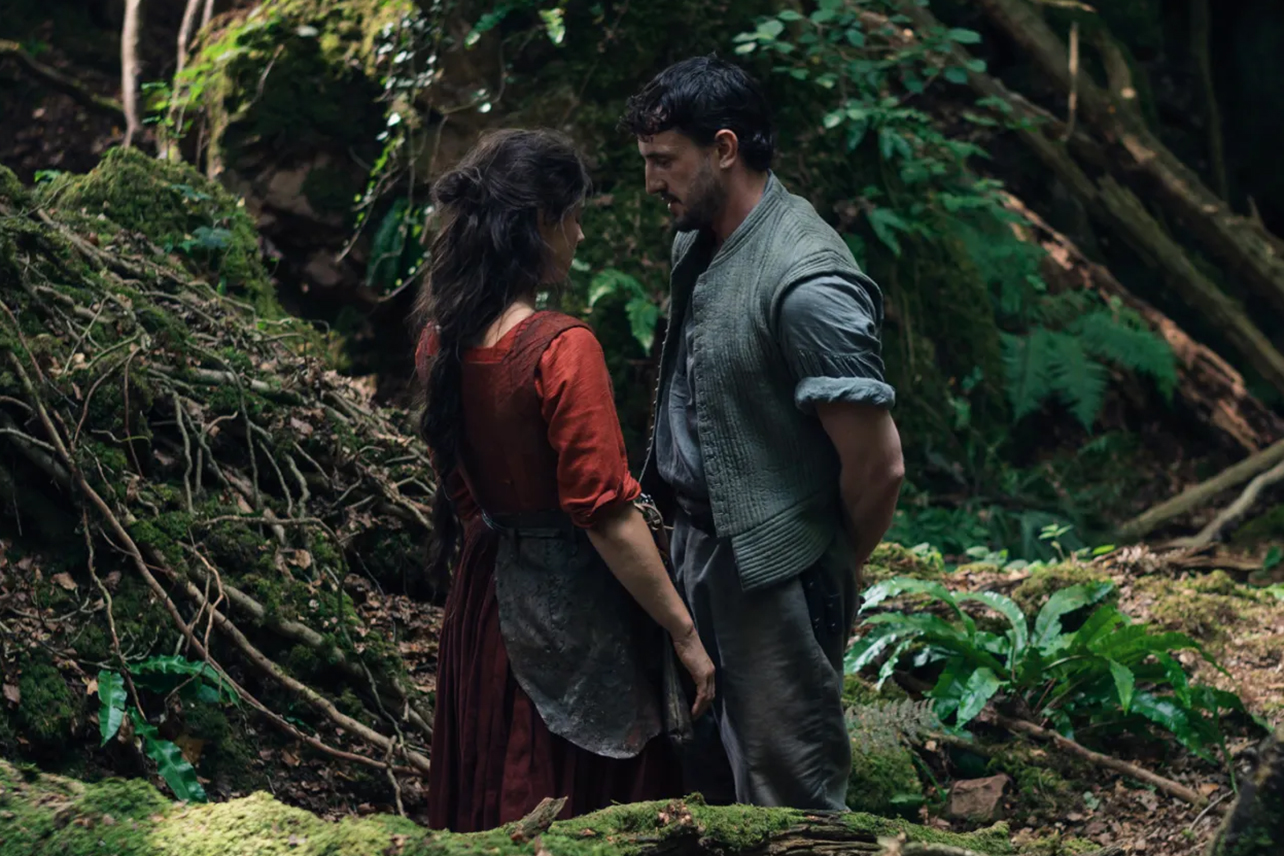
Hamnet begins with Agnes (Buckley) in a forest, summoning her pet hawk to her. The elder sister of the family, she is yet to be wooed on account of her status as the daughter of a forest witch. But that hardly bothers suitor Will (Paul Mescal) who takes a shine to her. After a whirlwind affair, the two get married — much to the disapproval of their separate families — and eventually have children. If this sounds a touch Romeo & Juliet, you’d be correct in that assertion since Will is William Shakespeare, and Hamnet is a work of historical fiction that tracks how the loss of 11-year-old Hamnet (Jacobi Jupe, who will undoubtedly be hot property after this) is the grieving engine that powered the creation of one of Shakespeare’s most notable and quoted plays, The Tragedy of Hamlet.
The tragedy portrayed in Hamnet is in the death of the child. Agnes prophesied that she will have two children by her deathbed, and after she loses some to being stillborn or through cot death (infant death rates in 1600 often hit 25%), she has three children: Hamnet; his twin sister Judith (Olivia Lynes) and an older sister Susanna (Bodhi Rae Breathnach). This vision leaves Agnes fearing for the death of a child, which one could argue is a self fulfilling prophecy within the narrative as while Agnes ultimately does everything she can to prevent this, it is ultimately her affection that leads the child to contract the illness that takes his life.
If you’re like this critic and haven’t read or studied the text of Hamlet with a fine-toothed comb, you may not quite follow exactly where the plot of Hamnet is heading, or even quite where it ends up. The Tragedy of Hamlet (often abbreviated to just Hamlet) is a Shakespearean tragedy that follows Prince Hamlet of Denmark as he seeks revenge for the murder of his father, King Hamlet. There are no big revenge plots in the life of Agnes and Will, nor is there even a death of a patriarch to avenge. In fact, Hamnet dies of bubonic plague. This is a film about how a piece with artistic merit is crafted from pain, and yet the creative liberty taken between the narrative of Hamnet and of Hamlet are distinctly incompatible with one another.
Much like one’s opinion on movies based on comic books, or franchises such as Star Wars, you should never have to have been involved in reading or watching supplementary material in order to understand what is happening on screen. To Zhao’s credit, the final act – upon which the play of Hamlet (character portrayed by Noah Jupe) is performed – might not be legible from a singular narrative perspective sans material from Hamlet, it is from an emotional one. Between Jupe, Mescal and Buckley, their performances relay the intent even if scrutiny to their words confounds.
This is Zhao’s fourth feature film, and is perhaps her most ravishing work yet. Her debut, The Rider, is a splendid if rustic work. The same could be said about her second, the Best Picture winning Nomadland. Even Eternals, her highly underrated and sadly disregarded entry into the Marvel Cinematic Universe is often beautiful to look at (its giant flaws emerge from an insistence on "Marvel" comedy). Zhao is no stranger to finding beauty in our own environment as Hamnet is often quite dazzling, making use of the inky black spaces that can be inhabited by traumatic visions or of a flickering candle that illuminates the despondent, grieving face of Will as he writes and attempts to come to terms with the death of his son.
But beauty can only be gazed upon for so long within the film medium. Hamnet meanders around their courtship, the impending tragedy and the grief for such a prominent portion of the movie, that when the film finally gets to what is actually tangible – i.e the Hamlet play itself – it has committed the sin of being tedious to sit through, as much as Max Richter’s score is pleasant on the ears. The third act of Hamnet also makes use of ‘On the nature of daylight,’ Richter's own piece which was created outside of the scoring process here. A remarkable piece of music that is impossible not to be swayed and moved by – notably used by Denis Villeneuve for the epilogue of Arrival – albeit this results in the ending of Hamnet is attempting to personally wring your tears out of you, when it hasn’t given Agnes enough of a personality outside of being a mother to emotionally earn it.
There’s undoubtedly merit behind Zhao’s work here, and as much as Buckley and Mescal give powerhouse performances, this is frustratingly bland, jejune storytelling. All the individual pieces are stunning; cinematographer Lukasz Zal paints beautifully with his camera; Richter’s score often seems to leap out of the frame; even the central idea of grief inspiring art has such rich potential to be moving but ultimately, Hamnet did not do as such. If a film like Hamnet does not engage with one’s emotions, when the film relies on — and tries exceptionally hard to — make you weep, that is a catastrophic blow to the art