

Every year I wind up watching the 1954 Christmas classic White Christmas, and every year it stands out as one of the highlights of the holiday season. The little tale of some old Army buddies hitting the big time as song-and-dance men and using their fame to honor their former general touches something within me. Maybe it's the earnestness of the acting by Bing Crosby, Danny Kaye, Rosemary Clooney, Vera-Ellen, and Dean Jagger. Maybe it's how I think back on my own grandfather who served in World War II. Maybe it's just a damn fine movie.
But I've come to realize that there is an undercurrent, a hidden theme throughout White Christmas that I don't think has been identified before. It's something that propels the actions of every character and lies beneath all of their motivations.
It's the fear of dying alone.
And I understand, this is a heavy topic for Pop Heist's fun little Heistmas event, so while I tell you about this dreadfully dark narrative theme, I'm going to break it up with some fun White Christmas trivia!
FUN FACT! Vera-Ellen, who played Judy Haynes was a dancer, not a singer! So her singing throughout the film was dubbed in by Trudy Stevens!
Death is omnipresent in the beginning of White Christmas. It does, after all, take place at the German front. Even though it's Christmas Eve, bombs are going off. One almost takes the life of Bing Crosby's Bob Wallace, although Danny Kaye's Phil Davis saves him at the expense of his own safety. But before the attack begins, the troops perform a little Christmas Eve show, complete with a little hand-cranked organ that plays the song "White Christmas" for Bing to croon to.
This song, despite how well it's appreciated now as a delightful holiday ditty, is presented as something else entirely: a slow dirge sung by a tired, weary soldier, who yearns to be home. You can see it in the faces of the men he's surrounded with. He sings about the simple pleasure of home, seeing snow on Christmas, thinking back to Christmases past with his family. They all feel it. They might not come back to their homes, their families, their simple pleasures like treetops glistening. This is the reality of a World War, loneliness amongst comrades, the fear of dying in a place so far away from your family, your home, the things you love and cherish.
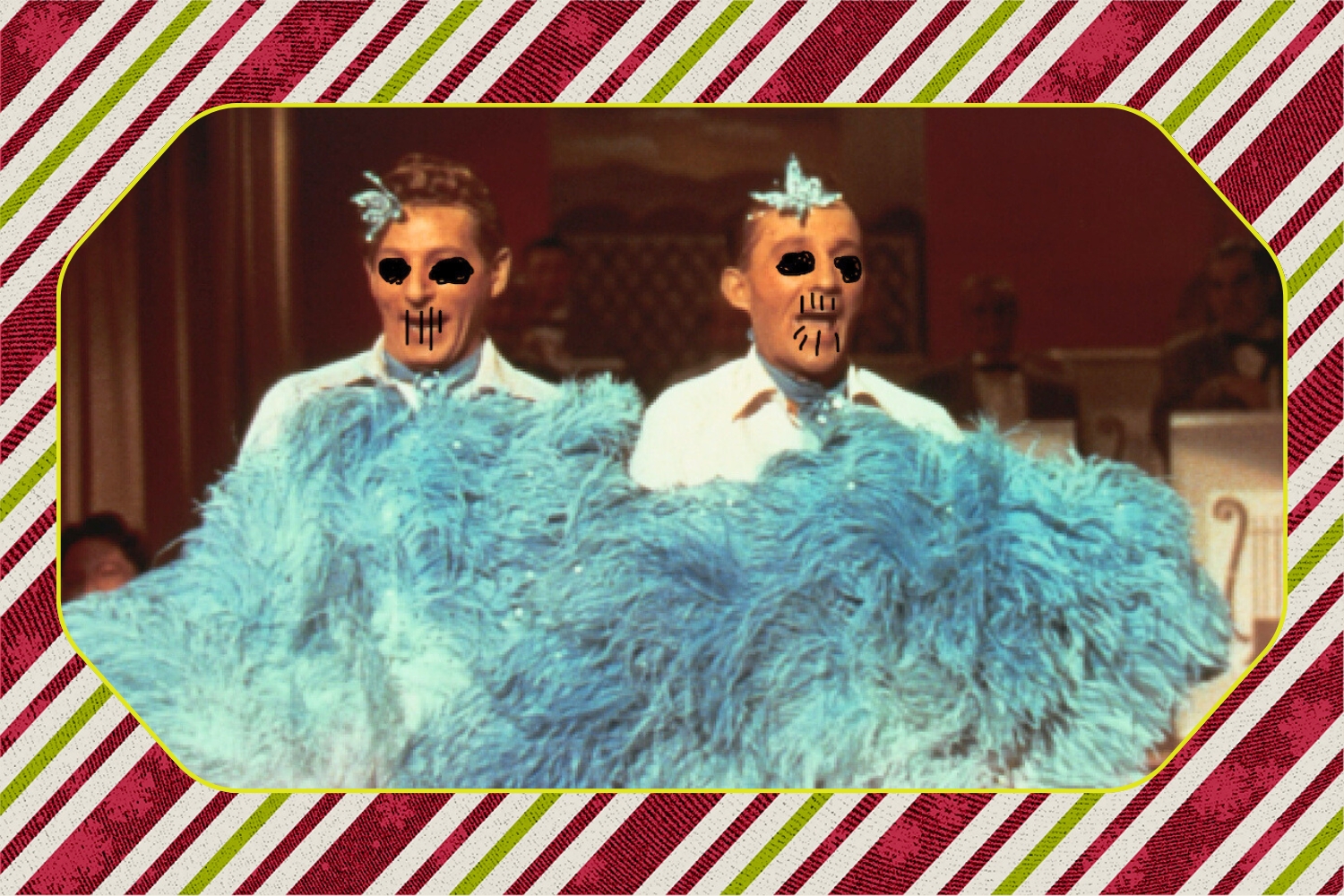
FUN FACT! Danny Kaye was the one actor who could crack Bing Crosby up on set more than anyone else! You can see it in the "Sisters" number that the two of them perform, as Kaye swings the feathered fans around and Bing breaks character and laughs heartily!
The key line for this scene is right at the beginning, when the Captain is touring the Army camp. "These men are moving up tonight, General Waverly. They should be lined up for full inspection." "Moving up" isn't a shuffling of personnel. This unit is about to get into heavy fighting and people will die. Alone. Away from home. The song "White Christmas" is one last parting gift to them, a prayer if you will, just to give them that last little whisper of hope from a GI who might be losing his life as well. It's a talisman that might prevent the worst from happening.
FUN FACT! White Christmas was the first film to be shot using Paramount's "VistaVision" process, a high-res widescreen format. While the process only stayed around for seven years, it would continue to be used sparingly for individual shots in films for the next 30 years, including the first three Star Wars movies!
Through the rest of the film we follow Wallace and Davis as they achieve success in the theater and hit it off with the Haynes sisters, Rosemary Clooney as Betty and Vera-Ellen as Judy. The Wallace-Davis show schedule is such that Davis works with Judy to pair Wallace off with her sister, so Davis can get some much needed rest. But that excuse is flimsy and self-serving. Davis has been looking out for the best interests of Wallace since the Army days and he sees the grim truth: if Wallace is focused on nothing but work, he's going to ignore the possibility of a family, establishing a home for himself.
There is no love in Bob Wallace's life. And that might mean that Davis's rescue during the war meant nothing. Wallace dies alone no matter what, no matter where. Wallace doesn't seem to put as much emphasis on this, but Davis does. Hooking Wallace and Betty up becomes an obsession between Davis and Judy, so much that they find themselves falling in love.
FUN FACT! Both Fred Astaire and Donald O'Connor were offered the role of Phil Davis! Astaire turned the role down after reading the script (and then asked to be released from his Paramount contract), and O'Connor had to pull out after he contracted a mule-borne illness from working on the 'Francis the Talking Mule' picture Francis Joins the WACS!
There's no love in Betty Haynes's life either. Her flirty sister Judy has tried to set her up, but it looks like there's no hope there; Betty is too focused on taking care of Judy, although Judy is perfectly capable of looking after herself. There's this…tension between the two sisters, a tension that doesn't dissipate no matter how many renditions of the "Sisters" song you hear. And that tension does fall into this fear of death, weirdly enough, although it's not stated as such.
The two of them are a performing duo, relying on each other, traveling with each other, doing everything together like the song says. Neither one of them is particularly happy, but being in this dyad means that they have someone to lean on when things go bad. Although it's not the best scenario, it gives them someone in the room should they ever die. It's a loved one that's there by blood rather than someone who has fallen for their better qualities. So they don't want to break this codependent team up, but they're both covertly seeking someone else in their lives.
There is much fear there beneath the surface.
FUN FACT! The song "White Christmas" was the best-selling single for over 50 years, starting in 1942! It was only dethroned by Elton John's reworking of "Candle In The Wind" for Princess Diana!
While it may seem like a stretch, it's the General, Dean Jagger, whose story just absolutely rings with this fear of loneliness, especially as he nears the end of his life, although the actor would continue to live until 1991. The General has decided to spend his retirement years after the war running an inn in Vermont, sure to be filled with gleeful skiers. The joy and camaraderie of being surrounded by people in his Army unit, alleviating his fears of loneliness and dying by himself, would have been replaced by a bustling inn.
But it doesn't happen. The weather doesn't turn around and the skiers don't materialize. He's stuck with his housekeeper and his granddaughter, so wracked with isolation that he offers his services to the Army once again, to get back amongst people. The General is terrified of being alone as he passes, and overjoyed when Wallace, Davis, and the Haynes sisters make their appearance. He hasn't been forgotten!
FUN FACT! The photo of their brother that the Haynes Sisters show to Wallace and Davis, "Freckle-faced Haynes, the dog-faced boy", is of Carl Switzer, who played 'Alfalfa' in the Hal Roach 'Little Rascals' comedies of the 1930s!
The rest of the film consists of these characters assuring themselves that they are loved and they are not alone. In fact, the cast just continues to expand and expand as the film goes on, from the addition of the full Wallace and Davis show crew at the inn, to the radio audience as Wallace pleads for his old unit to reunite, to the final show where the soldiers, the show cast, the inn workers, and the audience all gather for the big life-affirming performance. Characters have found love, they've found appreciation, they've found something to keep them from fearing lonely death.
When Bing Crosby and Rosemary Clooney duet on "White Christmas" at the end of the film it's no longer a plea for the familiar comforts of the homefront. It's a look at the past with the expectation that it will recur in the future, as each of the main characters explores a life free of their earlier dreads. They're dreaming of a white Christmas because they are safe again, like they were before the war, when they were children and surrounded by family.
Death is held at bay for now. No one dies alone.
FUN FACT! White Christmas was a huge payday for Bing Crosby writer Irving Berlin! Each of them received 30% of the profits of the film, while Paramount Pictures earned just an additional 30%! Danny Kaye negotiated a contract where he received 10% of the profits on top of an astounding $200,000 salary, nearly $2.5 million in today's dollars!
If you haven't already, consider supporting worker-owned media by subscribing to Pop Heist. We are ad-free and operating outside the algorithm, so all dollars go directly to paying the staff members and writers who make articles like this one possible.