

Welcome to the 2025 Heistmas Advent Calendar, a daily drop of pop culture Christmas icons, oddities, and joy. Check back every day from now through December 25 for each daily entry!
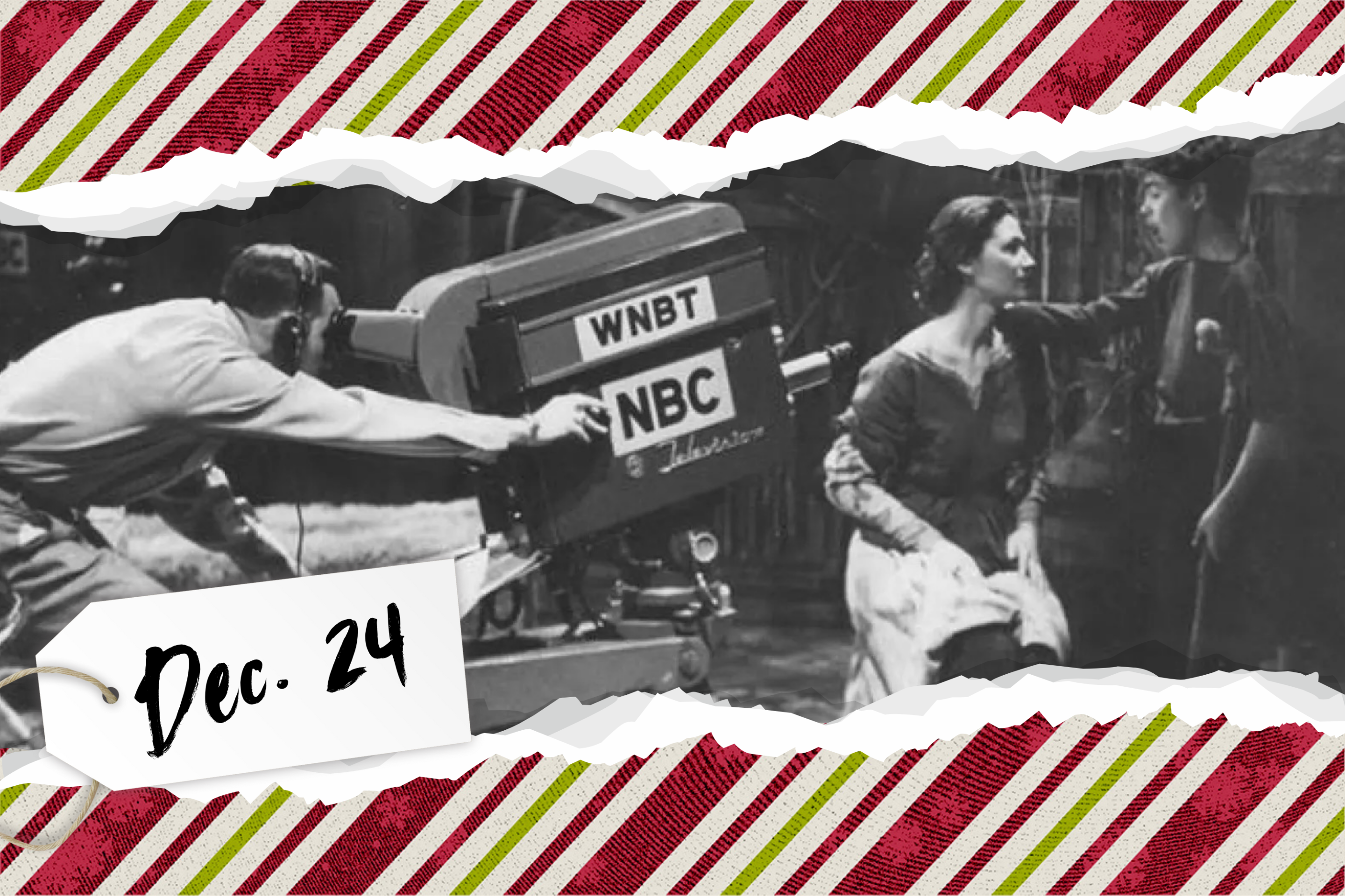
On Christmas Eve, 1951, NBC aired Amahl and the Night Visitors, a Christmas-themed opera, on stations across the United States. This broadcast was important for a number of reasons. Among them: It was part of an early television legacy of airing live opera; it was the world premiere of an opera by Gian Carlo Menotti, an important figure in 20th century classical music; the show itself was the first American opera ever composed expressly for television; and the music and libretto were written by a gay man (Menotti’s partner was Samuel Barber, one of the most highly regarded composers of the century.). It was also the inaugural broadcast of the Hallmark Hall of Fame, so may be considered a distant, distant, distant, distant ancestor of today’s all-consuming Hallmark holiday movies.
Menotti’s Amahl was well received and aired on NBC from 1951 to 1966, then once more in 1978. It survives and is still staged, but it is no longer typically broadcast. And recordings of the opera certainly haven’t landed in most people’s holiday rotation — though earlier classics like It’s a Wonderful Life (1946) and Miracle on 34th Street (1947) have weathered the decades well. So what’s the scoop?
The one-act opera concerns the story of the three Magi on their way to pay respect to the newborn Jesus. (Spoilers ahead, but this thing is 74 years old, guys, get a grip.) They pass through a town near Bethlehem where a disabled boy lives in poverty with his mother; the family offers the Magi their meager but warm hospitality. The mother is caught attempting to steal some of the kings’ gold to keep her son from having to beg in the streets. When they learn of her intention, they allow her to keep the gold; she wishes to give it back and to send a gift for the Magi to take with them to Bethlehem, but has nothing to give. Amahl, in a great show of generosity, offers his crutch for the three men to take with them; when they accept at his insistence, his leg is healed and he is no longer disabled. With his mother’s permission, Amahl accompanies the kings to Bethlehem.
(A lot of questions hang over this opera — A large one for me is why three grown, allegedly wise men would take a child’s crutch to give to a baby who cannot use it and who is also getting a wad of gold and other rich-people gifts for his zeroth birthday.)

It's hard to imagine this kind of special ever happening again. NBC will almost certainly never commission another opera, and it will almost certainly never produce Amahl and the Night Visitors again. Overtly religious content isn’t too hard a sell for Middle America, but opera sure as hell is, so it’s hard to imagine the network recouping its investment. Then, of course, there’s the opera’s ableist premise (you too, can walk, if you simply are poor and believe hard enough).
It's even less likely that NBC would re-air the original 1951 Amahl broadcast, or even slap it up on Peacock. This would require some fancy PR footwork and a lot of context for modern audiences. King Balthazar was portrayed by Leon Lishner, a white opera singer, in blackface — an inexcusable but unfortunately common practice for many roles in opera. (The New York Metropolitan Opera did not retire blackface for the titular role in Verdi’s Otello until 2015, and the Paris Opera didn’t formally end the practice companywide until 2021.) While it traces itself back to different roots than the minstrel shows of the 19th and 20th centuries — which defined what many Americans today understand as blackface — it is extremely racist nonetheless.
Luckily, in 1963, NBC recorded a new production of the opera with a different cast — including an African American singer in the role of Balthazar — and aired that recording annually until 1966, when regular broadcasting ended. (NBC did produce and film a revival, but it aired only once, in 1978.) So, while the troubling aspects of the 1950s and early ’60s productions can’t be erased, it’s at least possible to see broadcasts of the show without the explicit racism.

Why watch it at all, if there's so much trouble to it?
Truthfully, there’s a lot to celebrate about this opera. It’s a big, queer-authored moment in both television and music history, one that crossed over with popular culture. There’s some really sweet music in here, too. One chorus I think of every year is one the shepherds sing when they bring gifts to Amahl’s house to feed the kings:
Olives and quinces, apples and raisins,
nutmeg and myrtle, medlars and chestnuts.
This is all we shepherds can offer you.
Citrons and lemon, musk and pomegranates,
goat cheese and walnuts, figs and cucumbers.
This is all we shepherds can offer you.
Hazelnuts and camomile, mignonettes and laurel,
honeycombs and cinnamon, thyme, mint and garlic.
This is all we shepherds can offer you.
Take them, take them... you are welcome.
Take them... eat them... you are welcome, too.
(It sounds like a killer charcuterie plate!)
It's also important, I think, to observe and understand the value of the art: The singing is rich and the score is lovely, and it's extremely cool to see televised opera — which no longer exists in this form — and learn about how that could possibly have been produced. It's also necessary to see this piece, and other operas that commit the same offenses, to confront the perpetuation ableism and racism. (This may be a "doomed to repeat it" situation.)
On a meta level, there’s something melancholy about taking a network TV opera broadcast, since the advent of television programming (along an infinite number of other coinciding cultural and economic factors) also heralded a steady decline in popularity of classical music.
Television has been integral to the spectacle of the holidays for just about as long as the medium has existed. With such a massive corpus of celebrity-hosted holiday variety specials, animated and stop-motion shorts and specials, holiday-themed episodes and spinoffs of ongoing TV shows, and classic holiday music albums, it’s easy to forget that a little 45-minute opera, first broadcast nationally three-quarters-of-a-century ago, made a dent in the history of Christmas pop culture.
Check back tomorrow for even more Heistmas Advent Calendar Goodies!
If you haven't already, consider supporting worker-owned media by subscribing to Pop Heist. We are ad-free and operating outside the algorithm, so all dollars go directly to paying the staff members and writers who make articles like this one possible.


