

The Odyssey
Writer/Director: Christopher Nolan
Based on Homer's Odyssey
Cast: Matt Damon, Tom Holland, Anne Hathaway, Robert Pattinson, Lupita Nyong'o, Samantha Morton, Zendaya, Charlize Theron
Christopher Nolan is a fan of formulas. That's not a bad thing, but it does color his work to a great degree, and explains why some moviegoers can't find their way to really loving the films he makes. There's a rhythm to a Christopher Nolan story, particularly in his current, post-Batman iteration when he's one of the few filmmakers in Hollywood who can get a movie made just by putting his name out front. He likes narrative symmetry, he likes stories that rhyme, he likes clearly defined rising and falling action, and he's willing to get as nonlinear as possible to make his thematic beats sync up.
There's a certain rigidity to these narrative preferences, which accounts for the way some viewers see Nolan's films as emotionally cold, mechanical rather than instinctual. He works around stories rather than through them, searching for the symmetry and the perfect moment in a narrative that holds resonance for him as a filmmaker and a human. That makes him the perfect filmmaker for The Odyssey, the urtext of the Western canon, from which literal millennia of storytellers have taken countless motifs, inspirations, and entire narrative scaffolds. The results of this particular marriage of filmmaker and subject matter are predictably dazzling, delivering an epic in deep conversation not just with Nolan's past work, but with the very idea of heroism and what it means to a constantly evolving perception of Western civilization.
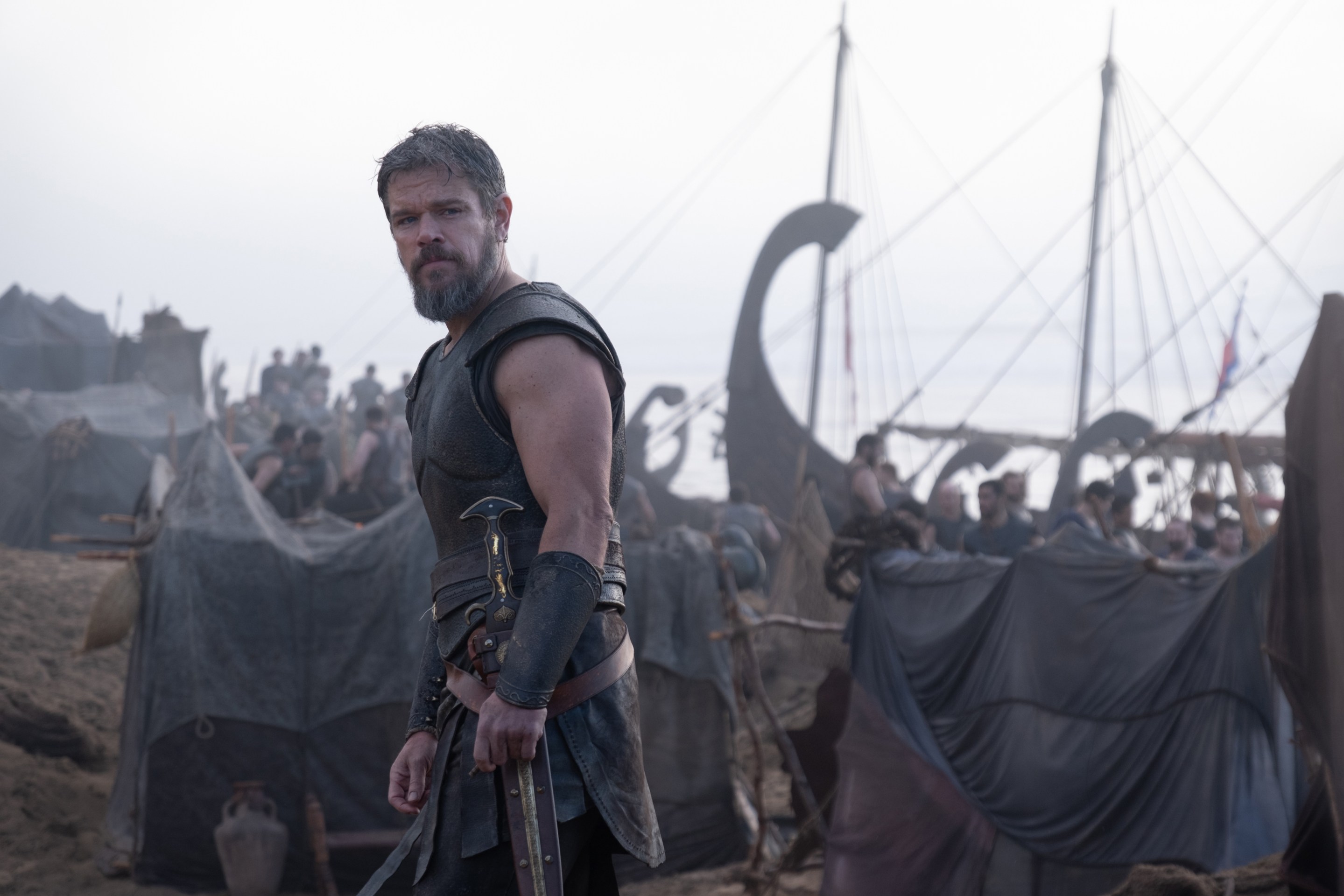
Though there are liberties taken with the structure, pacing, and certain key moments of narrative streamlining, Nolan's The Odyssey, adapted from Emily Wilson's translation of the original epic poem attributed to Homer, is largely faithful to the story's key beats. Odysseus (Matt Damon), the great hero who won the Trojan War for the Greeks, has been away from home for nearly two decades. His kingdom of Ithaca is slowly crumbling as a mob of ravenous suitors fill his halls every night, attempting to court his wife Penelope (Anne Hathaway) and supplant the ambitions of his son Telemachus (Tom Holland). A decade has passed since Troy fell, and though countless other veterans have returned, Odysseus remains lost. So, in an effort to save the kingdom, Telemachus goes searching for his father, while Odysseus fights to find a way home through storms, witches, monsters, and more.
All of those obstacles, and how Odysseus and his men – including an incredible Himesh Patel as his top lieutenant, Eurylochus – navigate them, are the film's top attraction (as they have been in every version of the story for centuries), and while Nolan certainly gives them all their due, he stays true to Homer's instinct to place those searching for Odysseus first in the story. As Telemachus searches, meeting his father's old allies like the Spartan King Menelaus (Jon Bernthal) along the way, gaps begin to fill. Odysseus becomes a presence without actually being present, so when we finally do pick up his story, something of the weight of it is already there. As a possible widow and an orphaned son who never knew his father, Hathaway and Holland are respectively fantastic, lending their own emotional weight to the narrative possibility.
When the narrative shifts to Odysseus, and we see his various trials and battles, Nolan turns on a dime from contemplative to deeply visually and texturally ambitious. Cinematographer Hoyte van Hoytema does arguably the best work of his career, rendering a version of the Ancient Mediterranean world that seems to be in decline, facing a long winter and a longer impending doom that seems to hang over the entire film like smoke. The always wonderful Ludwig Goransson embellishes these visuals with a score that drops the traditional orchestra in favor of drums, voices, the thrum of bow strings and the distant rumble of thunder, invoking the fury of the Gods even when they don't appear (though Zendaya is wonderfully evocative as Athena).
All of the ingredients for an epic are there, but when he could steer hard into the grandeur of adventure, Nolan instead leans into horror. Sequences involving Polyphemus the Cyclops (Bill Irwin) and Circe the Witch (Samantha Morton) take on nightmarish proportions, forcing Odysseus to question not just whether or not he'll get home, but whether or not he deserves everything that's come to him. The pulse-pounding thrills and action of these moments are palpable, and my heart was in my throat for a good portion of the film's runtime, but The Odyssey is at its best when it's pensive as well as thrilling. Nolan, who knows a thing or two about movie thrills, manages to juggle both.
He also, crucially, surrounds his stars with an absolutely phenomenal supporting cast. Morton's a scene stealer of epic proportions, while Robert Pattinson shines a gloriously slimy sheen as Antinous, one of Penelope's chief suitors. Patel is incredible, Bernthal is so good I'd like to see a whole movie just about Menelaus, and Lupita Nyong'o makes the most of her screentime as Helen of Troy. The real supporting MVP, though, is John Leguizamo as Eumaeus, the blind swineherd who keeps Odysseus's memory and legacy alive in Ithaca. He's a revelation, delivering my favorite performance in the film.
If you're not a fan of the way Nolan structures his stories, The Odyssey might not win you over. There's a lot here in common with his other films, most notably Oppenheimer, to the point that the film may as well be a kind of spiritual sequel (or prequel, if you want to think in terms of global history). Nolan has taken his favored motifs and themes and projected them onto this story, but because his favored motifs and themes are often as timeless as The Odyssey itself, it works. It also works because, after he's found his trademark narrative symmetry and rhythm, Nolan goes further, and asks why this story is so timeless. What does The Odyssey really have to say about our present moment, and what can we possibly still learn from it? The answer, of course, is plenty, and Nolan uses the stage provided by history's most famous ancient epic to prove himself a bard for the ages. Taken together with Oppenheimer and Dunkirk, The Odyssey presents a trilogy of films about life during endless wartime, what it means to exist in a world that feels on the brink, and what we can do in the face of encroaching darkness. It's among Nolan's most soulful films, and it left me breathless
The Odyssey is in theaters July 17.