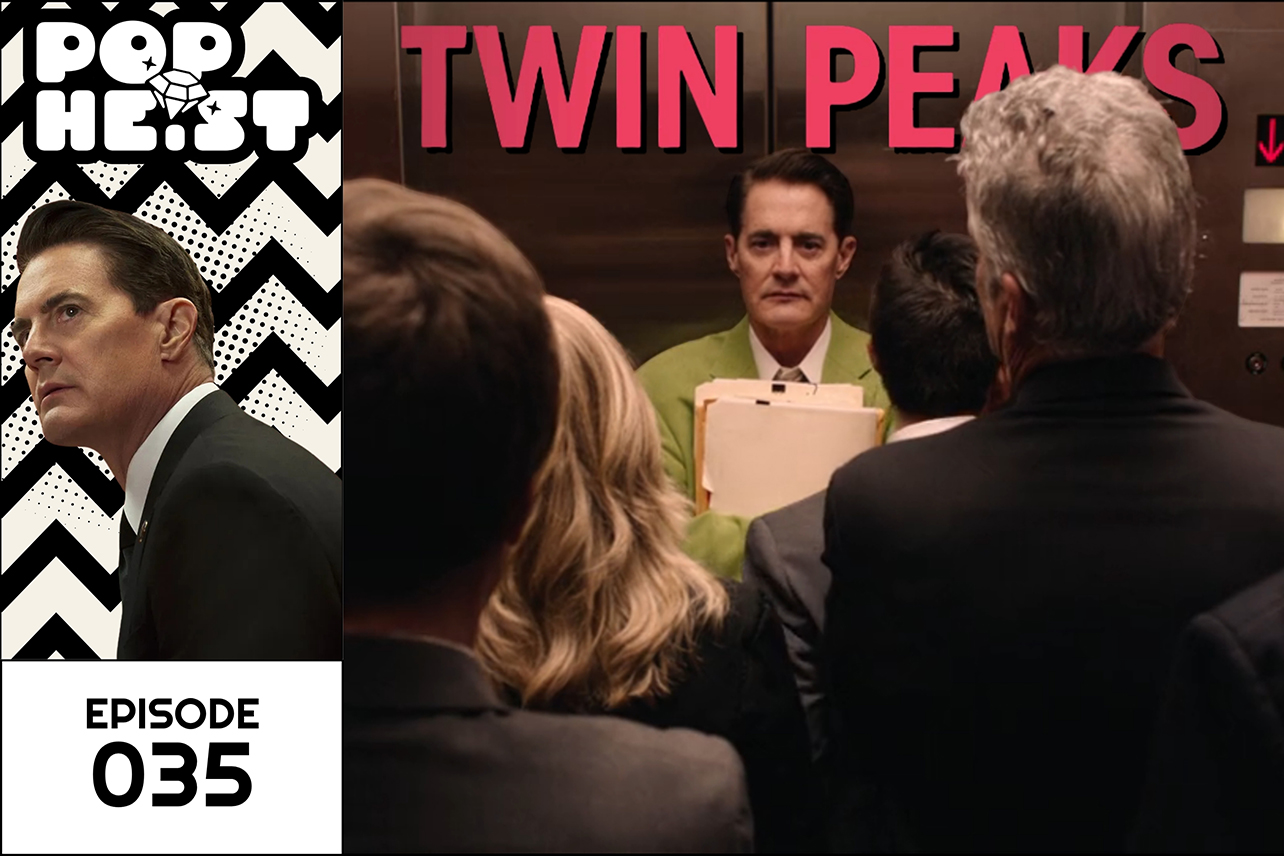


Twin Peaks Season 3, Episode 11: “Part 11”
Tagline: “There’s fire where you are going.”
World Premiere (San Diego Comic-Con): July 21, 2017
Original Airdate: July 23, 2017
Writers: Mark Frost & David Lynch
Director: David Lynch
Cast: Kyle MacLachlan, Mädchen Amick, Dana Ashbrook, Chrysta Bell, Jim Belushi, Brent Briscoe, Catherine Coulson, Giselle DaMier, Laura Dern, Miguel Ferrer, Robert Forster, Travis Frost, Balthazar Getty, James Grixoni, Michael Horse, Caleb Landry Jones, Laura Kenny, Robert Knepper, Jay Larson, Andrea Leal, Sheryl Lee, Matthew Lillard, Peggy Lipton, Sarah Jean Long, David Lynch, Don Murray, Priya Diane Niehaus, Charity Parenzini, Elias Parenzini, Linas Phillips, Linda Porter, Kimmy Robertson, Amanda Seyfried, Amy Shiels, Tom Sizemore, Harry Dean Stanton, Al Strobel, Jodee Thelen, Alicia Witt, Smokey Miles
Now this is a nice simple Twin Peaks episode. Just your basic, meat-and-potatoes storytelling about interdimensional vortices, murderous spectral woodsmen, mystery diseases, ancient symbols, and prophetic dreams about cherry pie. Easy peasy lemon squeezey!
In all seriousness, this is in many ways the most straightforward episode of Twin Peaks Season 3 to date. Sequences are largely self-contained rather than cross-cut, non-narrative surrealism and dream logic are kept to a minimum, and the continued sense that we’re getting somewhere across multiple storylines provides a natural gravitational pull, sucking us into the story — just like an interdimensional vortex.
The episode relies in large part on a concept for which J.R.R. Tolkien coined a term: eucatastrophe. This is the sudden, unexpected turn for the better that saves the heroic and the innocent at the last moment, from a vantage point completely unlooked-for. The Eagles intervening, Gollum seizing the Ring and falling into the Cracks of Doom, Sauron biting it just when his forces were poised to wipe out the good guys completely? That’s a eucatastrophe.
So is the survival of Miriam Sullvian. The friendly, poor schoolteacher who witnessed Richard Horne running over that kid somehow lived through Richard’s rampage, and made it out of her trailer before the gas explosion he set up to take her out. She crawls out of the woods and appears to a trio of boys playing catch — an homage to the infamous incident from Lynch’s own life, when he and his brother were approached by a disoriented, nude woman stumbling out of nowhere when they were out playing as kids. (This incident inspired a similar scene in Blue Velvet.)
Next we’re off to the Twin Peaks region, specifically the nearby town of Deer Meadow. An infuriated Becky Barnett lures her mother to the Fat Trout Trailer Park and steals her car so so she can go kill her no-good husband Steven at the apartment of his mistress. In the process she flings her terrified mother, who’s clinging to the hood of the car in a desperate attempt to stop her daughter, to the ground ass over teakettle, her shoes flying. It’s awful to see, in the same kind of way watching Richard Horne batter his own grandmother was awful.
The intended murder never takes place: Becky finds out that the illicit couple have already flown the coop, so she empties her clip into the empty apartment just to vent. Little does she know that Steven and the other woman, who turns out to be none other than Donna Hayward’s piano-playing kid sister Gersten (a returning Alicia Witt), are hiding out elsewhere in the apartment building.
When we return to this storyline a bit later in the episode, things have calmed down somewhat. With Carl’s help (he pulls out a whistle, blows it, and summons a VW van like he’s wielding the Ocarina of Time), Shelly has contacted her cop ex-husband, Bobby, for help managing the situation. The two sit their daughter down in the Double R and talk through her options, doing the best they can given Becky’s mercurial mindset regarding her much-loved, much-hated husband. It’s interesting to see how much Becky looks over to the nearby Norma Jennings for encouragement or approval; unsurprisingly, Norma seems to have taken on a grandmotherly role in Becky’s life, just as she’s half-mother, half–big sister to Shelly.
But some tunes never change, no matter who you’ve got looking out for you. The tender Briggs family moment is interrupted by a visit from Red, the strange drug dealer whose apparent magic powers helped spur Richard Horne to do the reckless driving that led to that boy’s death. We’ve already seen him and Shelly making eyes at each other in the Roadhouse; now she rushes outside and kisses him passionately on the street, the two of them smiling like teenagers as they make plans to meet later.
Bobby’s crestfallen face tells his whole story: He still loves this woman, but couldn’t make it work, and now he lives with his regrets. Meanwhile, Shelly remains very much captivated by dangerous men whose flaws she looks past: Leo, the old Bobby, now Red. It’s painful to see her replaying the same mistakes. It’s borderline infuriating, meanwhile, to watch Bobby fall back on the same old “if he touches you one more time I swear to God I’ll…” tough-guy bluster over his daughter. I’d hoped he’d matured more than that.
However much he’s progressed from the old Bobby, the chaos that erupts now would test anyone’s mettle. Gunshots suddenly ring out, shattering the Double R’s windows. Someone hits the lights and Bobby slinks out onto the street, gun drawn. In the middle of a horn-honking traffic snarl, an infuriated mother (Charity Parenzini) yells at her MAGA-coded husband (Linas Phillips) for leaving a loaded gun in the car, which she unthinkingly kicked to the back seat where her son (Elias Parenzini) could grab it and fire it at random.
In a peculiar moment, the kid stares Bobby down, as though the shooting were a deliberate act. When Bobby turns to look at the boy’s father, who’s dressed in nearly identical camo clothes, the man turns away in slow motion. Is the Lodge at work, or are we simply seeing Bobby’s realization that this kid will grow up to be a callous gun nut like his old man? Are the two forces one and the same?
Throughout all this, a nearby car has been honking incessantly. When Bobby approaches the vehicle, the driver (Laura Kenny), a smoker-voiced older woman, shouts semi-coherent statements about her plans for the evening being interrupted by the traffic jam.
“Her uncle is joining us!” she yells, one non sequitur after another. “She hasn’t seen him in a very long while!” She’s her mother’s sister’s girl, apparently. And doesn’t Bobby know she’s sick? “She” is a girl in the passenger seat, who lurches out of the darkness like The Stand’s patient zero to vomit green goop all over the mewling driver. Bobby’s left as baffled by this as we all are.
Just to review, a tender family reunion is triggered by Becky’s violent response to her abusive husband, which is kept from being a legal matter by her cop father, who lends her money because she has none. The reunion is interrupted by a child firing a weapon. The investigation into the gunshots is interrupted by another child who is desperately sick with an unidentified disease, in a car driven by a woman who is mentally ill. Do you feel how it’s everywhere in this season of Twin Peaks, whatever it is? Do you feel it in the air?
The air is very literally the right place to look if you’re Gordon Cole and his Blue Rose team. Gordon, Albert, Tammy, Diane, Detective Macklay, and witness/suspect Bill Hastings travel to the site where Bill and his mistress, librarian Ruth Davenport, allegedly entered “the Zone” and spoke with Major Garland Briggs, somehow. The site is a sunbaked no-place, a fenced-up ranch-style house long abandoned, surrounded by similarly decrepit buildings and vacant lots. It’s a place that just looks bad, the way the Palmer house looks bad, the way that one telephone pole looks bad.
It is bad, as it turns out. Gordon and Albert are the only members of the group to slip through the hole in the chainlink fence and approach the spot where Bill and Ruth entered what is obviously the Black Lodge; Diane refuses, Tammy stands watch, and Macklay and Hastings stay in the police car. Almost right away they see one of the woodsmen skulking around before he disappears into thin air. Gordon reaches the exact spot and sees a whirling vortex appear in the sky.
A black hole appears in its center, growing closer and closer, larger and larger, as Gordon reaches out to it. Behind the blackness, Gordon gets a brief glimpse of a trio of woodsmen, standing on an indoor staircase, looking down at him.
The contact leaves Gordon with a less intensive version of the left-arm paralysis that has affected several characters who have been drawn to the Lodge in the past.
Albert watches as Gordon glitches and his view of his boss goes migraine-blurry. Just before Gordon appears poised to be sucked into the Lodge himself, Albert intervenes, physically pulling him back from the brink. This is the kind of thing that makes Albert such a valuable character: Born a skeptic, cursed to work on the X-Files, he’s the kind of guy you need, the kind of guy who’ll say “Actually, let’s not step into the cursed interdimensional vortex.”
Albert and Gordon also find the headless corpse of Ruth Davenport, naked in the grass nearby. On her rigor-mortis’d forearm are written a series of numbers, coordinates that Diane memorizes. (It seems worth pointing out that Mark Frost and David Lynch could have put these numbers anywhere, but they chose to write them on a naked dead woman’s arm, an image freighted with dreadful import in the real world.)
Diane, meanwhile, continues her work as a double agent. She sits smoking a cigarette and says nothing as one of the woodsmen approaches Macklay and Hastings’s car.
It turns invisible and does its dirty work, somehow tearing Hastings’s head apart while invisible even to Macklay in the driver’s seat.
Needless to say, the incident leaves everyone shaken, though not so shaken that they can’t enjoy what Gordon calls “the policeman’s dream”: coffee, donuts, and in Diane’s case, a cigarette. “Smoke ’em if you got ’em,” Macklay shrugs wearily. They compare notes, and the woodsmen are pointedly compared to homeless men, with their rough-and-ready clothes and dirty appearance. Human beings who are considered detritus by society would be a natural cover for these dwellers on the threshold.
Back in Twin Peaks, Sheriff Frank and Deputy Sheriff Hawk are getting closer to “the Zone” in their own right. Hawk breaks out an ancient tribal map of the area, pointing out the location of Major Briggs’s burned military station as well as various symbols: a campfire for electricity, a force for good or evil depending on the intention behind its wielding; black corn, a symbol of death (garmonbozia?); the “black fire” that results from these symbols’ combination; an arrangement of stars that signals the same date, the day after tomorrow, as Major Briggs’s note.
There’s also that winged shape from the note and from Mr. C’s playing card, hovering in the sky beneath a crescent moon. (The owls are not what they seem.)
“Frank,” Hawk says, “you don’t ever wanna know about that.”
“Really?” replies the sheriff.
“Really.”
Huh.
Then the Log Lady calls. Frequently repeating herself, she somehow knows Hawk found the missing pieces she told him about. “There’s fire where you are going,” she says. “There’s fire where you are going.” (Note: A flicker of flame is superimposed over Gordon just before Albert rescues him from the vortex.)
This leaves us with the episode’s final storyline, which provides both the hour’s second eucatastrophe and almost all its comic relief. Bradley and Rodney Mitchum prepare for their big meeting with Douglas Jones, the thorn in their side they plan to remove permanently.
“Dougie,” meanwhile, is being feted by his boss Bushnell Mullins for cracking an entire organized crime ring operating through his insurance office. (Poor Anthony, the crooked agent, is left on the outside looking in when Dougie’s brought in for his big meeting.) Beyond the crime-fighting element, Bushnell is thrilled because the Mitchums’ unexpected $30 million payout triggers a secondary policy he purchased to cover just such a payout, meaning the firm comes out ahead in the end.
Won’t the Mitchums be thrilled to see Dougie when he arrives at their scheduled meeting carrying a thirty million dollar check? Surely they won’t just kill him before he has the basic human sense to hand them the envelope, right? Right? Right?
Here’s where I had to stop and reflect that Lynch and Frost had successfully sold me on the idea that FBI Special Agent Dale Cooper is in mortal danger from a character played by Jim Belushi. I mean it, they really had me going there! Anything can happen on this goddamn show!
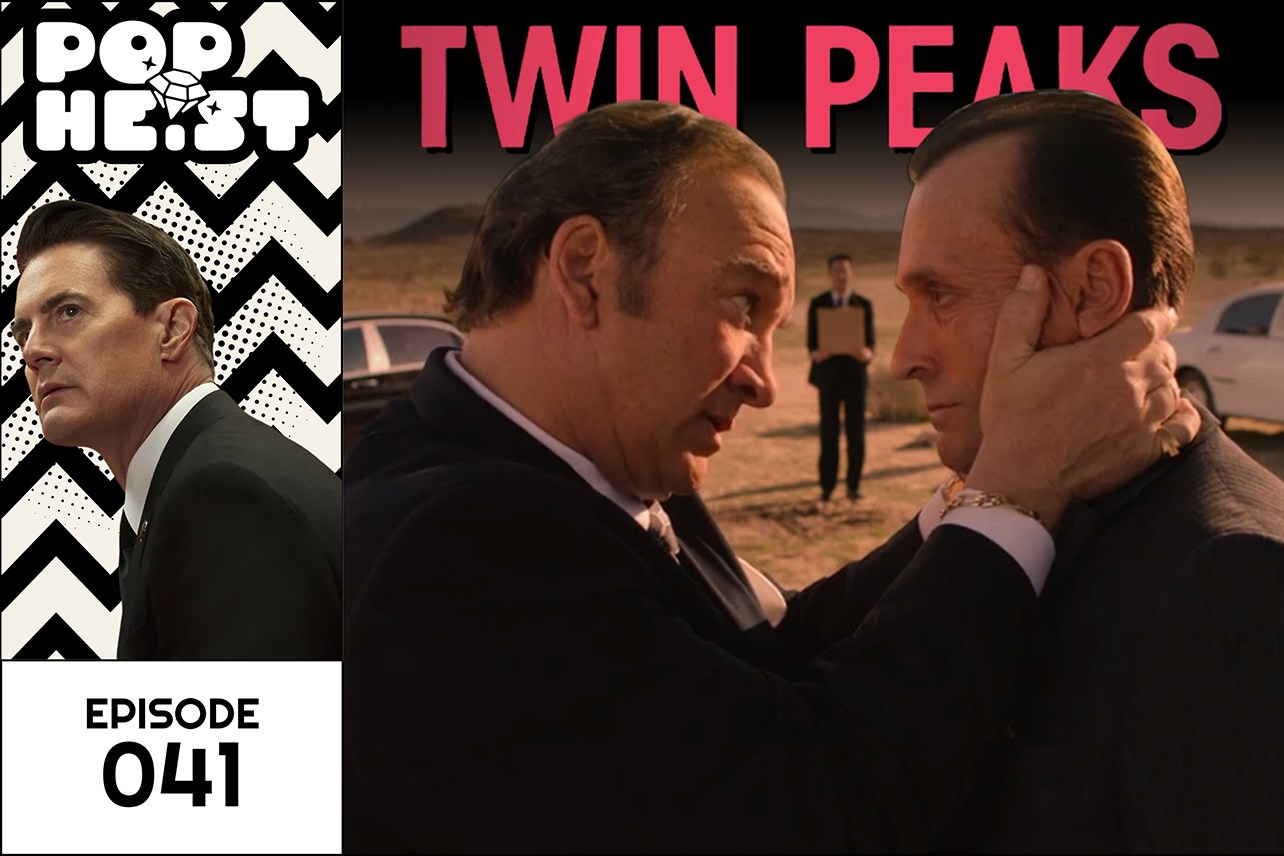
But Coop is spared death by Belushi, thanks to the intervention of the One-Armed Man. Appearing from the curtained, zig-zagged confines of the lodge once again, he summons Dougie over to a coffee shop and bakery before he gets in the limo that takes him out to the desert. (If you’ve seen Casino, you know the kinds of transactions that take place in the desert.) Whatever he gets there, he carries in a big cardboard box.
Here’s where Jim Belushi’s prophetic dreams affect the events of Twin Peaks. (What a sentence. What a show.) Bradley tells Rodney that he dreamed all night of this meeting with Dougie, but the details only come to him over time. He recalls that Rodney’s “Candie cut,” which he incurred when one of their three peculiar companions swatted a fly on his face with a TV remote, was healed in the dream ... and lo and behold, so it is in real life.
When Dougie shows up carrying a box, things get really freaky for Bradley. He says that Dougie carried something in the dream, and in the one-in-a-million chance that that thing is in that box, they can’t kill him, because he’s not their enemy after all.
What’s in the box? Cherry pie. “Damn good,” as both Rodney and (hooray!) Dougie go on to pronounce it when they eat it at a celebratory dinner after they leave the desert. Because Bradley doesn’t just discover the cherry pie of his dreams — he discovers the $30 million check, which is beyond his dreams. He and his brother whoop it up, then take Dougie to their favorite Italian place to toast to their newfound friendship.
Surrounded by the girls, who are as spacey as ever (Candie has been flummoxed by a bad traffic jam on the Strip; traffic jams everywhere you look), Dougie is also greeted by the old woman he helped hit the jackpot earlier in the season. Apparently, her winnings lifted her out of destitution, enabling her to buy a house, adopt a dog, and reconnect with her son.
“I hope you realize what a special person you have dining with you,” she says to the Mitchum Brothers, who sit beaming at the entire heartwarming interaction. “He saved my life.”
“Saved us a lot too,” says Bradley, his heart thoroughly melted.
The piano player (an uncredited Smokey Miles) plays us out as the credits roll.
It’s interesting how we never really see the seedy side of the Mitchum Brothers’ business. Okay, so we’ve seen them rough up Brett Gelman (can you blame them?) and threaten Dougie’s life. But even before the dream comes true, Bradley’s getting second thoughts on account of how Dougie brought down Ike the Spike, the mad dog killer they too were out to stop, albeit more lethally. Nor does their peculiar relationship with Candie, Mandie, and Sandie seem particularly sexual in nature; the exact contours are unclear, but it’s almost as if the Mitchums adopted a trio of female Dougie Joneses, and are just doing the best they can with them under the circumstances.
Contrast this with One-Eyed Jack’s, the remote Canadian casino operated by Ben Horne, Blackie O’Reilly, and Bernard Renault during the initial run. That place was always associated with the skin trade, specifically the trafficking of teenage girls. It was also part of the criminal empire of the Renault Brothers, genuine pieces of shit compared to the Mitchums.
I’ll put it this way: The gentle homage to the city we get when Dougie’s riding down the Strip in a limo to the tune of Shawn Colvin’s “Viva Las Vegas” cover (as heard at the end of The Big Lebowski!!!) is not the kind of thing Lynch and Frost would be interested in doing in One-Eyed Jack’s honor. But the Mitchums are sort of fantasy gangsters, basically decent guys in a rough business, the same way Coop and Gordon and Albert and Hawk and the Truman Brothers are fantasy lawmen, who’ve put on the badge for the right reasons and do the right thing with it.
Against this, the vortex of violence, poverty, and disease that seems to suck in everything eventually. Perhaps we’ve arrived, then, at this season’s central question: Will anyone do for us what Albert did for Gordon? Will anyone pull us back from the brink?