

Twin Peaks Season 3, Episode 8: “Part 8”
Tagline: “Gotta light?”
Original Airdate: June 25, 2017
Writers: Mark Frost & David Lynch
Director: David Lynch
Cast: Kyle MacLachlan, Leslie Berger, Robert Broski, Christian Calloway, Cullen Douglas, Erica Eynon, Tikaeni Faircrest, George Griffith, Tad Griffith, Sheryl Lee, Xolo Maridudeña, Joy Nash, Tracy Phillips, Frank Silva, JR Starr, Stewart Strauss, Caryl Strucken
Musical Guest: “The” Nine Inch Nails (Trent Reznor, Atticus Ross, Mariqueen Maandig Reznor, Robin Finck, Alesandro Cortini, Joey Castillo)
The script for the best television episode of all time was just 12 pages long.
When you see how easy it is to sum up, especially compared to the classically soap-operatic array of characters and storylines present in the previous few episodes, you can understand why. Structurally, Twin Peaks Season 3 Episode 8 — a monumental work of art, towering head and shoulders above anything else aired on television in 25 years that it — is a simple series of discreet episodes.
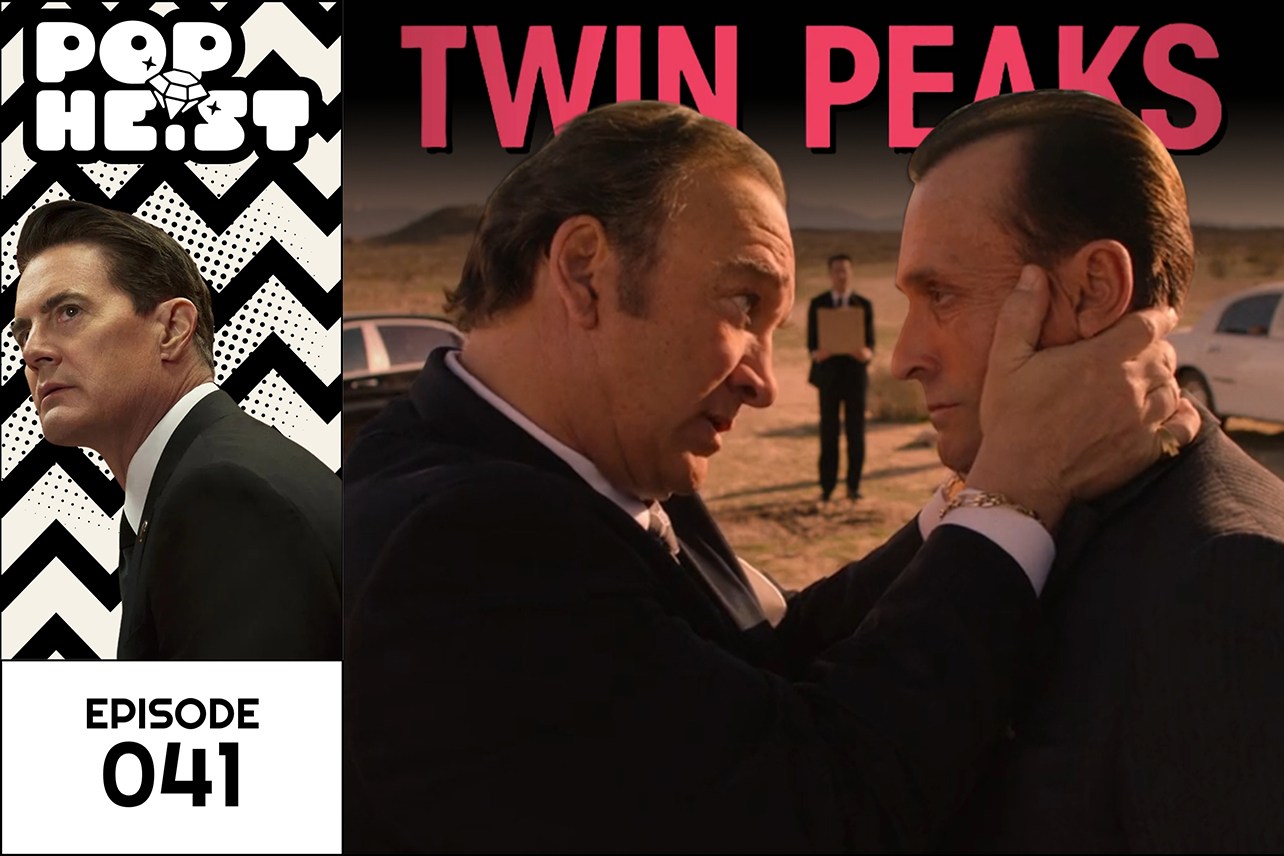
As brief as I can make it: Mr. C is betrayed and killed by his overambitious henchman Ray, then resurrected by the pitch-black Woodsmen of the Black Lodge. Ray flees in terror, but tells an associate he plans to take “Cooper” out once and for all if he comes after him.
The Roadhouse features a complete musical performance by “The” Nine Inch Nails.
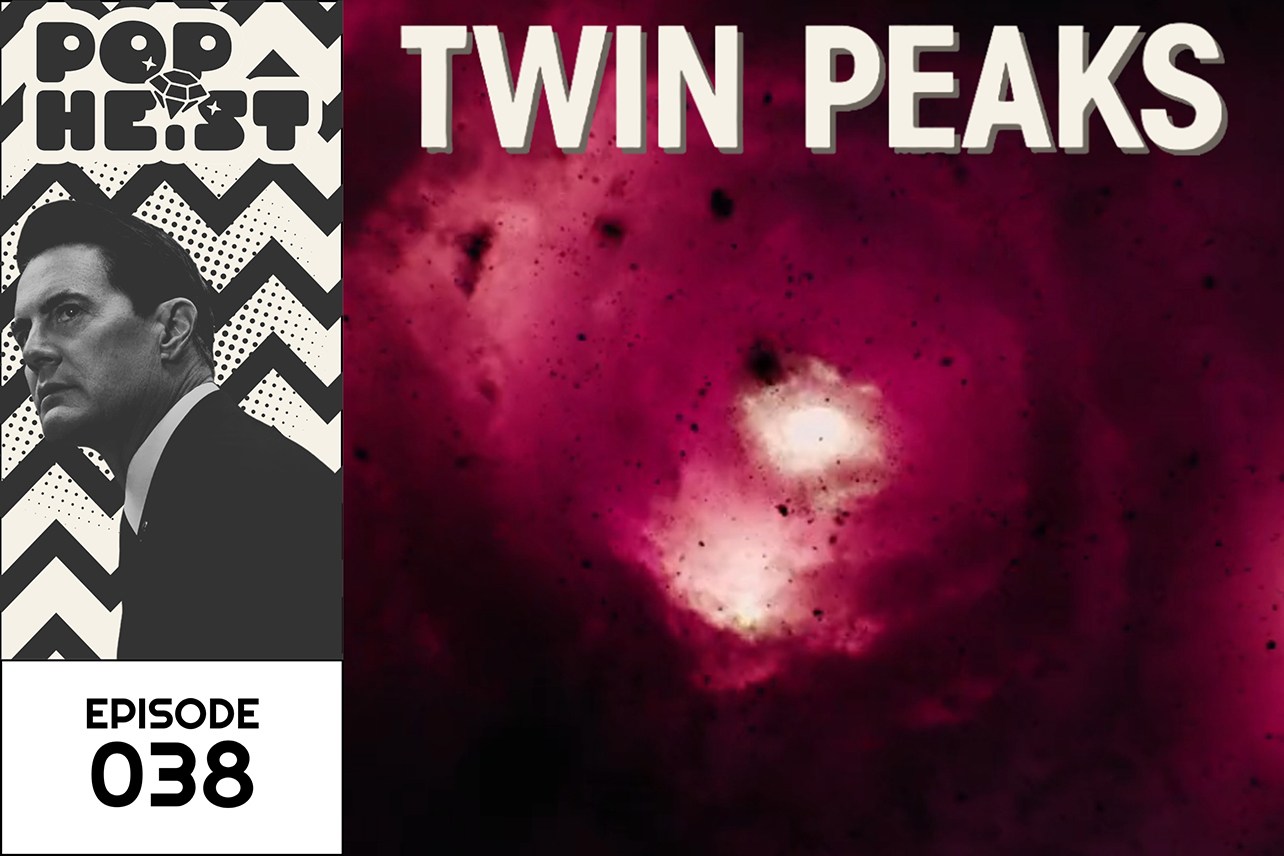
In 1945, America detonates the first atomic bomb. We view the explosion with psychedelic clarity and intensity.
The nuclear explosion appears to set the Woodsmen loose at the oft-mentioned convenience store where Lodge dwellers gather.
The explosion also allows the evil entity previously seen mutilating the young couple in that weird Manhattan viewing room to extrude a series of rock-like eggs and a sac-like orb containing the spirit of Bob into our world. The orb is now present within the evil Cooper.
Far away, in the middle of the vast purple ocean seen earlier in the season, the Giant and a woman named by the credits as Señorita Dido (Joy Nash) observe these events on a movie screen in a huge metallic castle on a craggy island, presumably the White Lodge.
Seeing that Bob has been unleashed, the Giant floats into the air. Gold dust pours out of his head, swirling and cohering into a golden ball containing the spirit of Laura Palmer. Señorita Dido kisses it goodbye and sends it soaring into a huge clockwork machine at the top of the theater, which sends the ball to Earth.
In 1959, as a pair of young teenagers walk home from a date, more Woodsmen (Christian Calloway, Stewart Strauss, likely others) descend into the desert, menacing motorists. The tallest and gauntest of these (Robert Broski), who holds an unlit cigarette and repeatedly asks “Gotta light?” in a gravelly voice, breaks into a radio station and kills the employees by crushing their skulls with one pitch-black hand. He takes over the airwaves and repeats an incantation:
This is the water, and this is the well.
Drink full and descend.
The horse is the white of the eyes,
And dark within.
The incantation puts everyone who listens to it to sleep, including the teenage girl (Tikaeni Faircrest), who’s all dreamy-eyed about her boy (Xolo Maridueña). When she passes out, a large, grotesque frog-moth hybrid that has hatched from one of the rock-eggs slithers through her window and crawls into her open mouth, which closes behind it.
The Woodsman leaves the radio station and walks off into the darkness. In the distance, a horse can be heard.
The girl sleeps as the credits roll.
The end.
That’s what we watched. What we saw beggars description.
Under any other circumstances heaping superlatives on an episode of television like I’m about to do would be overdoing it. With “Part 8,” I don’t know if I’ll even hit the floor of where those superlatives should be. This is a masterpiece, one of one, unparalleled on television before or since. David Lynch and Mark Frost constructed a cathedral for Hell.
As horror, this is absolute S-tier Lynch, as unrelentingly frightening, eerie, and awful as anything in Lost Highway or Mulholland Drive. We’ve seen the Woodsmen in frightening glimpses back at the Buckhorn police station, and in less sooty form at the Black Lodge’s meeting in Fire Walk With Me. (Though there was that soot-encrusted woman who mutely peered in on Carl Rodd and Agent Chester Desmond…) Seen now in their final form, they are incredible monster creations. One look is all it takes to know you do not want to see them, talk to them, come into physical contact with them. It’s best not to know they exist.
Cosmologically, they appear to function as the Black Lodge’s lower-order demons, semi-mindless drones that perform their assigned tasks and vanish. They lack the distinct looks and personalities of the other Lodge denizens we’ve met: Bob, the Man from Another Place/the Arm, Mrs. Tremond and her grandson, the Jumping Man, Cooper’s doppelganger. They function like an airborne toxin, blown on the atomic winds into our world to make it sicker.
The way they flicker in and out of view as they caper around the corpse of Mister Cooper, smearing him with his own blood as if performing some arcane and obscene ritual, is perfectly reflected in Ray’s troublingly muffled and distorted screams. Even before they extract the Bob-blob from his chest, we know we’re seeing something no human is meant to; the audio effect used on Ray gives that dreamlike, running-through-molasses sensation that there’s now no escape.
We hear that horrid muffled cry of terror again later, from the wife (Leslie Berger) of a motorist (Tad Griffith) who is stopped on the road by the advancing Woodsmen. Even though she’s in no immediate physical danger, she recoils from the Woodsmen as though afraid of a fate worse than death.
The onslaught of the primary Woodsman at the radio station is a miniature 1950s horror movie, with 2010s gore as only David Lynch would film it. The station itself and its beautiful receptionist (Tracy Phillips) are straight out of an Edward Hopper painting. Picture-perfect 1950s people listen to its broadcast of the Platters’ gorgeous “My Prayer” in era-appropriate settings: a mechanic’s garage, a diner, a smitten teen’s bedroom.
In strides this thing in human form, his skin blackened as if by atomic fire, pointedly asking “Gotta light?” as if humanity hadn’t just lit the brightest light of all. He (I initially wrote “It,” and maybe that’s better) kills the receptionist and the DJ (Cullen Douglas) with furious power and alarming ease, blood cascading from their pulped skulls down their faces or to the floor. His sepulchral voice sears his poem into our memories, as Al Strobel did way back when Mike first uttered “Fire walk with me.”
What does the poem mean? This is the water, and this is the well. Keep in mind that the Woodsman is busy killing the DJ as he recites the poem. The water is blood, pain, fear, sadness. The well is humankind.
Drink full and descend. The listeners drink the waters of the River Lethe and descend into oblivious sleep — a slumber deep enough for an insectoid entity to invade the body of a teenage girl through her mouth, presumably the purpose of the entire exercise. The rape symbolism is barely even symbolism. The Lodge has a way of doing things, it seems.
The horse is the white of the eyes, and dark within. A pale horse, a biblical harbinger of death, appeared to Sarah Palmer when Laura Palmer and Maddie Ferguson were murdered, and later was seen in the distance by Dale inside the Lodge. Presumably, it was that horse whinnying unseen out in the desert. It’s white, alright, and it brings nothing but darkness.
The poem is what makes the frog-moth’s awful invasion of the girl’s mouth possible.
Lynch and his team have to be commended for using CGI to create something just as unpleasant as the Eraserhead baby, the secrets of which Lynch took to his grave. This thing is just awful to look at, and when you see where things are headed, the scene becomes truly difficult to watch. This was the night of her first kiss, and now…
The deepest, most profound horror, however, is Lynch and Frost’s palable terror of the bomb. Simply put, this episode posits that America’s act of atomic destruction loosed literal demons upon the world. It is the root of all the evil we’ve witnessed, all series long. It’s the unforgivable sin, a crime against spacetime itself, a rape of the cosmos, the conversion of the fabric of the universe into a weapon. In that sense, the episode’s single most menacing image is the following text, superimposed over the desert:
The Lodge has been repeatedly linked to outer space, where nuclear reactions spontaneously occur in the stars; it’s also so deeply linked to fire that they named a movie after it. Presumably, it was our hubris in attempting to harness the great fire that brought the Lodge running. It’s the bomb we have to thank for Bob, for that thing in the girl’s mouth, for the entity the credits call the Experiment (Erica Eynon), for god knows what other horrors hatched out of all the blobs and eggs it puked out.
Obviously, we must consider the fact that Hawk’s people knew about the Lodge well enough to have etched petroglyphs of the Giant and the Arm into Owl Cave centuries before 1945. But the Black Lodge demons move backwards as a rule, right? The Woodsmen glitch in and out, backwards and forwards. And there’s the recent mystery of Laura’s preternaturally prescient diary pages to factor in as well. It’s not hard to imagine that, as in the writer Grant Morrison’s DC Comics epic Final Crisis, a crime on a cosmic scale could have repercussions through time in either direction.
But putting aside the Trinity test’s supernatural implications within the Twin Peaks mythos, one need look no further than the soundtrack to see what Frost and Lynch think of Robert Oppenheimer’s apotheosis. It’s “Threnody for the Victims of Hiroshima,” composer Krzysztov Penderecki’s incendiary piece commemorating one of the worst crimes in human history — a crime that augured an age in which humanity has the power to kill itself, and the world entire. It begins the moment that first flash-bang of light erupts. There is no disconnecting this initial test from the horrors that would come from it.
Then there’s the filmmaking, the images themselves, the way Lynch portrays the explosion. The mushroom cloud, seen in black and white as is most of the episode, radiates infernal majesty as we slowly move toward it, then inside the cloud. Then Lynch becomes half Stanley Kubrick, half Stan Brakhage, representing nuclear fire and the movement of subatomic particles with straight-up experimental filmmaking that gives way to Douglas Trumbull “Jupiter and Beyond the Infinite” spectacles of cosmic color, then right back again to the manic movement of tiny white dots in a void, then gouts of hellfire, then waves of white across black…
It goes on and on, minute after minute, broken up only by the equally experimental portrayal of the Woodsmen’s arrival at the convenience store.
Some of this would be at home among Lynch’s short films. Some of it is simply the most visually spectacular work of his career.
Against the Experiment and the Woodsmen and Bob and the Doppelganger and the frog-moth and humanity’s nuclear bloodlust itself, we have the silent residents of the White Lodge. This ornate movie palace of the mind has a mournful air, as if its residents’ power is primarily to watch, to bear witness, to guide, to aid, rather than to intervene with force.
While Dido is all but glowing with optimism, the Giant looks aged and sad. (His costume has been combined with that of the elderly room service waiter who was his human incarnation for a time.) This is so often the way with white wizards, from the passivity of Christ to the elderly incarnations of Tolkien’s Istari. Goodness cannot fight fire with fire. There’s a sadness to this, reflected in Major Briggs’s fear of “the possibility that love is not enough.”
Does this make Laura Palmer, conjured up by the Giant and sent to our world by Señorita Dido, a Christ figure now? Rather than just the girl unlucky enough to share a house with Bob, she now appears predestined to have come into conflict with the Black Lodge. Indeed, that appears to be the reason she exists. Did it go the way the White Lodge wanted it to? Or do the aged Laura who disappeared from the Lodge and the Dale Cooper currently trapped inside his own brain (and the life of Dougie Jones) still have parts to play in the fight against this evil?
There’s also a Nine Inch Nails performance, and Trent Reznor has never looked cooler.
Why is he there? Because David Lynch liked Trent Reznor, whom he encouraged to write something truly punishing for their performance. “She’s Gone Away,” written about Laura Palmer, was the result. I can’t feign detachment here: Nine Inch Nails is my favorite band, and they’re the musical guest on the greatest episode of television of all time. That rules.
There’s no overstating things here. As horror, as science fiction, as spectacle, as avant-garde art, as a plunge directly into Twin Peaks’ heart of darkness, as television, as cinema, this is as good as it gets, as good as it’s ever gotten. Paradoxically, it’s the bizarre specificity of Lynch’s nightmares — nuclear fire, Nine Inch Nails, a Woodsman asking for a light — that makes them so universally resonant. It is a terrible thrill to enter the dreams of another person, however dark those dreams may be.