

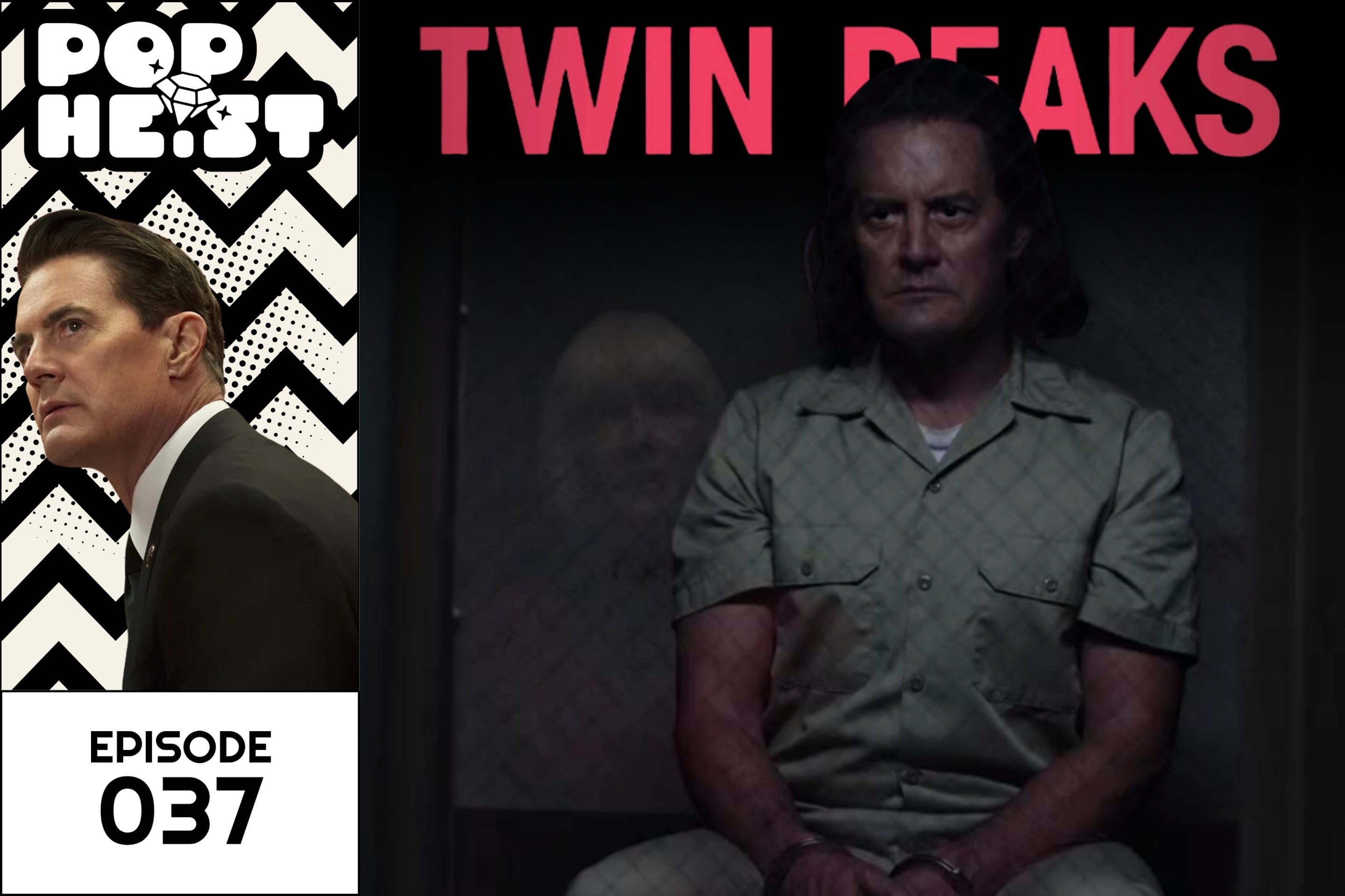
Twin Peaks Season 3, Episode 7: “Part 7”
Tagline: “There’s a body all right.”
Original Airdate: June 18, 2017
Writers: Mark Frost & David Lynch
Director: David Lynch
Cast: Kyle MacLachlan, Jane Adams, Mädchen Amick, Chrysta Bell, Richard Beymer, Brent Briscoe, Larry Clarke, Laura Dern, Hugh Dillon, Edward ‘Ted’ Dowling, Eric Edelstein, Miguel Ferrer, Robert Forster, Warren Frost, Ivy George, Ashley Judd, David Patrick Kelly, David Koechner, Sheryl Lee, Peggy Lipton, David Lynch, Riley Lynch, James Morrison, Don Muray, Walter Olkewitcz, Adele René, Elena Satine, Tom Sizemore, Naomi Watts, Christophe Zajac-Denek
Twin Peaks has never been in the question-answering business. This was its whole deal, as far as Mark Frost and David Lynch were concerned: It was a murder mystery that would never be solved. The universe, and Bob Iger, had other plans, but that doesn’t change the fundamentally subversive nature of this exercise in genre storytelling. Just in case this point eluded you, the filmmakers hammered it home in the Season 2 (and erstwhile series) finale, in Fire Walk With Me, and in every episode of Season 3 to date. This isn’t some mystery-box bait-and-switch exercise, promising Answers only to replace them with additional Questions until the whole thing runs off the rails. The mystery is the point.
So when an episode like this one comes along, an episode that at the very least hints at Answering half a dozen long-outstanding Questions in one go, it’s worth savoring. Twin Peaks may only play a mystery on TV, so to speak, but its mysteries are endlessly engrossing, and receiving any kind of concrete information about any of them is nearly as thrilling for us as discovering the petroglyphs in Owl Cave was for the good Dale Cooper. When you’re exploring a place both wonderful and strange, a few clear trail markers never hurt anyone.
I mean, for god’s sake, they found the missing pages of Laura Palmer’s diary.
Three out of four of them, anyway. The papers Deputy Chief Hawk recovered from the busted stall door in the Twin Peaks Sheriff’s Department are none other than the pages Laura discovered had been torn from the diary — stashed in the stall, Hawk theorizes to Sheriff Frank, when Leland Palmer was brought in for questioning about the murder of Jacques Renault and was desperate to hide them in case he was frisked.
They’ve never listened to my cries and I never wanted them to anyway. But there is this — This came to me in a dream last night….
“My name is Annie. I’ve been with Dale and Laura (me??!!!). The good Dale is in the lodge and he can’t leave. Write it in your diary.”
That’s what she said to me.
On another of the pages, she writes:
The moon has been high in the sky for hours now I can’t sleep!
It’s 1:30 A.M. I’m crying so hard I can hardly breath. NOW I KNOW IT ISN’T BOB. I KNOW WHO IT IS.
There’s a timeline anomaly here. In Fire Walk With Me, Laura discovers that Bob has torn out pages from her secret diary and gives it to Harold Smith for safekeeping. Only after that does she receive Annie’s dream-message and discover that Bob is her father, Leland. Even if Hawk’s conjecture about how and when the pages were hidden is wrong, it doesn’t explain how the information came to be in Laura’s secret diary in the first place.
Of course, a lot comes to people in dreams that they subsequently discount or forget entirely, as Dale “I know who killed Laura Palmer” Cooper knows better than anyone. This goes double if the place they’ve written it down has been hidden away. We don’t know that FWWM showed Annie’s only visit, or Laura’s only realization of Bob’s alter ego. We do know that either way, Laura was told about Dale being trapped in the Lodge by Annie long before either person showed up in Twin Peaks, by which point she was dead. Spacetime zigzags around here.
Whatever the pages’ provenance, they tip Hawk and Frank off to what we know to be the truth: Special Agent Dale Cooper never made it out of the Black Lodge, but something did. The spark of hope Annie’s visitation provided in FWWM has been fanned into a five-alarm fire, though the fourth and final missing page is still out there.
And what of the “not the good Cooper” who emerged from the Lodge, with Bob riding shotgun? After his brother Harry proves too ill from cancer treatments to speak with — this is not the last time cancer will come up — Frank skypes with Doc Hayward (an ailing but very funny Warren Frost, who returned to acting from a two-decade retirement to play the role remotely).
Doc appears to have retired to a fishing cabin on the river, and he’s markedly older, but he says he’ll never forget Cooper’s odd behavior before he vanished the morning after he emerged from the Lodge.
That’s when Doc drops another bombshell: He believes “Cooper” visited Audrey Horne, who was alive but comatose following the explosion at the bank in the Season 2 finale, in intensive care prior to his disappearance. This means that Audrey survived, at least for a while…and it hints at an extremely grim origin for the child-killing creep Richard Horne.
Richard, it seems, is keeping busy covering his tracks. We don’t see his sneering face this episode, but the owner of the truck Richard apparently borrowed when he ran that poor kid over goes missing before an arranged meeting with Deputy Andy, who agrees to reconvene at a remote location when the owner (Edward ‘Ted’ Dowling) is too afraid to talk to a cop out in the open about it. Justifiably so: A shot of his run-down house’s door hanging ajar is all we need to infer that Richard has silenced him permanently. (Strikingly, Angelo Badalamenti’s “Laura Palmer’s Theme” plays during the scene.)
As for the evil Cooper, we receive further confirmation, if we needed any, that he’s not who he says he is. For one thing, Agent Preston discovers that one of his fingerprints is backwards; Gordon Cole’s unusual analysis is that it’s the finger that corresponds to both the spirit and to the backwards word in the Doppelcoop’s greeting, “It’s yrev very good to see you again, old friend.”
Even more importantly, Diane, the Diane, says he’s not who he says he is. She herself is not who we pictured, either — the dutiful gal friday. “Tough cookie,” Gordon says at one point after weathering a barrage of f-bombs. “Always was.” It’s the last thing I expected, as is the fact that she appears to be very wealthy; her place in Manhattan must cost a fortune. (“Mr. C” was also rich prior to his arrest, living like a king in Rio at one point in the recent past according to his only known post-disappearance photograph.)
But I get the impression that she’s a different person than she was even in her younger “tough cookie” days, due to an incident involving the doppelganger. When Gordon and Albert finally convince her to travel with them to the federal prison in South Dakota where “Cooper” is being held, she makes it clear that prison is exactly where she feels he belongs. When she has her meeting with him, one on one through the prison glass, both she and the horrid thing on the other side imply that he raped her the last time they saw each other.
“At your house,” he growls when she asks if he remembers where he last saw her — a no doubt intentional quote of the Mystery Man scene, one of Lynch’s scariest and most famous pieces of filmmaking, from Lost Highway. (There’s a world in which the entities that bedevil the protagonists of Twin Peaks, Lost Highway, Mulholland Drive, and Inland Empire all hail from the same place, if you ask me.)
“That’s right,” she says. “Do you remember that night?”
“I’ll always remember that night.” He still has that horrible slowed-down tape-recording sound.
“Same for me. I’ll never forget it.”
Now she presses him. “Who are you?” This, too, is an echo: It’s what Laura Palmer demanded to know the night she uncovered Bob’s identity.
“I don’t know what you mean, Diane.”
“Look at me,” she demands. “Look at me!” When he does, she looks back, and finally flees
Outside the prison, Diane barely keeps it together as she informs Gordon that the man in the prison is not the man she knew, in a way that has more to do with some fundamental lack inside than any of the changes time might have wrought. To Cole’s surprise, she collapses into a hug with him outside the prison afterwards. He’s so taken aback he hover-hands the poor woman, or at least that’s the only explanation I can think of for his awkwardness. (Gordon Cole does not seem like the kind of fella who hover-hands beautiful women under any circumstances.) She won’t say anything further about that night at her house for now, but as with Audrey the conclusion to be drawn is horribly clear.
Meanwhile, the case of the original run’s other major white knight unfolds in an unexpected direction. Air Force Lieutenant Cynthia Knox arrives in Buckhorn, where she discovers that the murder investigation underway there uncovered more than just Garland Briggs’s prints at the scene, but Garland Briggs’s entire dead body. Well, not quite entire: His head is missing. What’s even more bizarre is that it’s the corpse of a man the age Garland was when he disappeared 25 years earlier, even though the autopsy suggests he hadn’t been dead for more than a few days.
Lt. Knox is not the only person, or “person,” interested in the case. While she fills in her boss, Colonel Davis, on the phone, a soot-covered woodsman emerges at the end of the hall, slowly walking toward her as the sound of electricity begins to hum and sizzle. She sees the man approaching and seems to think of him as just some mildly unpleasant individual in a police station, and it’s not like he attacks her, but good Lord is it disconcerting when he walks past the doorway as she confers with forensic examiner Constance Talbot and Detective Dave Macklay about the case in the morgue. Lynch is so good at making it clear when a person, or “person,” is fundamentally wrong.
Speaking of which, Mr. C is not done with us after Diane’s visit. Led back to his cell, he tells a guard to tell Warden Murphy he wants to talk about “a strawberry.” The deceased “Mr. Strawberry” is so threatening a name to the warden that he pulls a gun on the Coopelganger when they’re left alone, only for Mr. C to reveal that the dog leg found in his trunk is (naturally) just one of four; the other three have been sent to some bad hombres who will know to come after Murphy should Mr. C die in prison.
This is another anomaly. Mr. C only wound up in this guy’s prison because his car crashed, at which point the dog — Mr. Strawberry??? — had already been dismembered and the information about the warden somehow collected and distributed. Coincidence or clairvoyance? A zig of one, a zag of the other?
Whatever the case, Murphy knows he’s been beaten. He dutifully sets Mr. C free along with his accomplice, Ray Monroe. They’re given a shitty rental car…with a gun in the glove compartment. It’s probably not a coincidence that Mr. C calls shotgun.
The real Cooper is still stuck living the life of Dougie Jones in his own bumbling fashion, and that life keeps getting funnier and funnier. Dougie’s crooked coworker Anthony has himself convinced he’s being given the silent treatment because Dougie and their boss Bushnell are investigating him. Three detectives all named Fusco (Eric Edelstein, Larry Clark, and, amazingly, Anchorman’s David Koechner) show up to interrogate him about his missing car, which has now been involved in an explosion with multiple fatalities, only to be sent packing by the ferocious Janey-E Jones while issuing respectful apologies. Bushnell even puts off discussing Dougie’s “findings” so the overstressed couple can get home.
Then something bizarre even by Dougie Jones standards take place. As he and Janey E leave, Ike the Spike shows up with a gun to assassinate him in broad daylight. Suddenly, the Coop within Dougie springs into action. He grabs the killer’s hand, diverting the shot, then holds his hand in a death grip while leveling chops at his throat. (Janey-E contributes to the attack, of course.)
Then the Evolution of the Arm appears to Coop. “Squeeze his hand off!” it screams repeatedly. Dougie presses the Spike’s palm so hard against the butt of his gun that the flesh tears off when he pulls his hand away, leaving the forensic examiners who clean up the scene while stunned onlookers give their stories to the press with plenty of evidence to ID the attacker. Lynch’s unusual filming and framing for the news interviews lends a stark strangeness to its wide-eyed witnesses marveling at how the attack was thwarted.
“He smelled funny,” one little girl says of the Spike. “Douglas Jones…he moved like a cobra,” says a witness. None of these people are strangers to how this kind of incident works — these sudden eruptions of violence that are woven into the fabric of American life now.
There’s just a sense throughout this episode that something is in the air, something weird, and sometimes worse than weird. Jerry Horne calls his brother Ben alone and terrified in the woods, not knowing how he got there; granted, this is because he’s calamitously stoned, but still. Gordon whistles to himself to test his hearing aid, in front of the gigantic mural of the Trinity atomic bomb explosion that serves as his office decor. (He also has a picture of corn, which given what we know of the Black Lodge’s diet is an interesting choice all its own.)
Ben Horne and his assistant Beverly Paige gently flirt as they try to track down the source of a melodious high-pitched hum in her office; the sound is pretty, but nothing in that room is supposed to be making it. Wood doesn’t make noise. Neither do mysteriously returned room keys belonging to the agent who got shot investigating the murder of Laura Palmer.
“Who’s Laura Palmer?” Beverly asks.
“Oh,” Ben says, feeling god knows what emotions. “That, my dear, is a long story.”
When Beverly returns home to her husband Tom (Hugh Dillon), he’s suspicious and embittered over her late hours without him; she’s explosively angry and embittered over his resentment of her taking a job she never wanted in the first place so they can pay for his treatments. “Beat this thing,” Frank tells his own cancer-stricken brother Harry over the phone; we never hear Harry’s voice at all.
In addition to the ominous soundscapes of Dean Hurley and the familiar synth-score of Angelo Badalamenti, even David Lynch’s beloved mid-century pop music gets in on the act. Booker T. & the M.G.’s immortally cool rock instrumental “Green Onions” plays almost in its entirety over an unbroken shot of a worker sweeping up the floor at the Roadhouse; it’s slow cinema at its most entertainingly dull, until Jean-Michel Renault reveals that his family, which has been running the place for nearly 60 years, is still trafficking teenage girls there.
Santo & Johnny’s equally iconic instrumental “Sleep Walk” plays over a scene at the Double R, where Shelly and Heidi serve customers as Norma does the bills. Suddenly the door bursts open, and a man (Riley Lynch) yells “Has anybody seen Billy?” No one has. The frantic man leaves, and the song plays on. Ghostbusters did this as a gag at Tavern on the Green; Stephen King did it as a primary characteristic of the town of Derry and its people in It. As Laura put it, “They’ve never listened to my cries.” We sleepwalk past others’ unhappiness to preserve our own, for however much longer we can.


