

Street Fighter
Writers: T.J. Fixman, Kitao Sakurai (screenplay); Dalan Musson, Gary Dauberman (story)
Director: Kitao Sakurai
Cast: Noah Centineo, Andrew Koji, Callina Liang, Joe "Roman Reigns" Anoa'i, David Dastmalchian, Cody Rhodes, Eric André, Andrew Schulz, Vidyut Jammwal, Orville Peck, Don Lee, Curtis "50 Cent" Jackson, Jason Momoa
To the credit of Kitao Sakurai’s Street Fighter, an action film derived from a classic tournament fighting game franchise, the story indeed comes to involve said tournament, unlike Simon McQuoid’s 2021 Mortal Kombat reboot, another action film derived from a classic tournament fighting game franchise, which notably doesn’t build to involve said tournament. After around an hour of Street Fighter’s expositional and backstory heavy narrative, there we are: arrived at the second World Warrior tournament, an ostensible celebration of the greatest martial combatants across the globe, except the entire thing is a ruse designed by the heavy to acquire an unreasonable amount of power.
So in the end, the tournament doesn’t exactly matter, because the whole shebang is B.S. anyways. And besides that, several rounds — the ones we see on screen, anyways — end with forfeitures. But there is a tournament! Even fake-out fighting tournaments count in the 2020s canon of fighting tournaments! We’ll take it. Were the film itself better than it is, we’d be cheering, too. Street Fighter is neither a disaster (as certain reviews have put it) nor a triumph (as certain other reviews have put it), but rather a disappointment in that what works here works well, and what doesn’t clouds up everything else.
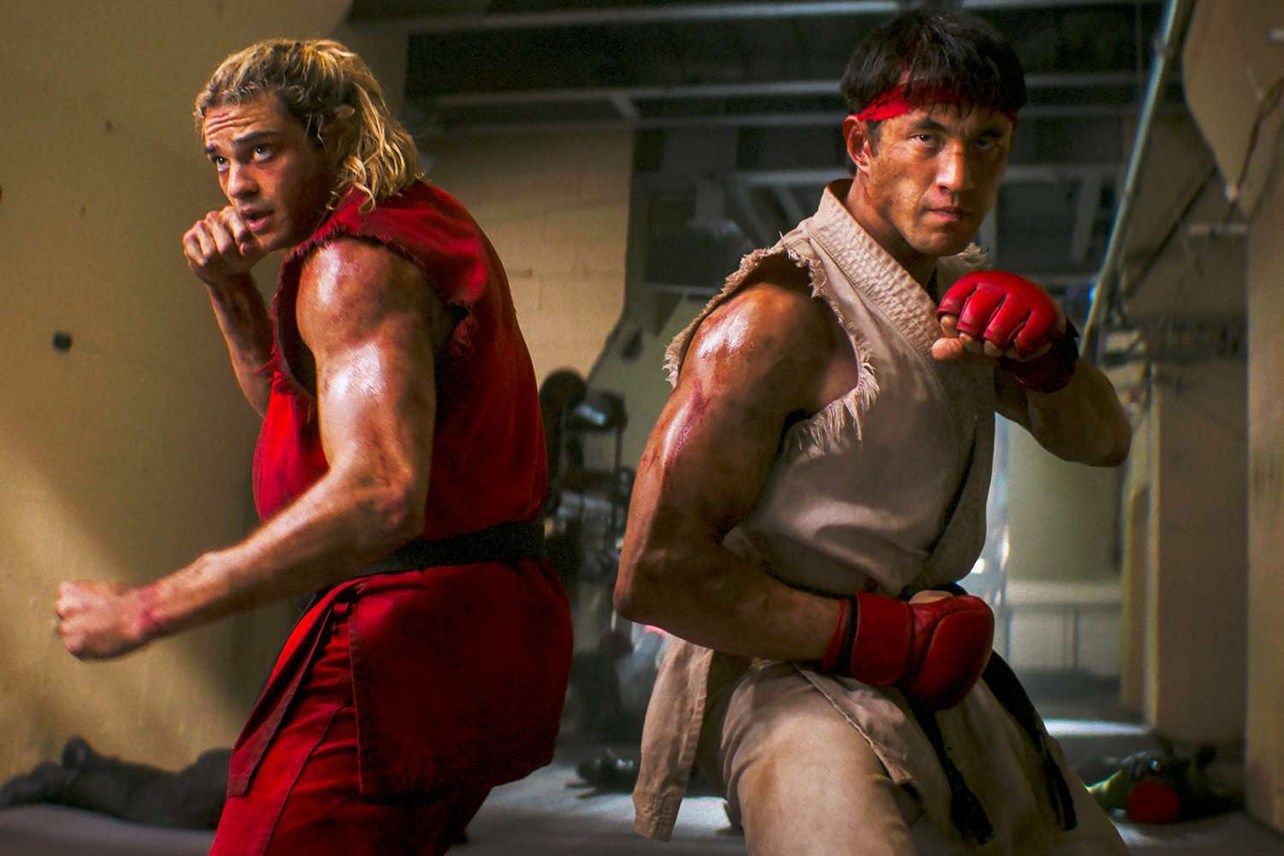
Sakurai packs a lot of origins and past-tense plotting into his and T.J. Fixman’s script, including an animated introduction in media res during the deciding round of the first World Warrior tournament: Street Fighter’s classic protagonist, Ryu (Andrew Koji), is locked in a brawl with Sagat, one of the games’ classic villains-cum-antiheroes; the latter is beating the former just about senseless, until Ryu taps into dark martial power against his master Gouken’s wishes (voiced by Don Lee) and turns the fight around in brutal fashion. In the bout’s aftermath, Akouma (Jason “Roman Reigns” Anoa’i), an evil martial artist and Gouken’s brother, shows up and kills Gouken, his goal being to piss off Ryu enough to unleash that dark power again. What Akouma achieves instead is a disunion of Ryu and his adoptive brother, Ken Masters (Noah Centineo), and Sakurai takes us to the present day from there.
“Present day” in Street Fighter ‘26 is 1993, which is fine, because Sakurai is mimicking a very 1990s style here: tongue in cheek, flashy, and focused on an expansive cast and not a single musclebound hero capable of felling armies on their own. There are, of course, a few other flourishes to root the film in its era, a’la retro MTV-adjacent aesthetics and the hyper-sexualization of its female characters; the last of these is coupled with a decidedly contemporary perspective in that those characters kick more ass combined than most of the remaining cast. In the case of Chun-Li (Callina Liang), the plot relies on her participation as a double agent ostensibly working for the authoritarian not-so-strong man M. Bison (David Dastmalchian), but in actuality an Interpol officer bent on taking him down. (We learn, again in an animated flashback, that Bison murdered Chun-Li’s dad in her childhood, so it’s as much about a personal vendetta as the common good.)
Sakurai brings all of these threads together via a new World Warrior tournament, which Bison hosts with the purpose of luring Ryu out of hiding; his plan is to capture the fallen champion, drain his power, and siphon it into himself with mad science. Naturally, Ryu takes the bait, setting him on a collision course with Ken — who harbors a grudge against Ryu for Gouken’s death — as well as with destiny. It’s a bit much in terms of “stuff,” when less would have served viewers far more. As Chun-Li, Liang cuts a compelling vengeful figure who can’t stomach the yellow fever white men in her orbit are stricken by; and as Ken, Centineo does surprisingly well wrestling with his grief, his rage at Ryu’s perceived abandonment, and even his sense of being an outsider in a world where he’s always been second best compared to his brother, not to his status as a rich caucasian brat. All of this is relevant. It’s just smothered by excess.
It can’t be overstressed that there’s a lot going on here. Maybe that’s a sign of Sakurai’s concession to the Street Fighter games’ fans — a mandate to rope as much of the game into the movie as possible, which frankly feels like a Sisyphean feat considering that the franchise comprises seven canonical games as well as a seemingly inexhaustible supply of spin-offs, crossovers, and expanded editions, plus a half dozen animated OVAs, films, and series, not to mention the 1994 live action Street Fighter movie and 2009’s Street Fighter: The Legend of Chun-Li. How to give audiences who know the property as full an experience as possible without provoking several disparate coteries of fans? There’s a likewise limitless degree of whining folks will commit to when their favorite pop culture ephemera isn’t shaped to their liking. Sakurai appears to anticipate that sort of nonsense through Street Fighter’s structure, despite demonstrating a willingness to sideline a few specific characters for an eventual (though not inevitable) sequel — like Sagat.
Tightening the script around Liang and Centineo wouldn’t solve all of Street Fighter’s problems, just the most pressing ones. A number of actors here don’t have martial arts backgrounds, and it shows, not entirely in the way that they fight and partially in how the fights are filmed; a terrific third act clash between Chun-Li and two Bison henches, Juli (Rayna Vallandingham) and Vega (Orville goddamn Peck), looks like it might have been well-staged, but is so dark-lit that it’s hard to appreciate the effort put into it. As Vallandingham is a bona fide thirteen-time taekwondo world champion, this is baffling; and as this is explicitly a fighting movie, it’s disruptive. At least we get displays of skill in better lighting from folks like Vidyut Jammwal, playing the yoga mystic Dhalsim, who, like Vallandingham, knows ball, but they’re fewer and further between, especially once we reach the point of the movie where CGI becomes part of its language so as to bring fantastical fighting moves to life. Much as seeing Dastmalchian launch himself at people like Superman is a delight, such things necessarily deprive the film of its physicality.
That puts Sakurai’s work into the unenviable position of “mixed bag”; come for the nostalgia, stay through the coarse pacing and alternatingly watchable and literally unwatchable fights. (The Chun-Li-Juli-Vega sequence might be really good, but it’s so goddamn hard to tell.) The movie has personality, that’s for sure, and a lively sense of humor for those who enjoy a good laugh at 1990s cringe or on-the-nose political satire, because what else is Dastmalchian’s Bison other than a big old middle finger aimed at men like Donald Trump and Vladimir Putin — weenies with way too much power and an overwhelming need to broadcast their performed manliness to the whole wide world at its expense? Street Fighter’s mix of tropes and styles lend a bugnuts atmosphere that’s hard to write off, though maybe not enough to recommend the just-too-muchery of it all. But hey: there’s a tournament. That’s not nothing!