

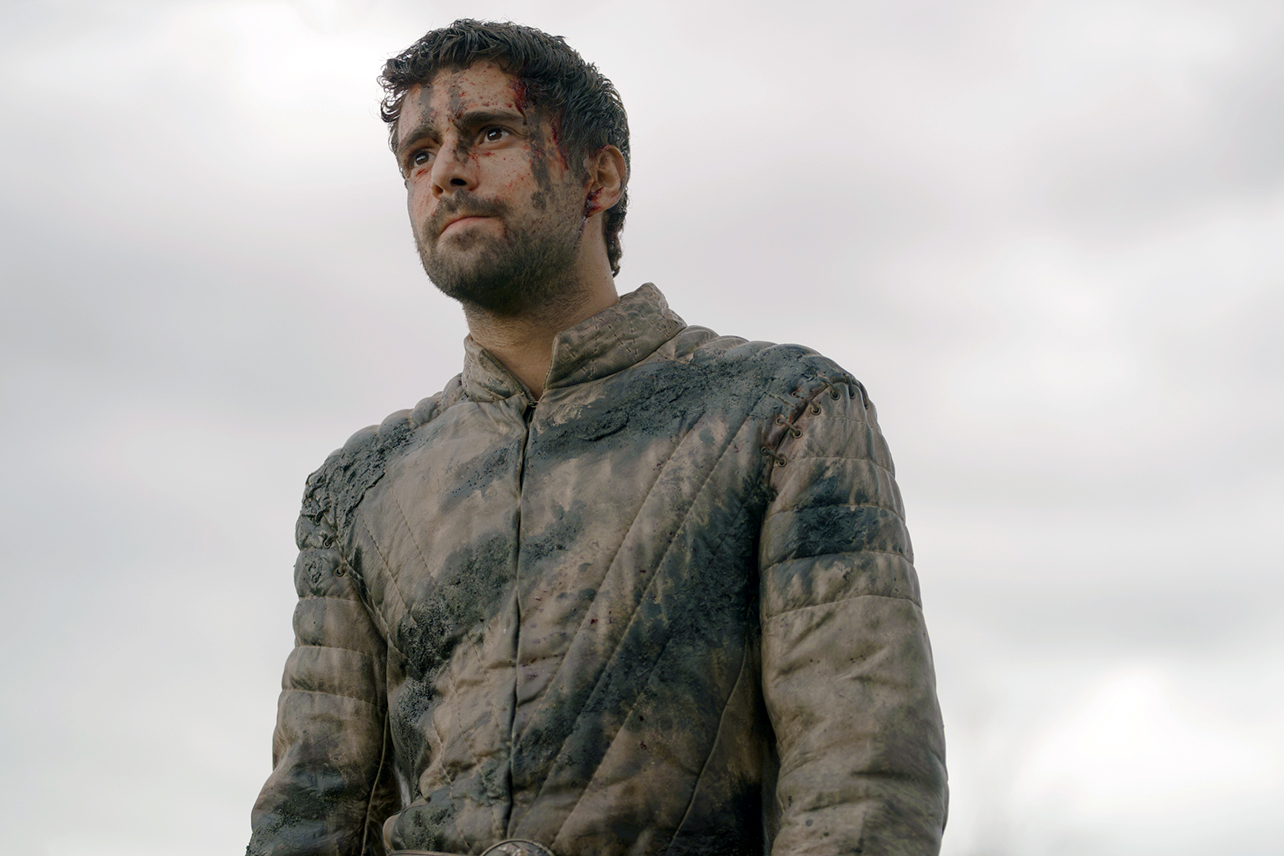
Criston Cole headed into Butcher’s Ball hoping for a glorious end. In my opinion, he got one, even if it’s not the one he wanted.
When House of the Dragon aired its first season in 2022, one character quickly emerged as the person audiences hated most. The world of Westeros has always produced exceptional villains. From Joffrey to Ramsay to Cersei, we revelled in waiting for them to receive their comeuppance. For the most part, we eventually got exactly that.
But there is something different about Ser Criston Cole.
His betrayal of Rhaenyra Targaryen, the person many viewers believed was the rightful heir to the Iron Throne, caused the most outrage. Come on, no one is really on Team Green, are they? Yet Cole only continued building upon that hatred. He murdered Joffrey Lonmouth, the lover of Rhaenyra’s future husband, in the middle of a wedding celebration. Years later, he helped place the crown on Aegon’s head and became one of the driving forces behind the Greens’ claim to the throne.
After witnessing the brutal chaos inflicted upon every soldier unfortunate enough to encounter a dragon, Cole’s belief in victory, and perhaps in anything at all, began to disappear. This was once a man who dreamed of running away with Rhaenyra and living a simple life together. Now, he had become a nihilist, marching toward a death he seemed to welcome.
That character arc, from the romantic lover of our main protagonist, to a bitter and vengeful kingmaker, to a man poisoned by what he believes to be the inevitable future of both himself and the realm, has been exquisitely performed by Fabian Frankel. It has also made Criston Cole, in my opinion, one of the most compelling television characters of the past decade.
If you’ll forgive the wrestling terminology, let’s begin with his initial heel turn.
Rhaenyra, still a young princess known as the Realm’s Delight, might not have fallen in love with Criston, but she clearly enjoyed the thrill of sleeping with the man she had personally named to the Kingsguard, the man stationed outside her door each night. To her, their relationship was a private indulgence, something exciting precisely because it had to remain secret.
Criston saw something else entirely. For him, it was the beginning of a fairy tale. He imagined the two of them abandoning their duties, sailing to Essos and building a simple life together. What Rhaenyra treated as an escape from responsibility, Criston saw as a potential promise of a new one.
And so when Rhaenyra rejected him, he saw it as a broken promise even though she had never actually made one. He had sacrificed his vows and the identity he had built for himself, believing their relationship would justify it. When she instead said his dreams could never become reality, he was forced to confront the possibility that what meant everything to him had been little more than an indulgence to her.
And so, every action Criston takes from here can be viewed as the response of a man who was spurned by the woman he loved, but also as the work of someone determined to prove that he had been right all along.
That makes Alicent Hightower the perfect person for him to attach himself to. Where Rhaenyra represents temptation, secrecy and the collapse of his vows, Alicent presents herself as duty made flesh. She appears restrained where Rhaenyra is impulsive, pious where Rhaenyra is indulgent and committed to the existing order where Rhaenyra threatens to overturn it. By choosing Alicent, Criston is not simply choosing Team Green. He is choosing the version of himself he still wants to believe exists.
His feelings for Alicent complicate that choice. Once again, Criston becomes emotionally entangled with a woman whose position makes an open relationship impossible. Yet this time, he can tell himself that the secrecy serves something greater. He is not abandoning his honour for desire; he is protecting the queen, defending her children and preserving the realm. At least, that is the story he tells himself.
Criston does not merely support Aegon’s claim, he helps transform an aimless, deeply damaged prince into a king. Placing the crown upon Aegon’s head is both a political act and a personal declaration. Rhaenyra rejected the future Criston imagined for them, so he helps build a future in which she can never rule.
In uplifting Aegon, Criston also elevates himself. The discarded lover becomes the Kingmaker. The knight who once dreamed of disappearing into Essos becomes one of the most powerful men in Westeros. Every victory for the Greens appears to confirm that he chose correctly. Every defeat for Rhaenyra becomes proof that she was never worthy of the devotion he once offered her.
And so, when it all comes crumbling down, Criston becomes a depressed, nihilistic man. The war he helped create has revealed itself for what it truly is: not a contest of honour or rightful succession, but a slaughter conducted by people with dragons. He has seen soldiers burned alive for causes they barely understand. He has watched strategy become meaningless the moment a dragon enters the field. Whatever belief he once had in victory, duty or divine justice has been stripped away.
Yet even when Criston recognizes that the ending is inevitable, he still tries to assert some control over how it will be remembered.
Before the Butcher’s Ball, he speaks to Gwayne Hightower like a man already preparing his own legend. Criston knows the battle will lead to his death, but he believes that death can still give his life meaning. If he cannot survive the war, perhaps the people of Westeros will sing songs about his bravery, chivalry and honour. Perhaps history will remember the Kingmaker as a noble knight who stood his ground against impossible odds.
It is the same instinct that has guided him throughout the series. When reality fails to match the story Criston has written for himself, he tries to force the world into a shape that justifies his choices. His relationship with Rhaenyra had to be a great romance. His loyalty to Alicent had to be honourable. Aegon had to be the rightful king. Now, his death has to be glorious.
The Butcher’s Ball denies him even that.
Criston does not die in a heroic duel or at the head of a magnificent charge. He is cut down by arrows before he can turn his final stand into story. It is abrupt, undignified and almost cruelly ordinary. The man who spent his life trying to control the story told about him is denied the chance to write its ending.
And yet, that may be exactly what makes his death glorious. Not because Criston received the heroic ending he wanted, but because the manner of his death completes the tragedy of his character. He spent years building an identity around honour while repeatedly acting against it. In the end, the world refuses to validate the fiction he created. He dies not as the shining knight of his imagination, but as another exhausted soldier swallowed by a war he helped begin.
That is what makes Criston Cole’s story so compelling, especially in 2026. We live in a moment when people constantly reshape their failures into narratives of victimhood, conviction and misunderstood greatness. Criston does the same thing on a grand, tragic scale. He cannot accept that he was wrong, so he turns every humiliation into proof of his righteousness and every compromise into evidence of his honour. Yet when the lies finally fall away, what remains is not a monster, but a frightened, exhausted man desperate to believe his life meant something. We may despise the choices he makes, but we recognize the instinct behind them.
Perhaps the greatest irony is that I began this article ready to explain why Criston Cole deserved our hatred, only to discover that I had written him an ode instead. That may be the clearest proof of how compelling he became: even in death, Cole found a way to make at least one more person tell his story.