

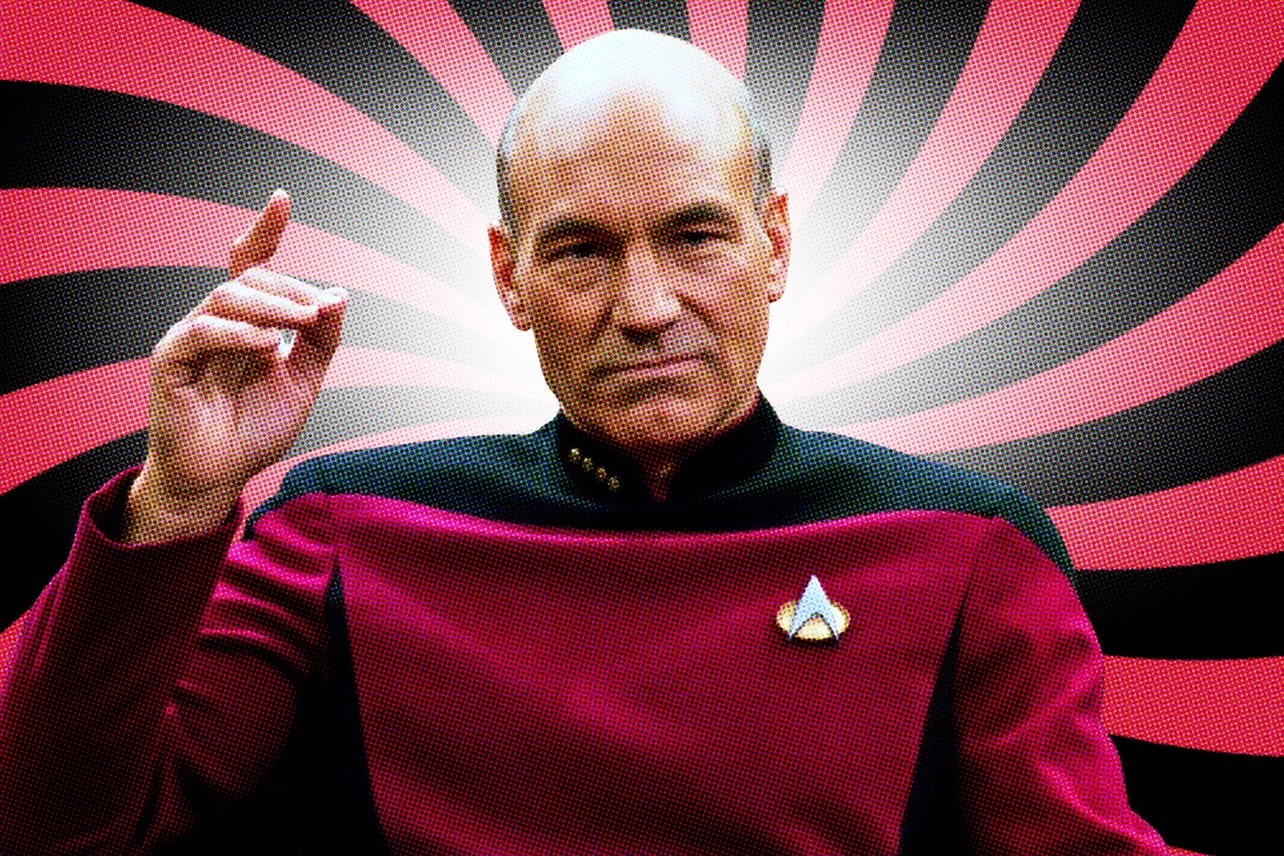
One of science fiction's most enduring and beloved characters, Captain Jean-Luc Picard represents the very best of Starfleet: wisdom, compassion, diplomacy, and an unwavering commitment to doing what’s right. Magnificently brought to life across television and film by Sir Patrick Stewart, Picard became far more than just another Star Trek character, evolving into an icon whose influence extended well beyond the franchise. Following Stewart's untimely death on October 28th at the age of 86, revisiting the character's most defining moments carries with it an added emotional weight. Here, we celebrate five episodes that helped define the man, the captain and the extraordinary legacy he leaves behind.
5. “Yesterday’s Enterprise” (3x15) – “Let's make sure history never forgets... the name... Enterprise.”
The ill-fated Enterprise-C passes through a temporal rift, creating an alternate reality in which the Federation finds itself embroiled in a losing, decades-long war with the Klingon Empire. Realizing that the ship must be sent back to its own time and certain destruction — an event that will eventually pave the way for peace between the opposing sides — a battle-hardened Picard demonstrates just how far he, and by extension, his crew, are willing to go for the sake of the greater good. Putting themselves between their time-traveling comrades and a trio of heavily armed Klingon battlecruisers, this slightly darker, yet still virtuous, version of ol' JL bravely makes the ultimate sacrifice, ensuring that the Enterprise-C can return home and complete its mission, thus restoring the timeline.
4. “All Good Things” (7x25 & 26) – “I should have done this a long time ago.”
In this Hugo Award-winning series finale, Q (John de Lancie) once again puts humanity on trial while Picard bounces between past, present and future in an attempt to solve a puzzle and ensure their survival. Tackling themes of self-discovery and the importance of embracing our potential, this delightful two-parter — widely regarded as one of the best finales in television history — perfectly encapsulates the original ideals behind Star Trek, exploring what it truly means to be human while reminding us that there is always room to grow. It also challenges Picard to confront the choices he's made, consider the path his life has taken, and contemplate the possibilities that still lie ahead. Plus, by bringing the crew together for one last game of poker, it delivers a perfectly poignant sendoff to one of Starfleet's finest officers.
3. “Chain of Command” (6x10 & 11) – “There are four lights!”
If this Season 6 two-parter taught us anything, other than the fact that Edward Jellico (Ronny Cox) was one of the biggest tools this side of the Neutral Zone, it's that Captain Picard is made of some pretty tough stuff. Captured during a secret mission to destroy a Cardassian weapons factory, Jean-Luc soon finds himself the personal project of the sadistic Gul Madred (played by Tron and Batman: The Animated Series baddie David Warner). Intent on breaking the man, Madred repeatedly shows Picard four lights, insists there are actually five, and electrocutes the captain whenever he says there are four rather than five. Regardless, Picard never breaks, managing to maintain control of himself despite the relentless barrage of torture. It's heartbreaking to watch, and even a little disturbing, but demonstrates that Jean-Luc Picard possesses a strength of will that is simply second to none.
2. “Darmok” (5x02) – “In my experience, communication is a matter of patience...”
A shining example of the resilience of the human spirit, “Darmok” takes Captain Picard and strands him on a planet with Dathon (Paul Winfield, who also played Captain Clark Terrell in 1982's Star Trek II: The Wrath of Khan), a Tamarian who speaks a language so complex that the universal translator is rendered pretty much useless, save for a string of enigmatic metaphors. Hunted by a beast, the duo must learn to communicate and somehow work together before it's too late. While it can be a little difficult to figure out what's going on at times, or to form any sort of emotional attachment to Dathon, this episode does a fantastic job of showcasing Picard's skills in a more diplomatic role while also proving that Gene Roddenberry's space-based western has far more going on than just phasers and starships.
1. “Star Trek: First Contact” (1996) – “The line must be drawn here!”
Directed by franchise veteran Jonathan Frakes (Commander William Riker), this second big-screen Next Generation adventure sees the Borg travel back in time in an attempt to conquer Earth and alter the course of human history. Still haunted by the trauma of his transformation into Locutus (“The Best of Both Worlds,” Parts I & II), a deeply scarred Captain Picard becomes consumed by vengeance, hell-bent on destroying the Borg once and for all. But as the fate of humanity hangs in the balance, Picard must learn to let go of his vendetta and move beyond the ghosts of his past to preserve the future. Featuring perhaps the most emotionally complex and humanized portrayal of the Enterprise captain ever put to screen, there's a reason First Contact remains one of the finest Star Trek films ever made, even 30 years after its release.