

Our Heist Guides introduce new fans to something we think is seriously cool, and they may even provide some behind-the-scenes knowledge to longtime diehards. It's everything you need to know to plan your own heist.
If you want a true primer on all things X-Men, consider pre-gaming this guide with our in-depth looks at where to start with the franchise and the team's 1975 relaunch.
What is the "Age of Apocalypse"?
In the dying months of 1994, Marvel Comics executed one of the wildest stunts in the history of superhero comics. First, they announced that they would cancel all of their X-Men titles. The notion that Marvel would shut down one of the most popular corners of their universe was unthinkable, and rocked the world of this author's 13-year-old self (who vigorously denied such a thing was possible to the friend who delivered the news to him; sorry Chad!). Then, Marvel announced that while they were indeed cancelling all their X-Men titles, they would be relaunching them all as new series, with new #1 issues (then, as now, #1s always goose sales) and set in an entirely new reality: the Age of Apocalypse.
In the Age of Apocalypse, time travel shenanigans meant Professor Xavier never lived to found the X-Men, nor to have his relationship with Magneto soured by their conflicting views of mutant supremacy. This allowed the rise of mutant supremacist Apocalypse as unquestioned ruler of North America. Instead of Xavier, it was left to Magneto — determined to carry on his deceased friend's dream for peaceful coexistence in the face of overwhelming odds and despair — to assemble a team of X-Men to oppose Apocalypse. These new X-Men were comprised of faces familiar to fans, but also different, darker, more hardened.
It certainly wasn't the first time Marvel — or even the X-Men — had dabbled in the notion of time travel and alternate realities. "Days of Future Past," the seminal story in which an adult Kitty Pryde has her mind sent back in time to her past self in order to avert a dystopian future in which mutants are on the verge of extinction at the hands of the robotic Sentinels, was published in 1980. It remained a frequent touchstone within the X-Men narrative ever since. But "Age of Apocalypse," while swimming in similar waters, was different.
How did "Age of Apocalypse" break new ground at Marvel?
For one thing, its scale was much, much bigger. In the years since 1980, the rise of the Direct Market (in which dedicated comic book stores offered readers the ability to find their favorite books without having to suffer the vagaries of drugstore spinner racks and the like) and a boom in bold, boundary-pushing visual artists fueled a burgeoning bubble of popularity and investment speculation in comic books. And the X-Men? Their increased popularity led to Marvel's mutants starring in not just one title, but eight.
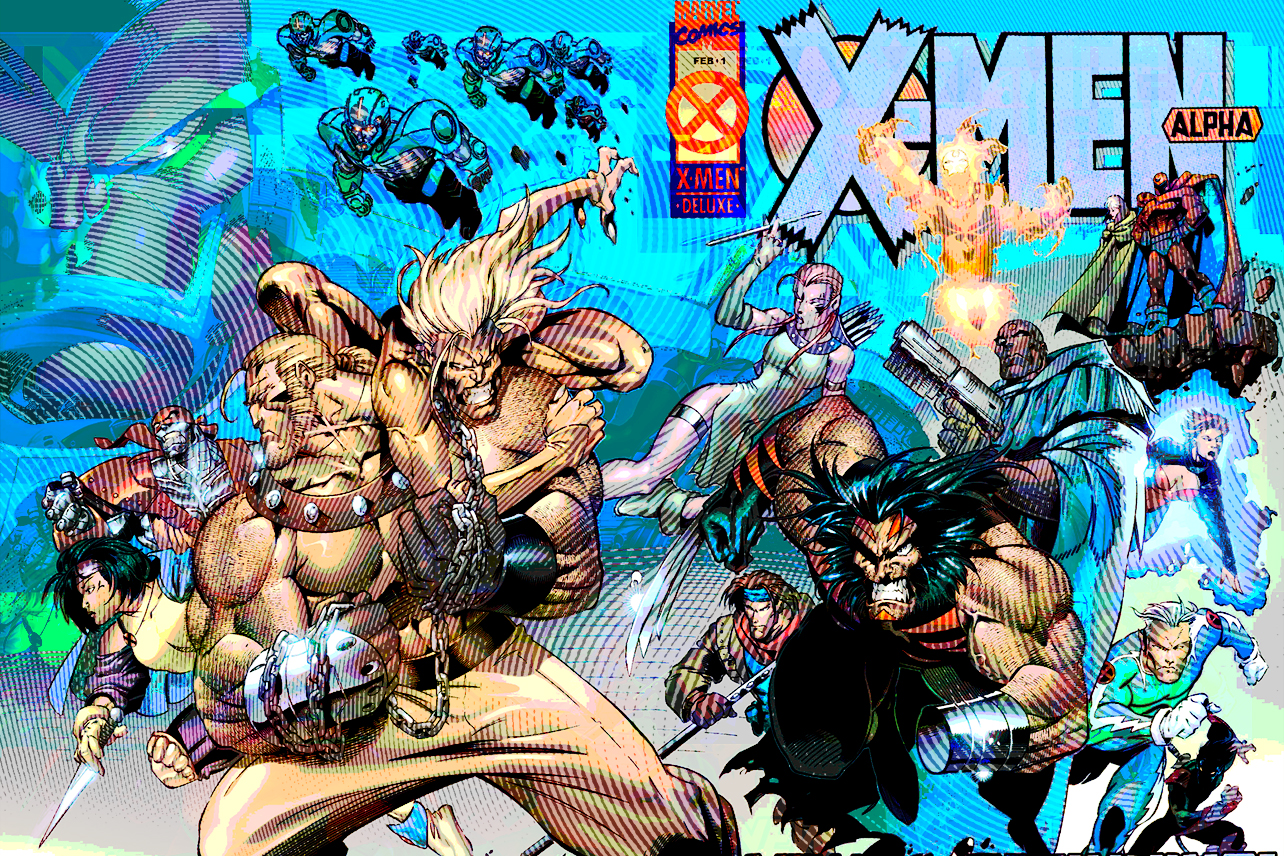
When "Age of Apocalypse" was announced, the X-books counted amongst their number Uncanny X-Men, X-Men, X-Factor, Excalibur, X-Force, Generation X, Wolverine, Cable, and the quarterly X-Men Unlimited. All of them would be involved in the story, along with a pair of bookend issues (X-Men: Alpha and X-Men: Omega, appropriately) and a two-issue miniseries chronicling the adventures of the rest of Marvel's superhero characters in this alternate world (X-Universe). The event would also run for a full four months, across the opening of 1995. Compared to the two-issue Uncanny X-Men arc "Days of Future Past," "Age of Apocalypse" — which involved nearly 40 issues across almost a dozen titles (and that's not counting the story that set it up, or many of the subsequent follow-up stories — for more on that, hold tight!) — is massive.
The other big difference between "Age of Apocalypse" and other alternate reality stories is that Marvel was very committed to the idea of it replacing the "main" universe. Whereas the general rule in Marvel time travel stories had long been that any efforts to change the past to prevent a future would just create an alternate timeline — the original, "bad" timeline would continue to exist, but the efforts of the time traveler would ensure that another, presumably better, future would come to pass as well — "Age of Apocalypse" was constructed differently.
In "Legion Quest," the story which sets up "Age of Apocalypse," Professor Xavier's powerful but mentally unbalanced son Legion journeys back in time to kill Magneto, believing that if Professor X didn't have to devote so much time to fighting Magneto, he would have been freed up to be a better dad. A contingent of X-Men follow Legion, intent on stopping him, and in the ensuing melee Past Xavier ends up pushing Past Magneto out of the way of killing blow from Present Legion and dies instead. Thus, the "Age of Apocalypse" is born.
Except the specifics of X-Men history make this alternate reality a little different. Early in his long run as X-Men scribe, Chris Claremont, alongside artists Dave Cockrum and John Byrne, introduced the alien Shi'ar Empire in a story that saw Jean Grey ascend to the cosmic powers of Phoenix and use that power to contain the reality-warping energies of the M'Kraan Crystal, unleashed by the mad Shi'ar emperor D'Ken. If Xavier died before he could form the X-Men, train Jean Grey, and trigger the events that led to Phoenix stopping D'Ken, argued "Legion Quest," then there would be no one to stop the M'Kraan crystal from consuming all realities across time. Thus, the creation of the "Age of Apocalypse" led not to a splintering of reality, but the destruction of all others. This was depicted, as each series came to a close before the "Age of Apocalypse" relaunch, via a creeping crystal wave stretching across the universe, allowing each book to conclude on a big cliffhanger moment (Rogue finally kissed Gambit! Wolverine killed Sabretooth! Maybe!) just before reality ended and the "Age of Apocalypse" began.
What is the"Age of Apocalypse" reading order?
"Age of Apocalypse" is a story that can be read, then as now, in a couple of different ways. Outside of the X-Men: Alpha and X-Men: Omega bookend issues, each of the different four issue series are largely self-contained. Each (mostly) focuses on a specific quest handed down in X-Men: Alpha that contributes to Magneto and the AoA X-Men's overarching goal of undoing Professor Xavier's death and restoring the "true" reality while evading Apocalypse's forces and staving off nuclear annihilation at the hands of the human resistance mounting a final assault on the world's big, blue-lipped ruler. With a few exceptions, each can be read in their entirety in any order respective to each other, with the Alpha/Omega issues serving as the ultimate kickoff and conclusion to their arcs. Read X-Calbre to experience Nightcrawler's mission to find the precognitive Destiny, then Weapon X to see the machinations of the Human High Council, then X-Man to witness the rise of Nate Grey, etc. Just wrap 'em all up before getting to X-Men Omega.
But to take them issue by issue and weave the different chapters together into one cohesive narrative would look something like this:
- X-Men: Alpha #1
- Astonishing X-Men #1
- X-Calibre #1
- Gambit and the X-Ternals #1
- Generation Next #1
- Weapon X #1
- Amazing X-Men #1
- Factor X #1
- X-Man #1
- Amazing X-Men #2
- Factor X #2
- Weapon X #2
- Gambit and the X-Ternals #2
- Astonishing X-Men #2
- Generation Next #2
- X-Man #2
- X-Man #3
- Factor X #3
- Astonishing X-Men #3
- Amazing X-Men #3
- Gambit and the X-Ternals #3
- Weapon X #3
- X-Universe #1
- Generation Next #3
- Generation Next #4
- Astonishing X-Men #4
- X-Calibre #2
- X-Calibre #3
- X-Calibre #4
- X-Universe #2
- Gambit and the X-Ternals #4
- Amazing X-Men #4
- X-Man #4
- Factor X #4
- Weapon X #4
- X-Men Omega #1
Additionally, the two issue X-Men Chronicles series features a pair of stories set in the past of "Age of Apocalypse." The first parallels X-Men #1, with Magneto's X-Men fighting Apocalypse's Horseman at Cape Citadel, while the second dramatizes the Magneto/Gambit falling out referenced in the present day narrative. Neither are required reading, but both have their charms; they can be read more or less anywhere in the sequence.
Similarly, Age of Apocalypse: The Chosen is an Official Handbook of the Marvel Universe-style reference guide to the characters (though in true '90s fashion, much more image-focused than text-based), and can be read whenever — though probably best towards the latter half of the story, to avoid any spoilers.
What if you wanted to just read one "Age of Apocalypse" series?
"Age of Apocalypse" is a tricky story to read in brief, as there really is no one core book that covers the "main" narrative arc and gives you the gist of the broader event. But if you wanted to read just one series to get a feel for the story without reading everything, your two best bests are Generation Next and Astonishing X-Men.
In Generation Next, Colossus and Shadowcat are tasked by Magneto with rescuing Colossus' sister Illyana (who is needed for his "reset reality" plan) from one of Apocalypse's slave pens and proceed to bring their young mutant students (analogs to the then-recently launched Generation X series starring a Jubilee and other "next generation of mutants" characters) with them on the mission. The ensuing story is a dark, disheartening tale featuring intricate, innovative art from Chris Bachalo and a gut-punch of an ending that will stick with you. It perfectly captures the feeling of desolation and hopelessness that pervades the "Age of Apocalypse".
Meanwhile, Astonishing X-Men is one of the most self-contained and lower stakes series in the whole event. While most of the other books involve some kind of "quest plot" that contributes to the overall narrative arc, Astonishing X-Men showcases a largely self-contained battle between a small group of X-Men and the poorly-named Holocaust, one of Apocalypse's chief lieutenants. What really makes it standout is the art from Joe Madureira (ably assisted by colorist Steve Buccellato and Digital Chameleon, who take advantage of the nascent digital coloring and recently-improved paper stock to give the color art an astonishing level of depth and complexity). The heavily manga- and anime-influenced style of "Joe Mad" would take the comics world by storm in short order, making him one of the most popular comic book artists of the age while inspiring an entire cohort of imitators, altering the default "house style" of superhero comics, an impact which would outlast Madureira himself (who left comics before the decade was out to work in video games).
While Madureira became the regular penciller on Uncanny X-Men a few months prior to "Age of Apocalypse," the event is really his coming out party: not only does he draw the four issues of Astonishing X-Men, but he was heavily involved in crafting the overall aesthetic of the new reality and redesigning its characters. Flame-throwing Sunfire has arguably never had a better look than the one Joe Mad gave him in "Age of Apocalypse." Astonishing X-Men thus stands as a kind of mission statement for the artist, showcasing his approach to and knack for character design and visual storytelling. The artistic identity of superhero comics in the mid-to-late '90s is more or less born in the pages of Astonishing X-Men, and that alone makes it worth checking it out. It's also a story that heavily features Blink and Morph, two of the more original "Age of Apocalypse" characters (in that their "main reality" counterparts had little previous backstory/narrative history), both of whom would have a long life after the event.
What happened next?
While "Age of Apocalypse" concludes with the "prime" reality restored just as the bombs drop around the surviving X-Men, Marvel never could let a good (and/or profitable) story go. As part of the fallout of the final attack on Apocalypse, four characters from the "Age of Apocalypse" end up in the prime reality: Holocaust, Sugar Man (a mad geneticist and the main antagonist of Generation Next), Dark Beast (an evil version of the X-Men's Beast, also a mad geneticist), and Nate Grey (the "Age of Apocalypse's" younger, more powerful version of Cable, created by Mister Sinister, a mad geneticist). Nate Grey even held onto to his own series when Cable returned (that Marvel published two ongoing series starring different versions of Cable for multiple years tells you all you need to know about the '90s).
Additionally, a number of stories would return to the past of the "Age of Apocalypse" in an effort to catch readers' attention by telling untold tales of the popular story set before its conclusion. These include X-Man '96, one of the earliest "returns," a pair of Tales of the Age of Apocalypse prestige format one-shots, X-Man #-1 (part of Marvel's "Flashback" month in which every book told a story set in the past of its title characters) and a Blink miniseries. In 2001, writer Judd Winick and artist Mike McKone launched Exiles, a series starring a team of characters plucked from various realities, including Blink and a version of "Age of Apocalypse" Morph. Both would be mainstays of the team throughout the book's seven-year run.
But throughout all these various "returns" to the "Age of the Apocalypse," the idea that the reality was a dead one, the exact circumstances of its creation having been averted, persisted. On the 10th anniversary of the story, the 2005 Age of Apocalypse limited series by current Marvel Editor-in-Chief C.B. Cebulski (then writing under the name "Akira Yoshida," during his yellowface period) and returning artist Chris Bachalo established that the "Age of Apocalypse" reality (designated Earth-295 in Marvel's numerical catalog of alternate realities) was still around, and that the "Age of Apocalypse" Jean Grey had tapped into the Phoenix Force to stave off the nuclear armageddon that should have destroyed the world even if it hadn't been removed from existence.
In doing so, Marvel took away one of the signature elements of the original "Age of Apocalypse", making it just another in a litany of "alternate reality caused by time travel" stories, rather than the creation of a unique set of circumstances. Cebulski's Age of Apocalypse also largely invalidates the plot of the original story, because if it's just a "regular" alternate reality, the prime reality never would have ended, and the efforts to restore it would have just spun out more realities.
How did "Age of Apocalypse" affect later X-stories?
With that door kicked open, a number of subsequent stories would play in the "Age of Apocalypse" sandbox. Rick Remender featured a number of the "Age of Apocalypse" characters in his Uncanny X-Force "Dark Angel Saga" story, crossing back and forth between the prime Earth-616 reality and the "Age of Apocalypse" Earth-295 (with the AoA versions of Nightcrawler and Iceman sticking around on Earth-616 by the end of the story).
This in turn led to a 2012 Age of Apocalypse ongoing series, which lasted 14 issues and closed out its run with a crossover between X-Treme X-Men and Astonishing X-Men (no relation to the AoA Astonishing X-Men series). 2015's Jonathan Hickman-led reality-altering Secret Wars event featured an "Age of Apocalypse"-inspired domain in its hodgepodge Battleworld (and a corresponding miniseries). And a new "Age of Apocalypse" miniseries, X-Men of Apocalypse, from artist Simone Di Meo and writer Jeph Loeb (who worked on the original story) celebrates the story's 30th anniversary in 2025. Oddly enough for a story meant to celebrate another story, its inaugural issue featured a lot of narrative inconsistencies relative to the established story.
"Age of Apocalypse" has loomed large in more indirect ways as well, inspiring a number of stories doing similar "riffs" on the concept. The year 2000 opened with "Ages of Apocalypse," spinning out of "The Twelve" X-Men storyline, taking the name and the general concept of alternate realities to tell a series of self-contained "what ifs?". "Age of X" in 2011 brought Legion back into the mix and chronicled an alternate reality in which the last mutants on Earth fight for their survival. 2013's Age of Ultron crossover offers an Avengers-centric twist on the idea of time travel creating dystopias ruled by a notable villain (while later lending its title to the second Avengers film). Legion comes back, along with Nate Grey, to kick off the "Age of X-Man" in 2019, repeating the publishing tactic of "Age of Apocalypse" by telling its tale across a series of books set in the new reality, but with a different setup that illustrates how utopias can be be as oppressive as dystopias.
And in another thirtieth anniversary celebration, 2025's "Age of Revelation", stands as both a spiritual and narrative sequel to "Age of Apocalypse", repeating its trick of cancelling all the existing X-books and replacing them with new ones set in the new reality. It also features as its antagonist and world-dominating figure not Apocalypse, but his chosen heir, the former Doug Ramsey, now named Revelation. Like Apocalypse before him, Revelation has remade the world in his image, while the mission of the remaining X-Men opposing Revelation involves using time travel to prevent the darker reality from ever existing. Now more than ever, everything old is new again.
Is "Age of Apocalypse" the best X-story of the '90s? Should the AoA have remained untouched after 1995? Are you digging "Age of Revelation"? Give us all of your "Age of Apocalypse" hot takes over on Bluesky.