

Every October, diehard horror fans and casual lovers of creepy fare alike gather around TVs to mainline their favorite scary movies. There are thousands to choose from, but if it's the Halloween season, there's a good chance you'll be wanting a horror movie set in October. And if you want a horror movie set in October, there's an even better chance you'll go straight for the title with the holiday right in its name: Halloween.
Since 1978, John Carpenter and Debra Hill's slasher film has been one of the gold standard horror movie experiences, a slasher classic that's also one of the most successful horror franchises of all time. After nearly 50 years, we still love it, but if you want to dig deeper than that first film, things can get a little convoluted. So, for this Heist Guide, let's take a closer look at the entire Halloween franchise, from its origins to its multiple reboots.
What is Halloween?
You probably know this one already, but just in case: Halloween is a 1978 horror film directed by John Carpenter, produced by Debra Hill, and written by Carpenter and Hill. Based on a simple concept revolving around babysitters being stalked by a killer, the film follows a group of teenagers in the fictional town of Haddonfield, Illinois as escaped mental patient and mask-wearing fiend Michael Myers comes back to his hometown to wreak havoc. The movie marked the feature film debut of Jamie Lee Curtis, and went on to become one of the most profitable films of its era, not to mention the launching pad for the slasher movie boom of the 1980s. These days it's a movie so ubiquitous that even if you haven't seen it, you've basically seen it, because it's a fixture of basic cable Halloween broadcasts and, of course, horror movie montages wherever they appear.
Yeah, I know Halloween. But what's the deal with this Michael guy?
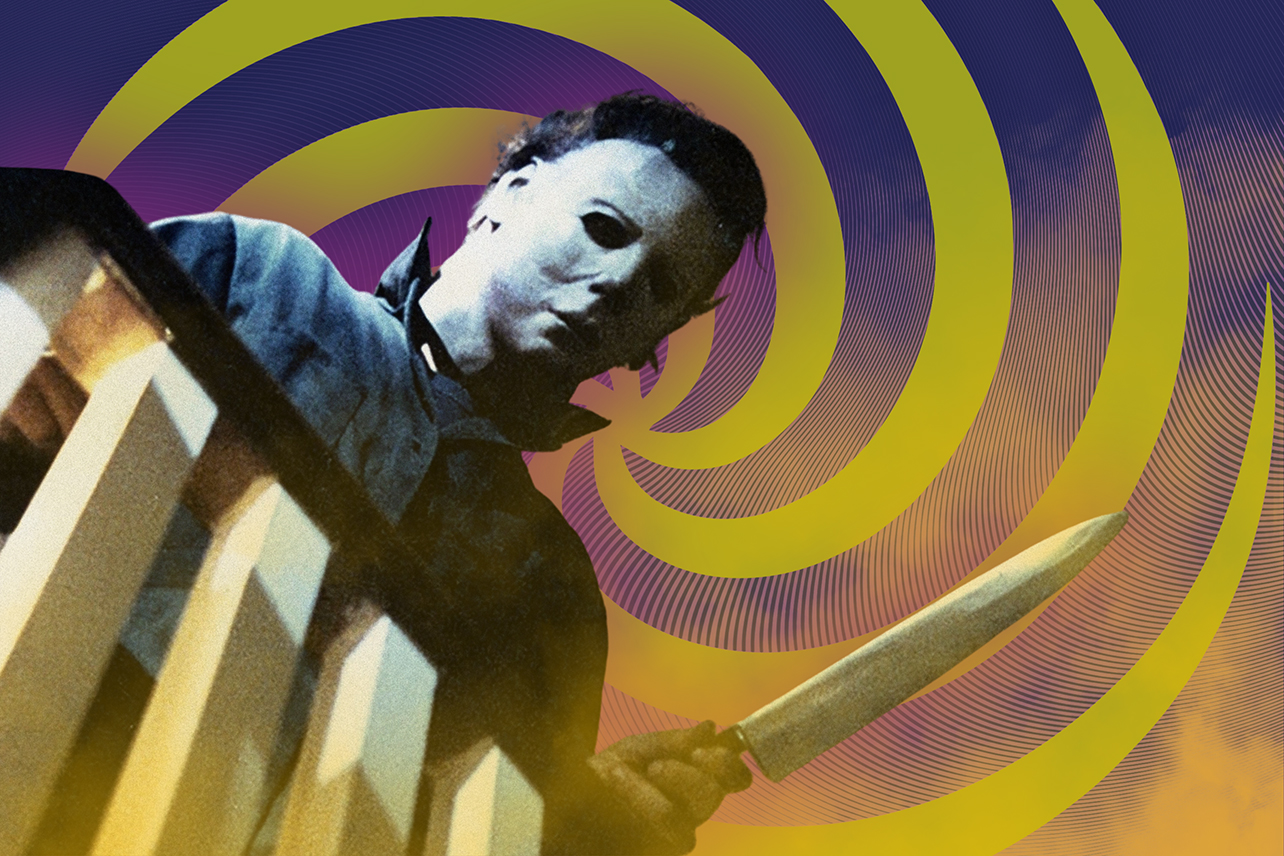
On Halloween night in 1963, six-year-old Michael Myers murdered his teenage sister Judith with a kitchen knife, and was institutionalized. Fifteen years later, he staged a breakout from his mental hospital, went back to his hometown, and carried out a string of gruesome murders on Halloween night, 1978. He doesn't speak, doesn't seem to feel much, and possesses almost superhuman strength, stealth, and calm. His distinctive slasher costume includes dark coveralls and an expressionless white mask with a shock of wild brown hair, famously crafted from a Captain Kirk Halloween mask the crew of the original film bought at a costume shop.
What happens after that first movie?
John Carpenter and Debra Hill weren't all that keen on making a Halloween II, but producers demanded it. To keep the franchise in their hands, they fired off a screenplay for a second installment set on the same night, following what happens in the immediate aftermath of the first film. Set almost entirely in a hospital, Halloween II follows Laurie Strode (Curtis) and Michael's doctor Sam Loomis (Donald Pleasence) trying to bring the killer down once and for all — and by the end, they seem to succeed. This film also introduced a longstanding piece of franchise lore in an effort to explain why Michael wanted to kill Laurie Strode so badly: She's his long-lost sister, and he has a drive to kill every member of his family.
Wait, so that's the end?! Two movies?
Here's where it gets complicated. Reluctant to draw out the Michael Myers story beyond what felt like its natural life cycle, Carpenter and Hill envisioned a Halloween franchise that would shift story and perspective with each new installment. Together with their friend, writer/director Tommy Lee Wallace, they dreamed up an entirely new story for Halloween III. This story, following deadly Halloween masks manufactured by a novelty company with pagan roots, steered clear of Michael Myers and Laurie Strode entirely. Halloween III: Season of the Witch arrived in 1982, less than a year after Halloween II, and confused more than a few viewers who were hoping for more Michael Myers. These days, though, it's considered a cult classic, with many fans calling it one of the best films in the franchise, even if it has nothing to do with the others.
So they just kept making unrelated movies after that?
Well…no. Season of the Witch didn't do as well as anyone would have liked at the box office, and the franchise went dormant for several years while Carpenter and Hill went on to other projects. Finally, in 1988, Michael Myers returned in the aptly named Halloween 4: The Return of Michael Myers. Once again set in Haddonfield, the film – directed by Dwight H. Little – imagined that Michael hadn't died at the end of Halloween II, but merely slipped into a coma. In October of 1988 he wakes up, breaks out again, and goes in search of his sister Laurie. But because Jamie Lee Curtis also didn't want to be involved at this point, the film kills Laurie Strode offscreen in a car crash, and instead focuses on her young daughter Jamie (Danielle Harris), a little girl who unexpectedly finds herself the target of a renewed Michael Myers because of her bloodline.
That sounds interesting! Is that the rest of the story?
Oh, definitely not! Jamie's story continued into Halloween 5: The Revenge of Michael Myers (1989) and Halloween 6: The Curse of Michael Myers (1995), and the mythology got even more convoluted with the introduction of an ancient Druidic curse visited on the Myers family. It's…well, it's a lot, but as rough as these films got, they all still have their defenders, particularly now that a "producer's cut" of Halloween 6 (starring a young Paul Rudd) is out in the world to shed more light on the lore. Personally, I'm a Halloween 4 partisan, but there's room for all of these bonkers sequels on my watchlist.
Wait — I thought Jamie Lee Curtis came back to Halloween? What's going on there?
Ah, well, if you thought releasing a movie that's the third part in a slasher franchise but doesn't include the slasher was weird, strap in. After Scream reinvigorated the slasher film in 1996, it felt like a good time to bring Michael Myers back, but with a twist.
Released to celebrate the 20th anniversary of the original film, Halloween H20: 20 Years Later brought back Jamie Lee Curtis as Laurie Strode. How? Well, the movie basically ignores all of the sequels after Halloween II, so Laurie's not a deadbeat mom who left her kid to fight Michael alone, and instead imagines a world in which she changed her name and moved to an undisclosed location, serving as headmistress of a private school in California. Still plagued by memories of the past, Laurie is doing her best to live a normal life with her son John (Josh Hartnett), until Michael breaks out (no prison can hold this man) and nabs the secret file with her location and new name. Forced to fight not just for her own life, but for her son's, Laurie goes to war with Michael at the school, and seems to defeat him yet again. Though it didn't end the story the way Curtis originally hoped it would when she signed on to the film, H20 remains a beloved chapter in the franchise for many Halloween fans, even if the mask was a little…well, off.
Wait, they didn't just use the same mask?
The original Captain Kirk mask from Halloween is lost to time and the elements at this point, and it was even back in 1981 when Halloween II was released. Since then, Michael's face has evolved over and over again, using everything from different Captain Kirk masks to original creations dreamed up by each individual film production. In H20 they even got legendary visual effects maestro Stan Winston to come up with a new mask, but for Halloween purists, nothing has ever matched the original 1978 model, and some versions (looking at you, Halloween 5) are almost laughable.
Okay, so the story ends with H20?
It probably should have, but this is Hollywood, baby! No way anything's that cut and dried. Four years after H20, Michael and Laurie returned in Halloween: Resurrection, which handwaved away Michael's apparent death in the previous film and reduced Laurie's role to what amounted to a glorified cameo for Curtis, in a scene that (she hoped at the time) would end her character's story once and for all. The actual meat of the plot involves a reality TV show which dares contestants to spend a night in Michael Myers' childhood home while livestreaming the entire experience. Of course, Michael eventually shows up and wrecks shop, as is his wont.
If you're looking for the absolute nadir of the franchise, Resurrection is probably the consensus choice. It's a fun idea, but it just doesn't work. Still, you get Busta Rhymes trying to bust out martial arts on Michael, and that's fun.
So that's the end?
Resurrection marked the final installment in a chain of sequels stretching back 15 years, each of them trying to reckon with an increasingly convoluted continuity in their own ways. It's still considered the end of the original Michael Myers saga, though it's technically just the end of the story as told in Halloween, Halloween II, and Halloween H20. That means that, if you count Halloween III as its own little universe, and Halloween 4-6 as another branch of continuity, we've now been through three different realities with this franchise. But we're not done yet.
What now?!
Calm down, this part's easy…relative to Halloween, anyway.
Five years after Resurrection, the Halloween franchise got a complete and total reboot courtesy of writer/director Rob Zombie, for whom the original film was a childhood favorite. The reboot, again simply titled Halloween, tells more-or-less the same story as the original film, complete with a new Michael Myers and a new Laurie Strode, but this time Zombie wanted to dig deeper into what makes Michael tick. The results divided fans, and Carpenter was not a fan, but Halloween did well enough to merit a sequel, and that's where things really got interesting.
For my money, Rob Zombie's Halloween II is not only his best film, but one of the best Halloween movies, an absolutely brutal horror experience that's also a poetic look at cycles of violence and the impact that those cycles can have on everyone, even the people trying to break them or ignore them altogether. It's a deeply unsettling viewing experience, and it's very different from anything that came before it in the franchise, but it's worth your time.
Okay, hang on. Didn't Jamie Lee Curtis come back again at some point?
Yup! More than a decade after seemingly leaving the franchise behind for good, Curtis returned to the Halloween universe in 2018, when director David Gordon Green helmed a legacy sequel simply titled Halloween. Yes, there are now three films in this franchise that are just called Halloween, and yes it's a little frustrating!
The new sequel picks up exactly 40 years after the original film, and ignores every other movie in the franchise but that first 1978 movie. After a visit from a true crime podcaster reintroduces Michael Myers to his mask, he finds a way to escape (because he always does) and makes his way back to Haddonfield, where a deeply scarred and paranoid Laurie realizes she finally has to put her plan to fight back in place. Co-starring Judy Greer and Andi Matichak as Laurie's daughter and granddaughter, respectively, the film packs lots of classic Halloween vibes into a portrait of trauma unlike anything Laurie faced before in the series, and won major accolades for Curtis' performance. Plus, Carpenter himself came back to contribute music for the score.
When Halloween 2018 was a hit, Green announced that the film would be the first part in a trilogy, which was continued with Halloween Kills in 2021 and Halloween Ends in 2022. Both sequels focused on other side characters in the Halloween saga while also continuing the story of Laurie Strode, and while the trilogy's conclusion remains divisive among a lot of fans, it also closed the book on Laurie's story for good. At least until the next reboot.
And that's all of the movies?
For now, yeah! There are always rumblings about the franchise coming back, and I wouldn't be surprised to see something new in the years to come. In the meantime, there are also loads of comic book and tie-in novels in the Halloween universe, so if you've seen the films and you still want more, you can look to the page.
You mentioned something like four different continuities scattered across these movies. What order do I watch them in?
Believe it or not, the best way to understand the evolution of the Halloween films, not to mention understand all the Easter eggs scattered through the franchise, is to just watch them all in release order, starting in 1978 and working all the way up to 2022. It's not a completely straight line, but it does provide a lot of context for where the franchise heads and why. That said, if you don't want to do all of that work, here's a handy guide to each branch of continuity.
Original Timeline:
Halloween, Halloween II, Halloween 4, Halloween 5, Halloween 6
H20 Timeline
Halloween, Halloween II, Halloween H20, Halloween Resurrection
David Gordon Green Timeline:
Halloween, Halloween (2018), Halloween Kills, Halloween Ends
Rob Zombie Timeline:
Halloween (2007), Halloween II (2009)
Outlier:
Halloween III: Season of The Witch
As for which one is the best, well, that varies from viewer to viewer. Personally I still have a soft spot for those original six films. They get so weird and go so many places, and each movie puts its own stamp on the lore. But I love all of them, because I love Halloween.
If you haven't already, consider supporting worker-owned media by subscribing to Pop Heist. We are ad-free and operating outside the algorithm, so all dollars go directly to paying the staff members and writers who make articles like this one possible.