

A simple question: What is The Odyssey about?
I suspect if we had an easy answer, we wouldn't spend nearly as much time learning and discussing the epic poem that's been the anchor of Western literature for nearly 3,000 years. We know the plot of The Odyssey, sure, and if you've got the time you can sit down and spool that thing out beat-by-beat, even rearrange Homer's verses into chronological order to get the clearest possible picture. But what is it about?
Emily Wilson, whose translation of the epic is the one Christopher Nolan leaned on to craft his new film, described it (in part), like this.
"It's a very sophisticated account of 'What does it mean to come home?' such that, the first four books aren't focused on Odysseus himself, they're focused on his son and his household in his absence," Wilson said in 2024. "So in order to get the story of 'What does it mean for Odysseus to come home?', we first have to establish 'What does it mean for him to be away?'"
There is far, far more worth saying about what The Odyssey means to its many audiences. Its supreme narrative and thematic multivalence, its chameleonic endurance, is a feature, not a bug. But watching Nolan's film for the first time, I had Wilson's words in my head, because she's right. In order to tell the story of someone coming home, of restoration and a return to wholeness, you first have to establish that something's missing. You have to meditate on the absences.
Absence is vital to Nolan's vision of The Odyssey, which is perhaps a strange thing to consider in the face of its epic scale and breathtaking setpieces. But with Wilson's words in my head as those epic sequences played out, I couldn't help but think of the absences, a poetic tapestry of them unspooling in haunted bardic verse throughout the film, and what they bring to a film that is as much about the things we leave behind as it is about the things to which we return.
Nolan dubs the setting of his film, in an opening title card, as "A Time of Apparent Magic," and indeed that's obvious to the viewer almost immediately. Nolan does not balk at the supernatural or try to explain it away as something natural in The Odyssey, preserving Homer's monsters and magic throughout. And yet despite the obvious presence of wonders both great and small throughout his world, Odysseus (Matt Damon) does not see the magic. For him, a man adrift at the end of a war he neither wanted nor took satisfaction in, the supernatural is either a cold fact of life, like fever or rot, or so distant that he doesn't dare believe in it anymore. His lone connection to the divine in the film's early scenes, a vision of the Goddess Athena (Zendaya) who may or may not be imaginary, attempts to connect with him, but he grumbles that the gods do not speak in a language which he can understand. Athena counters with the argument that "thunder," and "fire," and "pain" are all evidence of the Gods speaking to humankind, but he doesn't want to hear that. Despite the frequent presence of thunder in the distance, and the lashing of the waves on the open seas, the gods are absent for Odysseus of Ithaca, and we will soon learn why.
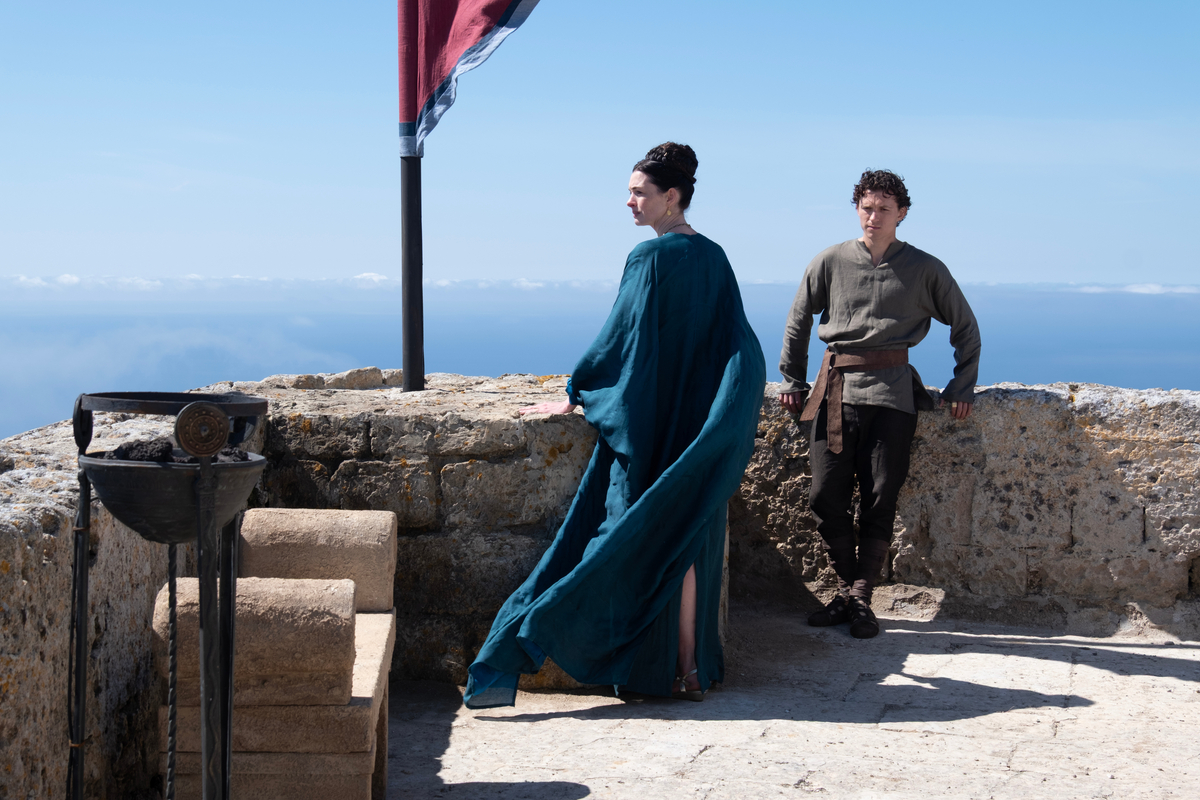
Speaking of Ithaca, there is nowhere else in the film where absence is more prevalent or more heartbreaking. In Odysseus's kingdom, prosperity has fled, replaced by hardening ground, "stringy beef and bad wine." His son Telemachus (Tom Holland) has never truly known his father, and thus never truly known a real presence of kingship in his life, leaving him woefully unprepared for coming of age at a time when challengers surround him. His wife Penelope (Anne Hathaway) misses her husband so deeply and completely she seems to exist in a state of constant physical pain. His loyal swineherd Eumaeus (John Leguizamo) has lost his mentee, his beacon of the future, and his sight, likely through constantly watching the horizon for an Ithacan ship. In Penelope's chambers, a funeral shroud (reminders of yet more absence in the form of Odysseus's father Laertes) sits unfinished, unwoven night after night because Penelope knows when she finishes it she will be forced into a new marriage. And then of course, there are the suitors, the craven men who fill the banquet hall of the palace each night in an effort to win over Penelope, who sits behind a screen the entire time, creating a kind of half-absence. Among them is Antinuous (Robert Pattinson), a man who is absent courage, decency, and as we soon learn in flashbacks, any trace of honor. He is the living embodiment of Shame, and he's the top contender for Penelope's hand.
From there the absences ripple out through the Greek world. On a visit to Sparta, Telemachus sees Helen of Troy (Lupita Nyong'o) robbed of her legendary beauty by her vengeful husband King Menelaus (Jon Bernthal), who is now missing both a faithful wife and a brother in fellow King Agamemnon (Benny Safdie). Though Helen's flight to Troy was the excuse to start the Trojan War, Agamemnon was the true instigator, sacrificing his own daughter to the Gods to speed his ships not to defend his brother's honor, but to take over profitable trade routes under Trojan control.
The things Agamemnon, and by extension Menelaus and Odysseus, threw away to achieve this goal are part of the story's spine, but visually and tonally Agamemnon's very presence is an absence, a void. Clad all in black, golden vertebrae trailing along the back of his helmet, he is the Darth Vader of Mycenaean Greece, a silent, emotionless beast, larger than life and yet completely bloodless. Even when he's stripped of his ebony armor, we never see his face, and you get the sense that it's because he doesn't really have one, not in any meaningful way. He returns from Troy only to be murdered by his grieving wife (Nyong'o again), another absence in the wider world of The Odyssey.
All of these absences — hell, even Ludwig Goransson's score doesn't conform to conventional orchestral tones — layer atop one another, and dozens more besides, rhyming and echoing. Nolan slowly peppers in winter weather, slicking the Mediterranean hills with snow, to indicate a decline, a fading. Even before the film tells us, we can feel it, whether Odysseus is misbehaving for the sake of cavalier distraction or simply brooding out at the horizon, contemplating the war he won. There is a larger absence here.
At a key point in the film, Odysseus concludes that he perhaps hasn't made it back to Ithaca yet because he simply doesn't want to, that all of his efforts to tempt the Fates and defy the Gods are not just a form of procrastination, but of punishment. He feels empty, but more than that, he feels something has been taken of him, rendered him a living void, a sentient absence. At times he tests other homes, most notably with Calypso (Charlize Theron) but in other places as well, and realizes the emptiness he feels cannot be filled by any destination other than, perhaps, Hades itself. There, on a barren and black plain, sent by a witch to speak to a prophet, Odysseus is confronted with the embodiment of all he's feeling: The absent dead.
They surround him, hungry and spiteful and cold, the soldiers he left behind, the ones he couldn't bury, even the behemoth shade of Agamemnon himself. It would be enough to simply feel grief at these confrontations, and perhaps shame and guilt, but for Odysseus it is a reminder of more than that.
Before you establish what it means to come home, you must establish what it means to be away.
In his absence from Ithaca, Odysseus has created thousands of fresh absences, voids where life used to be dotting homes across the Mediterranean. The city of Troy itself, once a jewel of the Ancient World, is now a smear on the map, its temple desecrated, its statue of Athena beheaded. He carries the weight of this everywhere, and it overflows in the wake of hearing the Siren song on the voyage out of Hell. As Odysseus himself later explains, what he heard was everything he'd ever wanted, but the tragedy of that knowledge is that "What you most can't have is what you've already had and lost."
Odysseus doesn't want to go home because his home is gone. It's physically still there, but his wife and son are strangers, his lands are changed, his people are different. Cowardly boys he knew decades earlier are now sniveling, spoiled men. It is not his home anymore, and what's worse, he wouldn't deserve it even if it was. He feels the weight of this absence tremendously, and feels it amplified in the absence of the divine, of real magic, in his life. He must go home, for the sake of his son and his wife, but will he feel at home?
The greatest absence of all in The Odyssey is not the dead, or the lost, or the inert or even the ruins left in the wake of the mysterious Sea Peoples roaming the Mediterranean. The greatest absence is what Odysseus refuses to speak out into existence for almost the entire movie. Finally, seated in disguise outside his wife's screened chambers in Ithaca, he says it.
Odysseus made the choice to doom Troy with the creation of the Trojan Horse. He made the choice to doom Sinon (Elliot Page) to die in the course of a deception. He let Agammemon's horde loose on the city, unleashing "ten years of rage" in the process. He opened a door that should never have been opened, like Pandora with her box, and became a war criminal. He watched gods and men (His vision of Athena appears in the crowd as one of the slain.) perish in one fell swoop, watched a gleaming city fall, and watched an age fall with it. This is what he has spent years, and countless more lives, leaving unspoken, what he's carried. The world is ending, and arrogant though it may be, Odysseus is right to blame himself.
All of the film's small absences, its deliberate voids and mysteries, are consumed by this one glaring omission finally spoken into reality. In laying bare his soul, not to a god or a priest but to the one person in the world he truly cannot bear to disappoint, Odysseus transmutes absence into presence. In a leap of faith, he fights for his wife and son and wins, praying for acceptance, his confession breathing life back into the divine around him. He learns that he cannot go home, but he can go back to Ithaca, and from there to points beyond, in search of a new home. He admits that he is complicit in the death of an age, and agrees to step aside to let a new age rise in the form of Telemachus on the throne of Ithaca.
The Odyssey ends as it began: With an absence. Odysseus sails to the unknown West, chasing the horizon with Penelope at his side. It is another loss, the mark of the passing of an age, but the film ends with a reminder that the sun sets so it can rise again. Endings create new beginnings.
Absence, in an act of apparent magic, creates presence.