

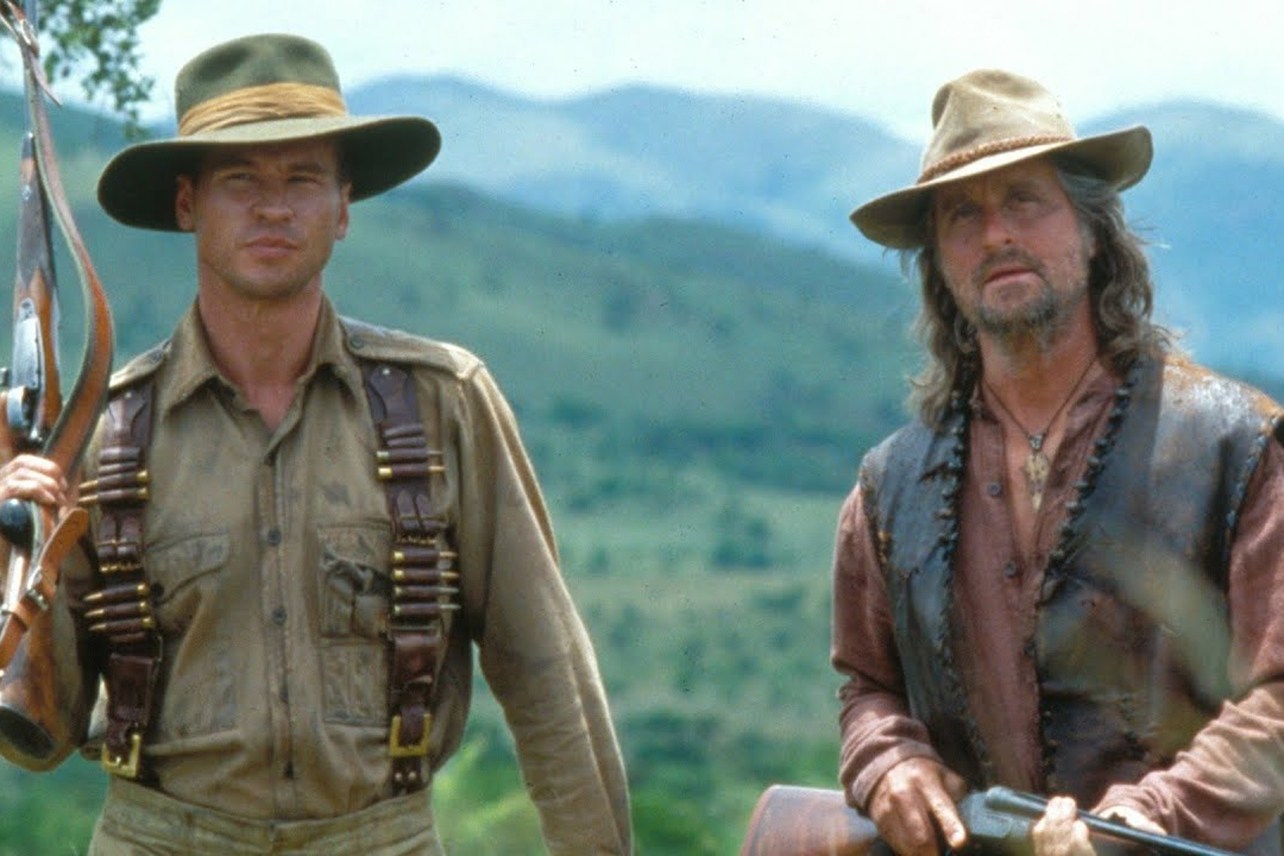
I’ve always been of the opinion that if Steven Spielberg had traded sharks for the Serengeti, The Ghost and the Darkness would’ve probably been the final result. Directed by Stephen Hopkins (Lost In Space, 24) and written by the late William Goldman (The Princess Bride), this 1996 historical adventure is a fictionalized retelling of the infamous Tsavo man-eaters, a pair of lions that terrorized workers during construction of the Uganda-Mombasa Railway in East Africa back in 1898.
Based on John Henry Patterson’s 1907 book The Man-Eaters of Tsavo, the film packed some serious star power with Michael Douglas (Ant-Man, Franklin) and then-Batman Val Kilmer, and eventually won an Academy Award for Best Sound Editing. More importantly, this was long before Hollywood became completely dependent on CGI, meaning many scenes featured real flesh-and-blood lions. Pair that with the sweeping scenery of the Songimvelo Game Reserve, Jerry Goldsmith’s thunderous score, and a gripping man-versus-nature story rooted in actual events, and you’ve got all the ingredients for what should’ve been a box office smash. Unfortunately, a troubled production and harsh reviews from critics like Roger Ebert — and eventually even Hopkins himself — left the film limping to a modest $75 million worldwide against its hefty $55 million budget.
Needless to say, The Ghost and the Darkness isn’t remembered as one of 1996’s defining blockbusters, especially when stacked alongside giants like Independence Day, Twister, and Mission: Impossible. Still, I’ve always had a soft spot for it. Sure, the plot takes some liberties with history, the camerawork occasionally feels flat and uninspired, and Douglas’ Charles Remington never really gets the larger-than-life Great White Hunter payoff you’re expecting, but there’s still plenty to enjoy by the time those end credits roll.
Like Spielberg’s Jaws, the film thrives on mounting tension as terrified locals face predators with frightening intelligence and insatiable appetites. Important events grind to a halt, specialists are brought in, and survival becomes the only thing that matters. Filling the roles of Brody, Hooper, and Quint this time around are Kilmer’s determined engineer John Patterson, Douglas’ charismatic hunter Charles Remington, and John Kani’s dependable foreman Samuel.
A huge part of the movie’s appeal comes from the chemistry between this trio. Kilmer plays Patterson as a capable but increasingly exhausted everyman who’s clearly in over his head, while Douglas swaggers into the film with enough charm and bravado to instantly shift the energy on screen. Meanwhile, Kani (Black Panther, The Lion King) gives Samuel a grounded sincerity that provides the story with a much-needed emotional backbone. Together, the three genuinely feel like men trying to survive an impossible situation rather than action movie archetypes simply trading exposition between lion attacks. Their camaraderie gives the film a human core that helps elevate it above your standard “killer animal” fare.
Speaking of those attacks, The Ghost and the Darkness still delivers some remarkably tense animal sequences nearly three decades later. Hopkins wisely treats the lions less like oversized house cats and more like calculating slasher villains lurking in the darkness. Whether it’s a sudden ambush in the tall grass, the terrifying hospital sequence, or the nighttime raids on the workers’ camp, the film understands how to build suspense through silence and suggestion instead of nonstop action. The lack of overdone CGI also helps tremendously because the lions feel tangible, dangerous, and completely unpredictable every time they appear on screen, this thanks in no small part to the amazing work done with trained African lions Caesar and Bongo (who also appeared in 1997's George of the Jungle with Brendan Fraser and Leslie Mann, for those who didn't know) during production.
Another thing working in the movie’s favor is its lean runtime. Clocking in at just under two hours, The Ghost and the Darkness never overstays its welcome. Hopkins keeps the story moving at a brisk clip, balancing character moments, historical adventure, and lion-fueled lawlessness without getting bogged down in unnecessary subplots or bloated spectacle.
It also helps that Goldman’s script never loses sight of the workers caught in the middle of the chaos. Their fear, exhaustion, and desperation give the film a real survival-horror atmosphere, making every lion attack feel tense and devastating. By the final act, you’re just as invested in seeing the railway completed as you are in watching the hunters bring down the beasts.
In short, The Ghost and the Darkness isn’t flawless, but it certainly is entertaining. Between its strong central trio, the nerve-rattling animal attacks, sweeping African landscapes, and Goldsmith’s unforgettable score, the film feels like a pulpy old-school adventure plucked from the golden age of Hollywood - albeit, one elevated by craftsmanship and loads of late '90s ambition. Even after 30 years, this blockbuster still packs plenty of bite!