

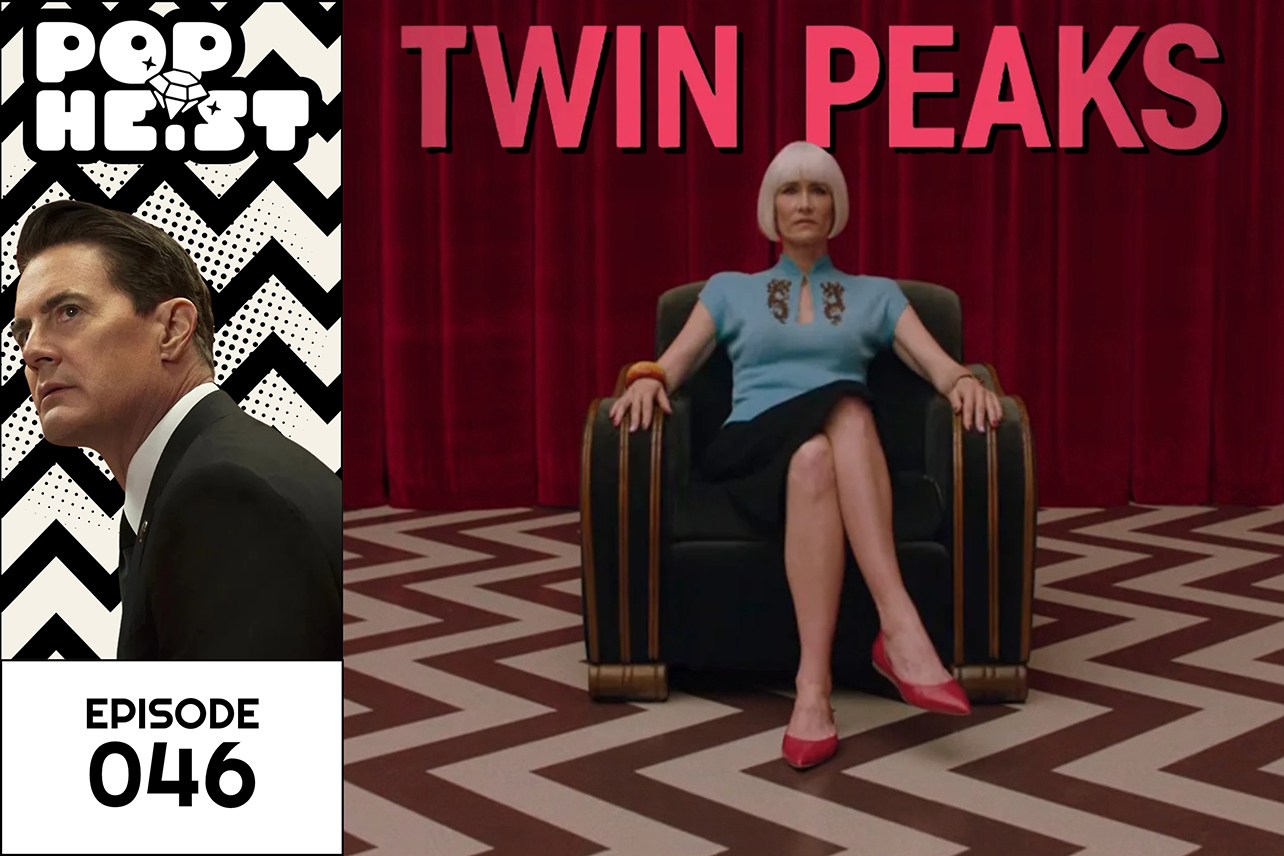
Twin Peaks Season 3, Episode 16: “Part 16”
Tagline: “No knock, no doorbell.”
Original Airdate: August 27, 2017
Writers: Mark Frost & David Lynch
Director: David Lynch
Cast: Kyle MacLachlan, Chrysta Bell, Jim Belushi, Jonny Coyne, Giselle DaMier, Owain Rhys Davies, Laura Dern, Josh Fadem, Eamon Farren, Sherilyn Fenn, Jay R. Ferguson, Miguel Ferrer, Pierce Gagnon, David Patrick Kelly, Robert Knepper, Andrea Leal, Sheryl Lee, Jennifer Jason Leigh, David Lynch, Clark Middleton, Don Murray, Tim Roth, Amy Shiels, JR Starr, Al Strobel, Naomi Watts
Musical Guest: Edward Louis Severson III (Eddie Vedder)
A review of Twin Peaks: The Return Part 16, “No knock, no doorbell,” in seven quotes.
1. “Goodbye, my son.”
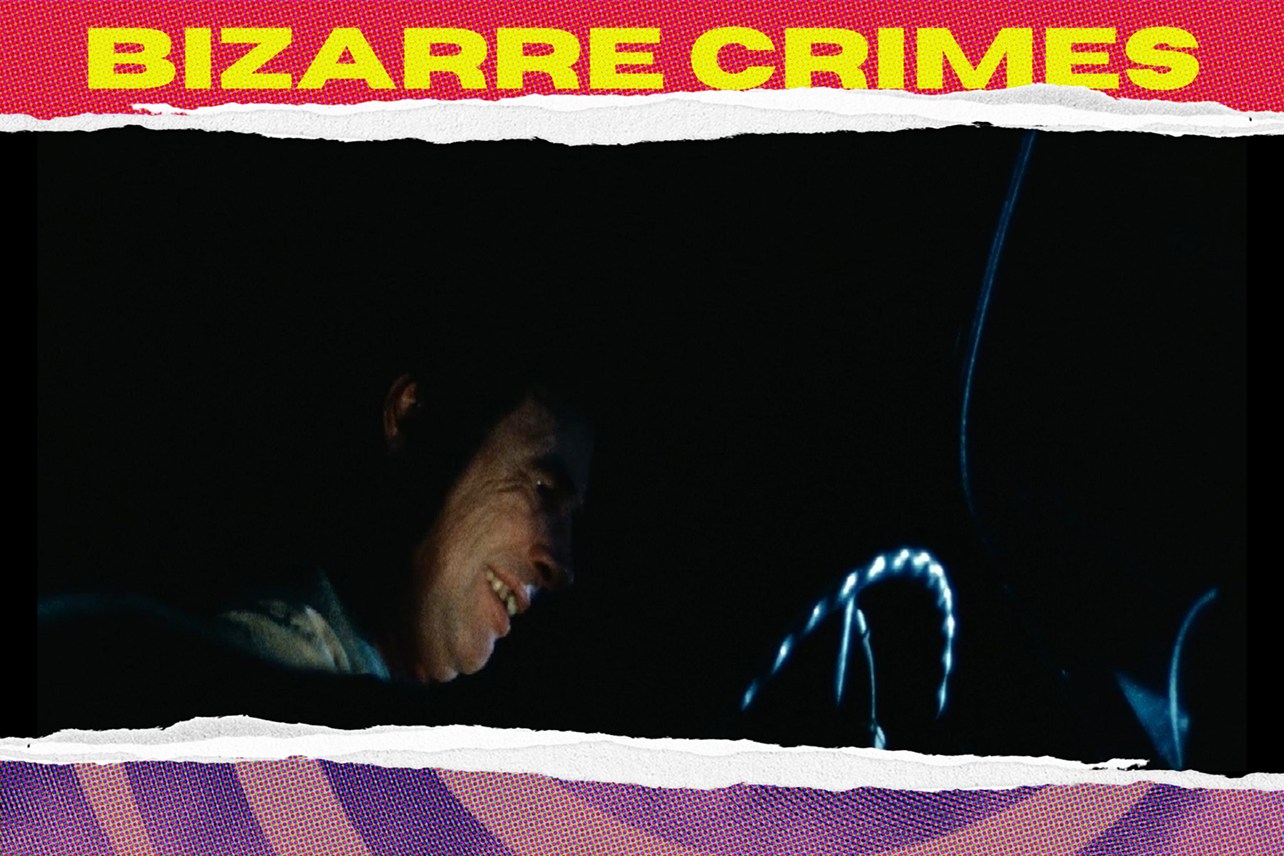
Richard Horne and Mr. C are a match made in hell. They wind down a dark highway in the dead of night, as creeps in David Lynch projects are wont to do. They stop near the coordinates the doppelganger has acquired…at least, one of the coordinates. He explains that he’s received this information from three different people — that would be the unfortunate Diane, the unalive Ray, and the indescribable Philip Jeffries — and that two of the three sets of numbers are the same.
“I’m looking for a place. Do you understand the place?” Mr. C asks, inscrutably. This, he tells Richard as they stand at the foot of a small hill with a boulder on top, is the place two of his three informants agreed upon. It’s right up there, on top of the boulder. Saying “I’m 25 years your senior,” a pointed statement given the nature of their relationship, the doppelganger hands Richard one of his several weird cellphones to use as sensor until he reaches the exact spot atop the boulder.
“I’m there!” Richard shouts when he reaches it. Then the forces of the Black Lodge electrocute him to death until he vanishes in a shower of sparks.
“Oh,” Mr. C says without a trace of emotion. “Goodbye, my son.” Sending a quick text message to an unknown person, he gets in his truck to leave.
This is the end of Richard Horne, the misbegotten son of a non-human inhabited by a demon and a comatose teenager. We’ll be seeing more from Audrey Horne, the teenager in question, by the end of the episode, and we’ll have many more questions about Richard’s upbringing to address then.
What’s crystal clear in the moment, of course, is what his father feels towards him: nothing. He doesn’t love him, he doesn’t hate him, and before the previous afternoon he never even bothered to have anything to do with him at all. Richard is useful to his infernal father for one thing: walking into a trap meant for Mr. C himself.
It’s impossible to mourn this man, of course, not after what we saw him do earlier in the season. If this is how he answers for the little boy and for the beaten schoolteacher and for his terrorized grandmother and disabled uncle, so be it. As we saw with Windom Earle last season, the Lodge has little use for its servants once they’ve outlived their usefulness. It consumes the souls of the just and the unjust alike. Its only interest is pain and suffering, and from the sound of his screams, Richard endures plenty of both before he finally disintegrates.
But it’s not hard to imagine Richard as a little boy, cursed with a devil’s genes. “That boy has never been right,” his grandfather Ben has said, as well as “Richard never had a father.” Imagine what a mind like Richard’s would have built up about his own father throughout his youth. A rogue FBI agent in a picture in your mother’s possession? I can’t conceive of the ideas Richard must have concocted, but I’m sure they either ended in rapprochement or revenge.
Instead, Richard’s father kills him, watching him fry like a bug in a zapper. He’s no more or less attached to his son than he is to an insect under his foot. Richard clearly feared he was a big nothing in the grand cosmic equation, and in the end, he was right. It’s an awful truth to witness.
Meanwhile, the still profoundly stoned Jerry Horne stumbles across the spectacle, which he watches through binoculars pointed the wrong way. He blames the binoculars for the horror he sees. That’s probably for the best.
2. “People are under a lot of stress, Bradley.”
Back in Las Vegas, “Dougie Jones” is in a coma following his electrocution in the previous episode. His hospital room bustles with well-wishers: his family, Janey-E and Sonny Jim; his boss, Bushnell Mullins; his newfound BFFs, the Mitchum Brothers; and Candie, Sandie, and Mandie, the Mitchums’ loyal attendants.
The Mitchums arrive bearing finger sandwiches to satisfy the Joneses’ appetites, then speed off to Janey-E’s house to fully stock it with food so she won’t have to cook while Dougie’s in the hospital. This is an S-tier friend move, by the way, so kudos to Rodney and Bradley for thinking of it.
Unfortunately, they’re not the only visitors to the house with the red door in the ghastly suburban development called Rancho Rosa. (This is also the name of the production company responsible for the show, as a distinctive staticky tag shows us before the opening credits every episode.) Hutch and Chantal, the talkative Southern lunatics tasked by Mr. C with lethally mopping up all his problems in Vegas, are staking the place out in their white van.
Naturally, the assassins are quite surprised to see Agents Headley and Wilson show up with a full team of Feds, on Gordon Cole’s orders. The agents find the home empty, and Headley furiously tasks Wilson with watching the house while he and the rest of his team go to Dougie’s office to try and locate him there.
Next, the Mitchums show up in a stretch limo, with a delivery van close behind. They, the girls, and some workers busily carry food and supplies inside.
“Looks like a fucking circus parade,” Chantal says, not inaccurately.
Then a wild card gets tossed into the mix: a bald Polish accountant in a brown leather jacket named Zawaski. Approaching the van, he tells them they’re in his driveway, which as best I can tell they are not. Chantal tells him so, in her own inimitably foul way. (“You on the rag?” Hutch asks her earlier; “What if I fuckin’ was?!?” she replies.)
“I move car,” Zawaski says, then begins trying to forcibly push their vehicle with his own. Pissed off now, Chantal fires a shot at him.
So he goes into his trunk, pulls out a fully automatic pistol with a clip the size of your forearm, and totally fucking annihilates these two assholes and their shit-ass van.
Like the FBI agents in their car, Bradley and Rodney witness most of this gun battle from a distance, hiding near Dougie’s front door.
“What the fuck kind of neighborhood is this?” Bradley asks.
“People are under a lot of stress, Bradley,” Rodney replies. Bradley can only agree.
I mean, aren’t they? Hasn’t that been the point of so much of Season 3? Scene after scene about incurable illnesses, health care, money, addiction, poverty, domestic violence, random violence. The world that the Bookhouse Boys once tried to keep out of Twin Peaks has only worsened — metastasized is perhaps the better word. Now it’s a world where contract killers with countless bodies on them get murdered by an angry accountant in a road rage incident while two casino-owning gangsters can only look on in disbelief.
This show aired in 2017. Have people’s stress levels improved?
3. “I am the FBI.”
This is the big one. This is the moment to which the entire season has built. This is something you knew you wanted, wanted badly even, but it’s not until you actually get it that you realize how deeply you’d missed it, and how profoundly you needed it back.
In the Vegas hospital where “Dougie Jones” lies comatose, Bushnell Mullins, who’s standing watch over his beloved colleague, begins to hear the same high-pitched hum heard by Ben, Beverly, and James in the Great Northern up in Twin Peaks. As he wanders off to search for the source, Mike appears, transmitting from the zigzagged, red-curtained confines of the Black Lodge.
Dale Cooper wakes up to greet him.
You know it right away. You can see it in the alertness in his eyes, the swiftness of his movements. You can hear it in how he breathes. This isn’t the zombified Dougie Jones anymore. This is FBI Special Agent Dale Cooper.
“You are awake,” Mike says to him.
“One hundred percent,” Cooper replies. It’s not Dougie’s voice, and it’s not Mr. C’s. It’s Coop’s.
This is Coop!
A transaction then takes place. Mike gives Cooper the ring. After asking Mike “Do you have the seed?”, Coop plucks out some of his hair and gives it to the One-Armed Man, telling him “I need you to make another one.”
Coop is a take-charge kind of guy, as always, and he speaks and acts with his familiar, inimitably crisp diction and syntax, efficiency and speed. Cramming finger sandwiches into his famished gullet — he hasn’t eaten since the George H.W. Bush administration! — he gets a doctor to confirm he’s a-okay, then sends Janey-E and Sonny Jim to fetch the car, which he’ll drive. He has Bushnell call the Mitchum Brothers and get him a plane to Spokane, so that they can go to a town called Twin Peaks.
Before he leaves, he shakes his erstwhile boss and friend’s hand. “You’re a fine man, Bushnell Mullins,” he says, as the honest-to-god Angelo Badalamenti “Twin Peaks Theme” plays on a soundtrack that until now has been almost all ominous whooshes by Dean Hurley. You feel it in your bones. Battling Bud is a fine man. They’re both fine men.
By now, Bushnell has heard from Phil back at the office that Headley’s feds are on their way to the hospital. “What about the FBI?” he asks Cooper.
Coop turns to the camera reassuringly. “I am the FBI,” he says.
This is a high point of Twin Peaks. Honestly, it’s a high point of my life. I’m incapable, I’ve learned, of watching it without sobbing tears of joy. After decades apart, my dear friend Dale Cooper has returned.
4. “I’m not me.”
Diane has been activated. Immediately after watching his son fire walk with oblivion, Mr. C sends a text message reading simply “ :-) ALL”. But he’s out in the middle of nowhere and the text goes undelivered.
It’s not until we see Diane at the bar the next day that we see it reach its intended recipient. The platinum-bobbed, foul-mouthed FBI vet immediately goes into shock, her body going rigid as though subjected to an electric current. It’s not hard to guess with the message means anymore.
Massive drums on the soundtrack follow her up from the bar, into the elevator, and over to the room where Gordon, Albert, and Tammy are working. Once again, Gordon shows a glimmer of psychic ability. He already seemed to have sensed Coop’s impending awakening through the hum of the Bureau’s many machines and monitors; somehow, he knows Diane is at the door before she even knocks.
When she comes in, she sits down and finally reveals what happened the night she saw “Cooper.” He’d already been gone for years, and suddenly there he was in her apartment, “no knock, no doorbell.” She was overjoyed and wanted to know where he’d been and what he’d done, but instead he “grilled” her about happenings at the Bureau, no doubt wondering if his old friends Gordon and Albert were on his trail.
Then he kissed her, something that had only happened between them once before. (Coop, you sly dog.) But the moment their lips touch, she becomes afraid…and her fear makes her old friend smile.
The memory causes her to break down in tears. “His face…” she says, making a gesture mimicking the effect of Bob’s face emerging from the doppelganger’s own. “And that’s when it started. He raped me. He raped me.”
Laura Dern is burning like a candle by now, like a fuse on a rocket. Tremulously, she recalls “Cooper” taking her to “an old gas station.” I’m sure you can picture that place in your mind even now.
Then she starts speaking like she’s just realized something shocking and profound. “I’m in the sheriff’s station,” she says, repeatedly, while admitting she sent Cooper the coordinates.
“I’m not me,” she starts saying, her face a mask of confusion and agony. “I’m not me! I’m not me! I’m not, I’m not me!”
All this time she’s been fiddling with her purse, which contains a revolver. Albert has noticed and reached into his jacket.
She draws. Albert and Tammy pull out their guns and fire first, hitting her.
She disappears.
Tammy is amazed. “That was a real tulpa,” she says.
“Sheriff’s station,” Gordon says. Clearly, it sounds familiar to him.
In another place, Diane sits on a chair in the red room, regal, defiant, magnificent.
“You were manufactured,” Mike tells her.
“I know,” she says. “Fuck you.” Then her face cracks open, allowing black smoke and a golden orb to escape. Her body shivers and collapses as electricity erases her from existence, forcing Mike to shield his eyes. When he looks again, there’s a tiny golden seed where “Diane” used to sit.
This raises the question: If the real Diane is at the Twin Peaks Sheriff’s Department, where is she? Who is she?
5. “Whoever you are…thank you.”
Before he and the Mitchums head off, they meet up at the brothers’ casino. There, “Dougie Jones” pulls his wife and son aside to say goodbye to them, telling them he has to leave. “You’ve made my heart so full,” he tells them, telling them they’re a family. Then he slips up: “Dougie — I mean, I will be back.”
This freaks both Janey-E and Sonny Jim out, but Coop repeatedly reassures Sonny Jim that he really is his son. And he is, isn’t he? Sonny Jim was co-authored by a duplicate of Coop. He’s taking responsibility for the boy in a way Mr. C, who directly fathered Richard by committing a horrible crime, never did, never would, never could.
But he promises to return. “I’ll walk through that red door, and I’ll be home for good.” When you connect the dots — the original manufactured Dougie Jones and his golden seed, the manufactured Diane and her golden seed, Coop’s gift to Mike of a few strands of his hair and request that he “make another one” — you can start to imagine what our special agent has in mind.
“Don’t go!” Sonny Jim pleads, in full Shane mode.
“I have to,” Coop says, every bit the stoic but golden-hearted hero.
Before he leaves, Janey-E approaches him. She knows now that this man is not the Dougie she knew, but his presence in her life was nevertheless some kind of miracle. “Whoever you are,” she says, “thank you.” Caressing his face, she kisses him passionately, a deliberate contrast with the kiss of death his doppelganger gave Janey-E’s estranged sister, Diane. She knows this is not goodbye, it’s farewell. Fade to black.
6. “You both have hearts of gold.”
“Dougie, let me get this straight,” says Rodney Mitchum. He and Bradley and Candie and Mandie and Sandie and “Dougie” are in the back of a limo, enjoying drinks (Coop has a coffee, naturally) and one another’s company. “You don’t sell insurance. You’re an FBI agent, who’s been missing for 25 years, and we need to get you to a town called Twin Peaks, to a sheriff’s station.”
I mean, when you put it that way…
“Dougie, we love you,” says a dyspeptic-looking Bradley, “but we are not traditionally welcome at such places.”
“Or by such aforementioned people,” Rodney chimes in. “Law-enforcement types.”
“I read you one hundred percent,” Coop replies. “Friends, that’s about to change. I am witness to the fact that you both have hearts of gold.”
“They do,” Candie coos, absolutely beaming. “They really do!”
Brad throws his arm around Coop and rests his hand on Rod’s shoulder. Rod squeezes it. Both men look so very happy, absolutely delighted to hear Candie say that about them.
And suddenly, my reservations about the Mitchum Brothers are put to rest. Okay, so they’re gangsters, and casino owners. So they rough up their employees occasionally (although again, it was Brett Gelman, so whatever) and take out the occasional contract on someone’s life (although again, it was Ike the Spike, so whatever). When it comes down to "nut-cutting" time, as Lyndon Baines Johnson would say, Bradley and Rodney are alright. Candie’s vote of confidence, and their obvious happiness over it, speaks volumes. But of course, so does the endorsement of FBI Special Agent Dale Cooper, sound of body and mind, keen of judgement, pure of heart.
7. “What?”
Back in Twin Peaks, another superstar graces the stage of the Roadhouse. The emcee introduces him as Edward Louis Severson III, but he’s better known to you and me as Eddie Vedder. While the credits separate him out from the main cast the way they usually do with this season’s musical guests, they list him under his more famous Pearl Jam lead-singer name, with his real name where the characters’ names usually go.
That’s odd.
Near the tail end of his performance, Audrey and Charlie finally, finally, arrive at the Roadhouse. So that settles the question of when their eternal-seeming argument was taking place: tonight, apparently. I mean, I guess. Logic would suggest it.
But still. That’s odd.
Anyway, Charlie sidles up to the bar and orders two martinis, grabbing Audrey a seat. She makes a point of toasting to Billy rather than to them.
“Ladies and gentlemen,” says the elderly host, “Audrey’s Dance.”
All eyes turn to Audrey. The crowd wordlessly vacates the dance floor. The band begins playing the music she once danced to on the Double R’s jukebox as a teenager 25 years earlier.
Okay. Maybe she’s famous in town. Maybe she’s done this before. But the mesmeric way she reacts, the synchronized swaying of the crowd to the music, the spotlight that falls on her amid the purple glow of blue lights on red curtains…that’s odd. Increasingly odd. Disturbingly odd.
But her dance isn’t. It’s beautiful. Charlie seems unimpressed, but the rest of us? It’s like Coop waking up. It’s something we’ve wanted to see all season long. It’s something we’ve wanted to see for decades.
Then some drunk guy lobs a bottle at another guy’s head for dancing with his wife, and this magic moment is shattered. For the audience on the other side of the screen, it’s one more display of lowlife behavior at the Roadhouse — one of the season’s most consistent signs that Rodney’s right and people are under a lot of stress.
For Audrey, it’s too much, too much. She runs right up to Charlie, almost speaking right into the camera. “Get me outta here!” she whimpers.
With an electrical hum, we cut to a white room, or a white void. Audrey, wearing no makeup, her hair in a ponytail, wearing some kind of white garment, looks into a round mirror.
“What?” she asks, now completely consumed by panic. “Wha-what? Ohh! Ohhh!”
As electricity continues to hum, the screen cuts to black. We fade back in at the band in the roadhouse, their backs to the red curtain. And as the credits roll, the band plays backwards.
You can read the signs and symbols here in various ways. There’s the temporal anomaly of Charlie and Audrey’s long argument to consider, weighed against the solidity of other Twin Peaks residents’ mentions of her boyfriend Billy and his strange disappearance. The purple lighting of Audrey’s dance has only one analogue in the setting, the purple ocean that surrounds the White Lodge.
The white room and the mirror could mean Audrey is in an institution, or it could mean she never recovered from the coma she was sent into by the bomb at the bank in Season 2 and is trapped somewhere in her own mind, or it could be a cosmic void unlike any we’ve seen before. The red curtains, the electrical hum, and the backwards band all point towards the Black Lodge, so the white room could mean her soul has been torn from her body and she is now is nowhere at all.
A confident “I am the FBI.” A terrified “What?”
Where is this road headed?