

Twin Peaks Season 3, Episode 15: “Part 15”
Tagline: “There’s some fear in letting go.”
Original Airdate: August 20, 2017
Writers: Mark Frost & David Lynch
Director: David Lynch
Cast: Kyle MacLachlan, Jay Aaseng, Joe Adler, Mädchen Amick, Dana Ashbrook, David Bowie, Catherine Coulson, Owain Rhys Davies, Eamon Farren, Sherilyn Fenn, Jay R. Ferguson, Miguel Ferrer, Patrick Fischler, Robert Forster, Nathan Frizzell, Mark Frost, Pierce Gagnon, Harry Goaz, Grand Goodeve, Michael Horse, Caleb Landry Jones, Sheryl Lee, Jennifer Jason Leigh, Peggy Lipton, James Marshall, Everett McGill, Clark Middleton, Casey O’Neill, John Pirruccello, Kimmy Robertson, Wendy Robie, Tim Roth, Rod Rowland, Carlton Lee Russell, Malachy Sreenan, Harry Dean Stanton, JR Starr, Jessica Szohr, Jake Wardle, Naomi Watts, Alicia Witt, Charlyne Yi, Nae Yuuki, Anthony Marcacci
Musical Guest: The Veils (Finn Andrews, Sophia Burn, Uberto Rapisardi)
In Memory Of: Margaret Lanterman
“I’m dying.”
She was. Catherine E. Coulson, the actor who turned the Log Lady from a bit part into an icon of Twin Peaks, was dying of cancer when she delivered this final performance. It is impossible to divorce my feelings about this from my feelings about the Log Lady’s final scene. I cannot help but see it as a farewell from Coulson herself, courtesy of her old friends and collaborators Mark Frost and David Lynch. Hearing her last phone call to Hawk feels like hearing the last words of a loved one.
Hawk, I’m dying….You know about death, that it’s just a change, not an end. Hawk, it’s time. There’s some fear, some fear in letting go….Hawk, my log is turning gold. The wind is moaning. I’m dying. Goodnight, Hawk.
“Goodnight, Margaret,” Hawk says before the call ends. “Goodbye, Margaret,” he adds afterwards. He gathers Andy, Lucy, Bobby, and Frank in the conference room, and tells them that Margaret has died.
“The Log Lady’s dead?” Lucy asks. You can hear the disbelief in her voice. The Log Lady has always seemed like a woman out of time, eternal.
But when those tears fall, they’re not just the tears of Lucy Brennan. That’s Kimmy Robertson, crying for her old friend. You can see it, you can hear it. She’s mourning a woman she really has lost.
All of us are. Coulson’s Log Lady was the soul of the show, one of the white wizards, a gentle force for good. Even among her dying words she finds time to warn Hawk to watch out for “the one under the moon on Blue Pine Mountain,” which feels instantly important. Such was her power that she transcended the fourth wall, providing a series of extracanonical introductions to each episode of the first two seasons that were written by Lynch for reruns of the show on Bravo. (It was a different kind of network back then.) Perhaps this is why she alone has received “In Memory Of” tags both for the actor and, in this episode, the character herself. It somehow feels that the Log Lady existed in both worlds at once.
This is television of astonishing power, honoring both a real person who mattered to people and the art she made, which also mattered to people — in many cases, mattered more to those people than any other art.
And this occupies, what, a tenth of the runtime of this episode, if that? These 55 minutes include some of the most ecstatic emotional highs and most abject emotional lows we’ve ever seen on this show. If you told me it was your favorite Twin Peaks ever, I wouldn’t argue with you for a second.
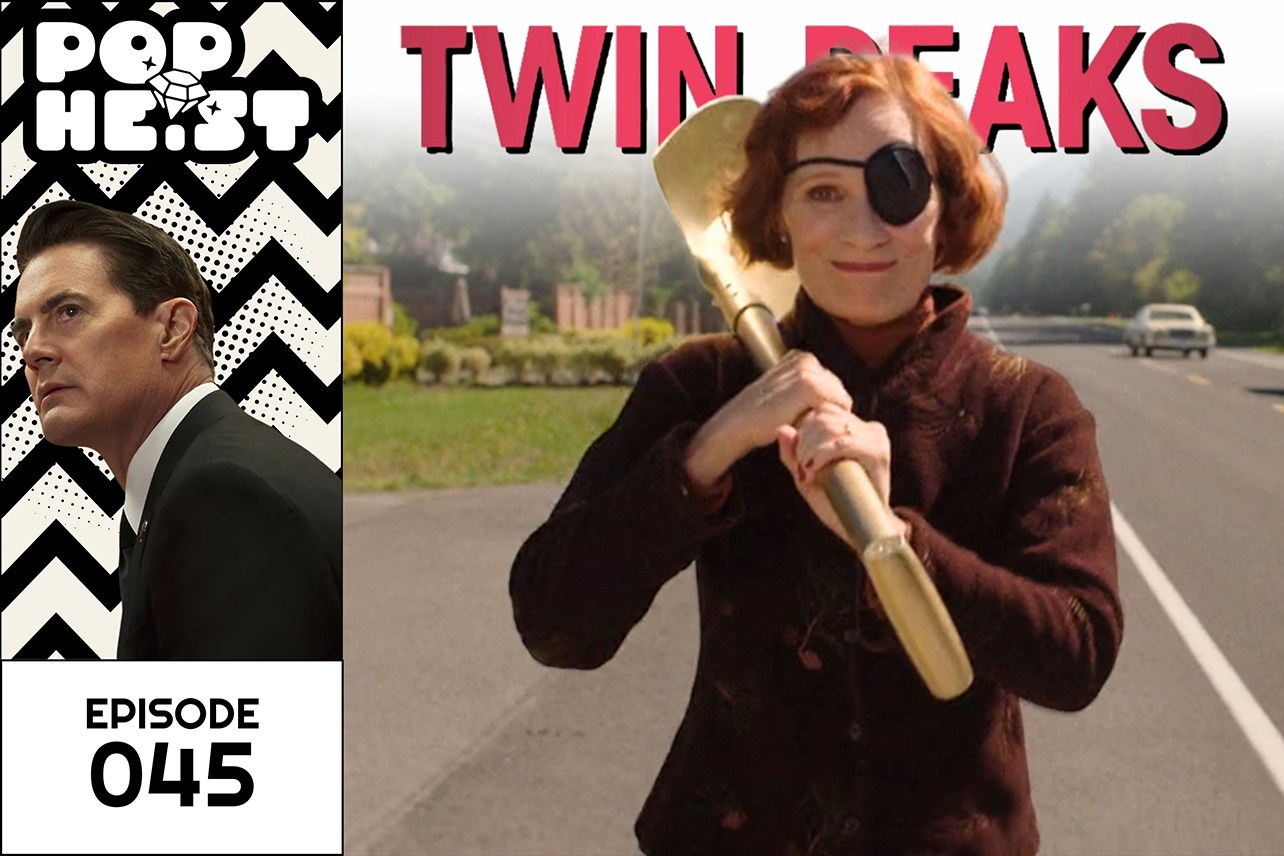
In this same episode, a happy ending we’ve wanted since 1990 finally arrives. Marching from their house to Big Ed’s Gas Farm with her golden shovel slung over her shoulder, Nadine Hurley walks up to her husband … and does not hit him with the shovel, as it seemed she might. Instead, she informs her husband that he’s free — that she regrets knowingly keeping him apart from his true love Norma all these years, but she’s seen the light thanks to Dr. Amp and wants to give him the gift of happiness.
Ed’s initial skepticism — you’d be skeptical of anything involving Dr. Jacoby too — gives way to resolve almost immediately. As Otis Redding’s “I’ve Been Loving You Too Long” plays, Ed strides smiling into the Double R ... only for his smile to wilt when Norma brushes him off so she can talk to her business partner and boyfriend, Walter. Stunned, Ed sits down and orders coffee. “And a cyanide pill,” he mutters under his breath. He closes his eyes and sits there, defeated.
Then a familiar hand emerges from behind him and rests on his shoulder. Reader, you’d best believe I cried.
Norma only wanted to talk to Walter to end their business partnership and their relationship. She doesn’t need to franchise her diner when she’s got everything she wants right there at home. Apparently, that includes Ed, who proposes on the spot. Their kiss melts Shelly’s heart; Otis Redding’s music sails off into the blue, cloud-strewn sky. Frost and Lynch’s belief in the transcendent power of love couldn’t be made more visually clear than it is here. Like that little boy’s soul ascending, or Laura Palmer’s descending, we belong in the heavens.
Of course, hell on earth is just as real in the Twin Peaks world. Not far away from where Shelly thrills to Norma and Ed’s joyful reunion, her son-in-law Steven, out of his mind on drugs, shoots himself to death in the woods. Gersten Hayward, his girlfriend, survives — when the couple is spotted by former newscaster Cyril Pons (Mark Frost, reprising his cameo role from the original series), she panics and makes a run for it, narrowly avoiding what seemed almost certain to be a murder-suicide. Cyril relates what he’s seen and heard to Carl Rodd, owner of their trailer park, so it’s only a matter of time before Shelly, Bobby, and their now-widowed daughter Becky will have this tragedy added to their plate.
Down in Las Vegas, where the bumbling FBI office pulls in the wrong Doug and Jane Jones for questioning (along with their screaming kids), a different kind of gun violence is set loose. Chantal and Hutch have arrived in town, and executing Duncan Todd and his assistant Roger is the first item on their to-do list. Blowing Duncan’s face apart, then having to come back and finish the job on Roger when his gasps for breath give away his survival, doesn’t stop Chantal’s hunger for hamburgers.
Sitting and eating fast food in their van, the happy couple discuss the degraded state of the nation, which — get this — employs people to kill other people. This deeply offends these professional killers, on the grounds of hypocrisy.
“The government does it all the time,” Hutch says. “People get paid for it, too, just like us.”
“Damn right,” Chantal chimes in between mouthfuls. “Two-faced fucks.”
“So-called Christian nation,” Hutch continues, wound up now. “Might as well be ‘Thou shalt kill. Show no mercy. Forgive no one.’ It’s a nation of killers, killing all along. Killed damn near all the Indians, didn’t they?”
Granted, from there the conversation kind of veers off course — they begin talking about how much fun Chantal has torturing people, and how “you can’t torture a corpse.” But don’t let the messengers obscure Hutch’s message, which is inarguable, and one of the main points this frequently bleak season of television has been making. Twin Peaks and America, in all their wonder and horror, are one and the same.
But there’s at least a glimmer of hope down in Sin City as well as sin. While mindlessly monkeying around with a TV remote, “Dougie Jones” stumbles across an airing of Sunset Boulevard, during which a character asks for someone named “Gordon Cole.” In real life, this is where Lynch got the name for his character on the show. In the show, it’s what seems to trigger Dougie’s inner Cooper more than any other phrase or image or object so far, even more than coffee and cherry pie. Seeing a look of urgency on his normally placid face hits like a gust of cold air.
Suddenly the familiar hum of Lodge electricity, the fire on Hawk’s map, emerges from a socket in the wall. Dougie crawls over with a fork and sticks it right in there, electrocuting himself and blowing the fuse. Witnessing it helplessly from across the house, Janey-E screams as everything goes dark.
Honestly, the forces of good are having a rough time of it this episode. Back in Twin Peaks, things are swinging at the Roadhouse, where the dapper MC dances to ZZ Top’s “Sharp Dressed Man.” But James gets decked and jumped by the husband of Renee, his seemingly requited crush, for daring to say hello. The timid biker is outnumbered and beaten to the ground.
When James’s pal Freddie intervenes against the guy and his buddy, a single punch from his righteous green-gloved fist sends them both into scary-looking seizures.
The punches land James’s attackers in intensive care and Freddie and James in the Sheriff’s Department’s holding cells. (Even funny violence has real, unpleasant consequences this season.) There they join Deputy Chad, mystery woman Naido, and the nameless drunk, who are all still carrying on in the same slightly maddening fashion.
Meanwhile, evil incarnate creeps ever closer to his destination. Using the coordinates he got from Ray (who got them from the recently deceased Bill Hastings’s secretary), Mr. C arrives at the convenience store, above which the denizens of the Black Lodge dwell. The building, which does not actually have a second story that’s observable from outside at all, is crawling with soot-covered woodsmen.
These demons guide him through spacetime and into the same creepy room that was in the photo Laura Palmer was given by the Lodge’s Mrs. Tremond and her grandson in Fire Walk With Me. (You’ll notice it doesn’t actually have a second story at all.) There, he faces a woodsman (Anthony Marcacci) operating a machine that sizzles with white electricity; during the flashes, the red-suited, white-masked, pointy-nosed Jumping Man (Clayton Lee Russell) from Fire Walk With Me briefly appears.
Mr. C passes muster with these guardians and walks through a dark hallway to some kind of motel or apartment courtyard. A backwards-speaking woman of the Lodge wearing a soiled robe (Malachy Sreenan) lets him into room number 8.
Inside, the doppelganger finally tracks down the man Ray claims ordered his assassination: Philip Jeffries. Only he’s not a man at all now — or if he is, he’s sealed inside some kind of giant teapot reminiscent of the strange metallic objects we saw in the building on the purple sea.
(Jeffries’ voice is provided by Nathan Frizzell, who also dubbed over reused dialogue from original actor David Bowie; he was both too ill to participate himself and too much of a perfectionist to allow what he considered his substandard Southern accent to mar Lynch’s masterpiece, hence the voice actor.)
The Jeffries-Thing vaguely denies responsibility for the death sentence on the doppelganger, as well as calling him several days earlier. But the doppelganger, who apparently shares the memories of the real Cooper up until the point of their divergence, asks about that fateful day at the Philadelphia office long ago, when Jeffries briefly appeared…and refused to “talk about Judy.”
Convinced he’s talking to the real Cooper now, Jeffries extrudes numbers that appear to be a second set of coordinates in the steam emerging from his/its spout, like Gandalf blowing elaborate smoke rings. But when the doppelganger presses Jeffries about Judy’s identity, the ex-agent cryptically says this: “You’ve already met Judy.”
Since Jeffries thinks he’s talking to the real Cooper, let’s assume this means the real Cooper has met Judy. Suddenly we have a list of suspects as long as the female cast list from Seasons 1 and 2, along with Diane.
But before the doppelganger is granted his brief audience with Jeffries, the red-suited, white-masked, beak-nosed Jumping Man from Fire Walk With Me appears, his face blurred and distorted and shaking and morphing uncontrollably.
Does this face look familiar to you at all? Have you already met them too?
After Mr. C is expelled from the Lodge back to terra firma, he is confronted by none other than Richard Horne, who followed him from the farm where that gang of criminals was headquartered. Richard recognized him as FBI, you see, from a photo on the wall of his mother…Audrey Horne. Richard just wants his dad, it seems. Mr. C decks the little piece of shit for drawing a gun on him, but lets him ride shotgun in his truck, saying they’ll talk things over as they drive.
The episode’s final two scenes — three, really, as we’ll see — leave us in darkness. First, we return to the home of Audrey and her husband Charlie, where Audrey snaps and physically attacks him as they continue the argument about finding her lover at the Roadhouse that they’ve been having for…how many nights has it been now? How many days? Or are all these scenes meant to take place at some yet to be reached point in the future, when Audrey will finally make it to the Bang Bang Bar to find her beloved Billy? Where is Audrey? Where has she been?
When we arrive at the Roadhouse for the usual musical performance, we watch a pair of hulking bikers physically lift a timid woman (Charlyne Yi) out of a booth she’s occupying by herself — she says she’s waiting for someone; maybe it’s Billy — and deposit her on the floor. She sits there meekly for a moment, then gets on her hands and knees and crawls into the crowd. There, amid the revellers, she begins to scream and scream. We never learn why.
The credits roll over a shot of the courtyard outside Philip Jeffries’s room, which is troubling enough. But just before the familiar Lynch/Frost production tag shatters the silence, the scene cuts to a different view, one that reveals the robed woman from the Lodge watching us from the darkness. Who else would she be watching? We’re the only ones there. Maybe that doesn’t make literal sense, but neither does the credits memorializing a fictional person.
We are close to the end now, a vortex drawing us ever deeper. It seems wise to expect reality to become un-fixed as we move closer to the center of it all. Because the emotions all remain true, it feels scary to watch this show now, not knowing what will happen in the few hours that remain. But that’s natural. We’re leaving what’s solid behind, and there’s some fear, some fear in letting go.