

Skip to Content
Member Exclusive

‘Twin Peaks’ 3×06 Recap: A Dark, Dark Age

"What kind of world are we living in where people can behave like this?"

12:48 PM EDT on August 17, 2026

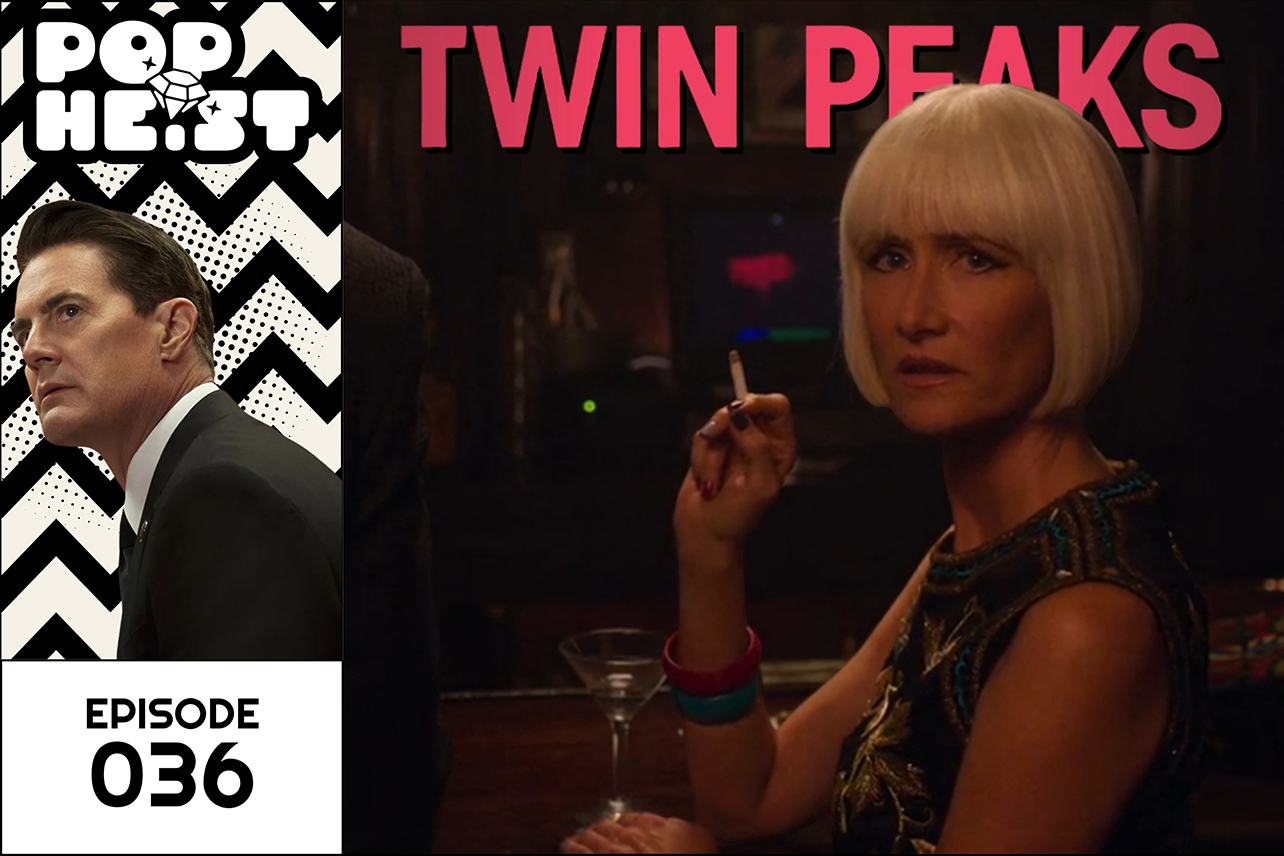
Laura Dern in Twin Peaks

Twin Peaks Season 3, Episode 6: “Part 6”
Tagline: “Don’t die.”
Original Airdate: June 11, 2017
Writers: Mark Frost & David Lynch
Director: David Lynch
Cast: Kyle MacLachlan, Mädchen Amick, Tammy Baird, Ronnie Gene Blevins, Candy Clark, Lisa Coronado, Jeremy Davies, Laura Dern, Josh Fadem, Eamon Farren, Miguel Ferrer, Patrick Fischler, Robert Forster, Pierce Gagnon, Hailey Gates, Balthazar Getty, James Grixoni, Andrea Hays, Michael Horse, Sheryl Lee, Jeremy Lindholm, Sarah Jean Long, David Lynch, Don Murray, John Pirruccello, Hunter Sanchez, Tom Sizemore, Harry Dean Stanton, Al Strobel, Jodee Thelen, Naomi Watts, Christophe Zajac-Denek
Musical Guest: Sharon Van Etten (Sharon Van Etten, Carolyn Pennypacker Riggs, John Phillip Iron III, Zeke Hutchins)


This is the hit-and-run episode.

Other things happen in the sixth episode of Twin Peaks’s return — funny things, fascinating things, frightening things, things we’ve waited to see for 25 years. Most of them fade in the glare of white-hot agony generated by that one scene. It is one of the most viscerally upsetting moments in both David Lynch’s oeuvre and, frankly, the history of television drama.

Children have died on TV many times before, of course; Law & Order: Special Victims Unit wouldn’t be on its 27th season, and the medical procedural genre wouldn’t exist, if they didn’t. Even in Twin Peaks, Laura and Maddy and Ronette may technically have been 18, but they were high school students, and we’ve watched their murders play out in horrific detail. 

But there’s watching an adult actor pretending to be murdered by another actor pretending to be possessed by a demon, and there’s watching some truck-driving asshole decide he’s Mr. Important and mow down a happy little boy in front of his mother. The former is a metaphor for the sexual and domestic violence that goes on behind closed doors in sleepy suburbs all over America. The latter is not a metaphor at all, but something that can happen to your kids tomorrow. Maybe it already has happened to a family you know.

Seeing it happen on camera is almost unbearable. I know because I almost couldn’t bear it. The impact of the scene when I watched it the first time was bad enough, but somehow knowing it was coming made it worse, not better. I felt sick with anticipation the moment I realized what episode I was watching. My stomach was nauseated. My head pounded. My body started to shake. Even before it happened I could barely suppress the tears I knew were coming.

Then Richard Horne plows through that intersection, runs over a little boy (Hunter Sanchez) who is laughing and playing with his loving mother (Lisa Coronado). She sees her son’s death in front of her. She screams and screams and screams. She runs to his little body, lifting him bloody from the ground, his head dangling limply. She holds him against her chest, hand on his head, and sobs from somewhere unfathomable inside herself. Her world has ended.

She is not alone. All around the intersection, horrified onlookers rush out of their cars or gather on the sidewalk. Some hide their faces in their hands, unable to take it. Others cling to the person they’re with, sensing that a loss nearly as terrible could happen to them at any time. But no one can save the boy, or stop the runaway driver.

There is one person nearby who gets a good look at him: Miriam (Sarah Jean Long), a bubbly young schoolteacher who tips so big at the Double R despite her shamefully low salary that Shelly and Heidi (Andrea Hays, returning from the original series) agree her next order of pie is on the house. Unfortunately for Miriam, Richard sees that she’s seen him, although at the moment even he seems consumed by the fact that he’s done something terrible. All the rest of the witnesses can really do is look on.

One person among them is different. 

Carl Rodd is a minor character in the Twin Peaks universe, although he is played by a major actor, Harry Dean Stanton. His only appearance is in Fire Walk With Me, where, as the owner of the Fat Trout Trailer Park where murder victim Teresa Banks lived, he interacts with Agents Chester Desmond, Sam Stanley, and eventually Dale Cooper. He was last seen on the other side of a dirty car windshield upon which the phrase “Let’s Rock” was scrawled in lipstick. 

“I’ve already gone places,” he told Desmond. “I just wanna stay where I am.”

Twenty-five years later, Carl takes a daily trip into town just to sit in the park, take in nature, maybe do a little people-watching. Today he is accompanied by Mickey (Jeremy Lindholm), who helps take care of his wife, a disabled veteran. “Fucking war,” Carl spits. The problem is the red tape poor and disabled people are forced to go through keeps her from getting the care she needs for months on end. “Fucking government,” Carl adds. 

For his part, Carl seems fine. Old, yes, frail, yes, but still ticking despite his habits. “I’ve been smoking for 75 years,” he tells Mickey, grinning. “Every fuckin’ day.” (If you’ve come to a David Lynch project for anti-smoking messaging, you’ve come to the wrong place.)

Carl’s unassuming trip to the park puts him in the right place at the wrong time. It enables him to bear witness. Not just from his park bench, where he watches the boy goofing around with his mom before the accident. Unlike the other witnesses, though, he sees more than just the child’s life and death. Drawn to the scene by the mother’s screams, his horror turns to awe as he watches the boy’s soul ascend from his body in fiery form before disappearing.

God,” he mutters, one of the few times I’ve ever heard this mild, reflexive expletive truly mean what it says.

Then Carl does something no one else could do. As a standout piece by composer Angelo Badalamenti plays, Carl walks over to where the mother is cradling her dead child, kneels down, and puts his arm around her. He doesn’t do anything, doesn’t say anything, doesn’t adopt a smiling or comforting affect. His face is as stern as a cliff.

But something in his eyes comforts the mother, who looks up at him. Perhaps she can sense that he has seen what he has seen — that he has been places. His eyes have taken in the totality of her son: his life, his death, his afterlife. His gaze is an acknowledgement that all these things, wonderful and terrible, were real, that they meant something, that they mattered. He has done more than witness this tragedy. He has borne witness to it. 

Other forces, it seems, have also been drawn to the scene. Somehow, the utility pole numbered “6 - 324810” that previously stood in Carl’s trailer park is now right there. The whooping sound associated with the pole — the sound of the Arm, the Man from Another Place — does not recur, but there is the telltale buzzing of electricity associated with the Lodge. Perhaps that’s because the Arm has evolved.

As for Richard Horne, he too has a run-in with dark forces he does not understand. He’s a drug dealer in the employ of Red, the handsome guy who made eyes with Shelly and spoke with Jean-Michel Reneault at the Roadhouse a few episodes ago. His speech is as jittery as his movements and his thoughts are bizarre and erratic, suggesting that like Richard, he has an intimate acquaintance with the product he’s dealing.

But there’s more to Red than just being a scary weirdo with tommy gun–toting guards backing him up. He is, as Richard later calls him, a “magic motherfucker” who can flip a coin in slow motion, make it hover spinning in midair, magically insert it into Richard’s mouth, then materialize it back in his own hand. This is a demonstration, Red says, of his control over Richard, whom he repeatedly dismisses as “kid.” It’s this insult that drives Richard into the blind, meth-fueled rage that leads to the boy’s death.

Back in Vegas, the Dougie Jones saga continues to unfold. Our anmnesiac hero gets a ride home from that lawman statue with the police; he repeatedly touches one cop’s badge, another sign that Dale Cooper is still in there somewhere. Once he’s behind the familiar red door of his house, he eats a sandwich with Janey-E and plays with Sonny Jim…until Janey-E opens an envelope left by the creeps Dougie owes money to and sees evidence of his adultery with Jade.

“Jade give two rides,” he says, not helping his case.

“I’ll bet she did,” Janey-E hisses in response. 

But Dougie is saved by the bell when the telephone rings. It’s the guys he owes money to — it soon becomes apparent these are not the same people who’ve been trying to assassinate him — and Janey-E arranges a meeting with them, though she double-books herself with the doctor’s appointment she’d arranged to find out what’s wrong with Dougie.

Then she makes Dougie get to work on the case files that his boss Bushnell sent him home with. Dougie touches the “7” in the Lucky 7 insurance logo. At that moment, the sound of electricity can be heard near the familiar stoplight that swings across the intersection of Sparkwood and 21 back in Twin Peaks ... and Mike, the One-Armed Man, appears from within the Black Lodge. 

“You have to wake up,” he tells “Dougie.” “Wake up. Don’t die. Don’t die. Don’t die.”

Mike has good reason to worry. Elsewhere in Las Vegas, functionary Duncan Todd sees an ominous red square appear on his computer screen, prompting him to open a safe and retrieve an envelope marked only with an ominous black circle. This is sent to a dwarf hitman the credits label Ike “The Spike” Stadtler, for reasons which soon become obvious. 

The envelope contains two photos: Dougie Jones and Lorraine, the woman Duncan previously hired to kill Dougie and who organized the botched car bombing that left three car thieves dead instead. (The “one one nine!” mom returns as the cops go through the wreckage.) 

Ike stabs both photos repeatedly with a huge awl. There’s something off about this guy, from his method and weapon of choice to his hobby of repeatedly rolling dice and recording the results in a notebook.

Ike proceeds to massacre Lorraine and everyone else in her office, by hand, with the awl, in graphic giallo-level gory detail, growling like an animal, to an incongruously jaunty hip-hop beat. (David Lynch loves the “hitman kills random woman” gag.) Regretfully, he realizes he’s damaged his spike in the process.

“Dougie,” of course, has no idea this lunatic is eventually headed his way. He has no idea of anything, really. But when Mike appears to him and issues his warning, Dougie begins going through his insurance case files and doodling in them. The doodles seem mostly random, though certain things recur: a ladder, a staircase, a line swooping vertically and connected to a scribble. Maybe it’s symbolic of Dale Cooper’s need to rise up from the depths of his amnesia to stop his doppelganger. Maybe it’s nonsense.

That’s how it seems to Dougie’s boss, Bushnell “Battling Bud” Miller…at first. While Dougie finally makes the connection between his elderly boss and the young boxer in the poster on his wall, Bushnell somehow makes sense of Dougie’s senseless doodles. 

“Dougie ... thank you,” he says, hilariously. “I want you to keep this information to yourself. This is disturbing, to say the least. I’ll take it from here, but I may need your help again. You’ve certainly given me a lot to think about.” When he tries to shake Dougie’s hand, Dougie turns and imitates Bushnell’s pose instead. “You’re an interesting fellow,” the boss concludes. I’m laughing just from typing out the dialogue. This is a level of blissful silliness that puts Season 2 to shame.

Meanwhile, Janey-E displays formidable problem-solving skills of her own. Approached by two less-than-impressive goons (Ronnie Gene Blevins and the great character actor Jeremy Davies), she reads them the riot act rather than quake in her tennis shoes. 

“My husband has a job, he has a wife, he has a child. He does not make enough money to pay back $52,000 for anything. We are not wealthy people. We drive cheap, terrible cars. We are the 99 percenters and we are shit on enough! And we are certainly not gonna be shit on by the likes of you!”

“Nevertheless, lady...” one of the goons tries, but to no avail. Janey-E successfully bargains them down to $25K, the price of the original loan plus an insanely-generous-by-lawful-standards 25% interest. “That is my first, last, and only offer to you.” She whips out the cash…but she’s not done with them yet.

“What kind of world are we living in where people can behave like this? Treat other people this way without any compassion or feeling for their suffering? We are living in a dark, dark age, and you are part of the problem.”

“Tough dame,” the goons conclude once she finishes her rant, gives them the money, and storms away.

If you’re keeping score, that’s twice in this episode that the characters reference sociopolitical reality. Income inequality exists in this world. So do America’s imperial misadventures in Afghanistan and Iraq, with all their bloody and disastrous consequences. A dark, dark age indeed.

This darkness extends to Twin Peaks. The Sheriff’s Department receives another visit from Doris, Sheriff Hank Truman’s emotionally abusive, possibly mentally ill wife. Her level of fury at him, her sensitivity to perceived and imaginary slights, her insistence that Frank is some kind of monster, all point to some kind of disordered detachment from reality.

“She didn’t used to be like this,” Maggie the dispatcher says to the obnoxious Deputy Chad, who talks big about how he wouldn’t take that from her if he were Hank. “You didn’t know that their son committed suicide?” 

“Yeah, I heard something about that,” Chad sneers. He then pretends to cry, rubbing one eye while saying “He couldn’t take being a soldier” in a mockingly mournful voice. It’s amazing that in an episode with Richard Horne’s hit and run, Chad still stands out as a scumbag.

He remains an unbeliever in the forces guiding his fellow deputy, Hawk, too. In the men’s room at the station, Hawk drops a coin which rolls into one of the stalls. When he retrieves it, he notices it’s an old “Indian head nickel,” and immediately he can feel this is something important. When he turns his head, he sees that the stall was manufactured by a company named after the Nez Perce tribe, which also uses the head of a Native man in a war bonnet as its logo. In other words, they have something to do with his heritage — the Log Lady’s clue.

Hawk looks up, and sees that the corner of the stall door has been pried open slightly due to a missing screw. He takes the whole thing apart with a crowbar — “Use the ladies’ room, Chad,” he wearily says to his annoying coworker — and discovers several small, crumpled pieces of paper. The pages appear lined, covered in handwritten text. Whatever they are, whoever’s handwriting that is, this must be the missing thing pertaining to Agent Cooper that the Log wanted Hawk to find.

Far away, in New York City, Albert continues his own search for answers about Agent Cooper. (Gordon is busy wining and dining some no doubt beautiful lady somewhere, by the sound of his phone call.) He’s in the cold and rainy city to find someone who knows Coop better even than Albert and Gordon themselves. It’s Diane. Diane from the tapes. That Diane. And it’s Laura goddamn Dern. 

If I chose to end this review on an exciting note, it’s not because that’s how the episode itself leaves you feeling. Like most episodes so far it features a dreamy musical guest, Sharon Van Etten, to help ease the pain at the end. But the overwhelming impression in scene after scene — the hit and run, Richard’s deranged meeting with Red, Janey-E’s rant about our dark, dark age, Ike the Spke’s gruesome murder of multiple women, Chad mocking a soldier’s suicide in the final scene before the credits — is bleak. It has the dark spirit of Fire Walk With Me, brought now to the TV series. It grinds at you, like pavement against skin.

Harry Dean Stanton died on September 17, 2017, exactly two weeks after Twin Peaks Season 3 concluded.


Stay in touch

Sign up for our free newsletter

Related Stories

‘Hannibal’ 3×12 Recap: You Owe Me Awe

The Kodak Carousel is for more than just vacation pictures!

August 7, 2026

‘Twin Peaks’ 3×04 Recap: It Doesn’t Get Any Bluer

"It’s yrev very good to see you again, old friend."

August 3, 2026

‘Twin Peaks’ 3×03 Recap: Ladies and Gentlemen, We Are Floating in Space

THERE’S SIMPLY NEVER BEEN ANYTHING LIKE THIS ON TELEVISION

July 27, 2026

‘Hannibal’ 3×10 Recap: The Mouth of Hell

Once Murder Husbands, always Murder Husbands

July 24, 2026