

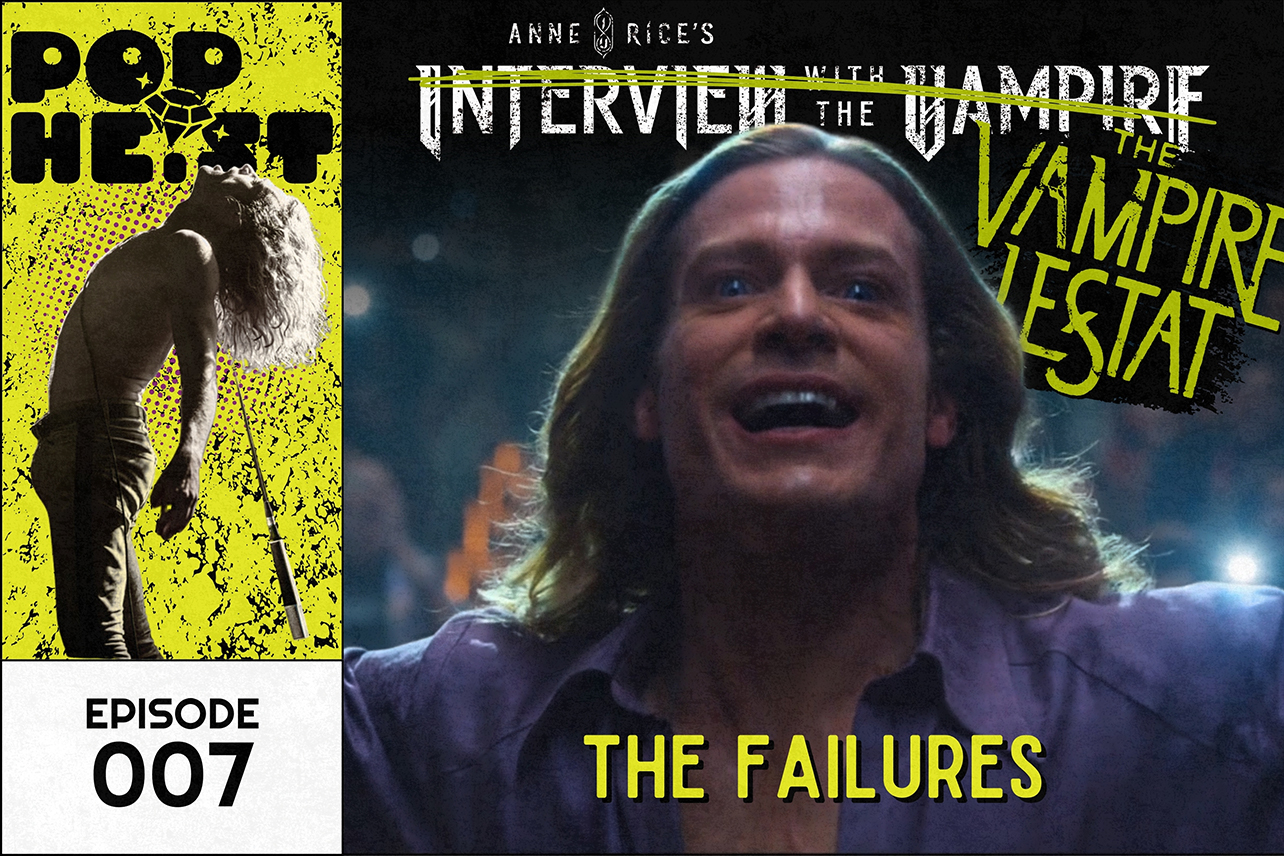
The Vampire Lestat Season 1, Episode 7
“The Failures”
Writers: Hannah Moscovitch
Director: Alan Taylor
Cast: Sam Reid, Jacob Anderson, Assad Zaman, Joseph Potter, Delainey Hayles, Jennifer Ehle, Eric Bogosian, Justin Kirk, Christopher Heyerdahl, Damien Atkins, Steven G. Norfleet, Maura Grace Athari, Ryan Kattner, Seamus PAtterson, Sarah Swire, Gopal Divan, Kameron Lopreore, Christopher Geary, Jamie Cavanagh, Amaka Umeh, Caleb Horn, Shepherd Munroe, Gage Munroe, Guy Maddin
Rolin Jones’s Interview with the Vampire was always good, but during Season 2 something extraordinary happened. It just got better and better from episode to episode until the finale, which was the best episode the show had ever aired. And they say lightning doesn’t strike twice! Moving, disturbing, disgusting, hilarious, and harrowing, this final episode of The Vampire Lestat’s first season is the best episode in the whole show’s history.
This is true even though it succumbs to that otherwise woeful trend of shows building and building to an explosively violent climax that never arrives. Shōgun Season 1, House of the Dragon Season 2, and Fallout Season 2 were all good-to-great, yet they all dry-dicked us when it came to bloodshed, if you’ll pardon the Daniel Molloy–level vulgarity.
This episode overcomes that deficit through its sheer richness. “Silver threads,” Lestat says dreamily as he (apparently) looks directly into Heaven at one point. “Silver threads stretched out over other threads.” That’s how the writing on this show feels. Hannah Moscovitch’s script is a tapestry of different tones, styles, genres, emotions, sensations, all of it so wittily worded, so diamond sharp that Oscar Wilde could use it to file his nails. Director Alan Taylor, the major Sopranos and Game of Thrones director, returns to the chair for the first time since IWTV’s phenomenal series premiere, and lays out a real feast for the eyes as well as the ears.
This is par for the course this season, if I hadn’t made that clear in previous reviews. My fingers burn up the laptop keyboard, trying to jot down every clever turn of phrase, every elliptical implication and inference, every devastating sentence-long evisceration of someone’s entire deal, while also trying to record the sheer sensual impact of what we’re asked to, and made to, look at.
One other thing I don’t think I’ve stressed nearly enough: This show had a very, very high bar to clear with me specifically, because (there’s no other way to put it) discovering glam rock changed my life. Velvet Goldmine and David Bowie were my gateway to a whole new way of thinking about art, performance, style, and ultimately the self. That music made me feel like a butterfly emerging from the rigid cocoon of my adolescence.
I’m also (huge surprise!) a musical theater nerd, and as that is the other main perceptible influence on composer Daniel Hart’s music for Lestat and his band…well, if any of it was even a little off I’d have cringed my way through the entire season, as a fan of both Roxy Music and Rocky Horror. Instead, I blast this music in my car. I irritate the other people in our building with it. It’s so goddamn good. The whole show is so goddamn good.
The episode follows the divergent journeys of Louis’s and Lestat’s severed heads. The former is brought to a butcher shop, closed for All Saint’s Day in heavily Catholic Montreal. That will keep out the humans, while the daylight will ensure Louis’s potential vampire allies are all asleep. Now he must face the architect of his near-murder: Armand, whom Louis once called the love of his life.
Armand, still working through the 12 steps (lol), rather passive-aggressively apologizes to his prisoner for participating in the trial that cost Claudia her life and nearly as well. (He says he did it for the sheer aesthetic pleasure of the act, which fills is an huge blank spot, for me at least.) He also apologizes for framing Lestat, a lie that slowly poisoned his and Louis’s own relationship. Louis spits his “Armends” (I question the sincerity of a man who makes up a funny word for his own version of making amends) back in Armand’s face.
Then Armand reveals his ace in the hole. Using his telepathy, he orders one of his vampire followers (“I have a hundred now”) to kill himself…then threatens to do the same to Regina, the Claudia-lookalike scammer, if Louis doesn’t cooperate. Turns out Armand found and hired her to “coincidentally” run into Louis and set off that whole psychologically ruinous mess, just to fuck with him. Regina, who’s understandably horrified to be sitting face to, uh, head with Louis in this state, sobs with a slit wrist as she tells Louis how sorry she is. She, at least, sounds sincere.
So does Louis when he finally apologizes for his own transgressions. He lied when he acted like he’d forgiven Armand for his role in the trial. He lied when he called Armand the love of his life, when it was always Lestat, whom even now he can’t stop thinking about. Most of all, though, Louis apologizes for not being able to show Armand, who was once a 12-year-old boy named Arune who was enslaved and abused, the tenderness he deserved.
This seems to be the right answer. Armand sets Regina free and leaves himself, ordering his servant Rashid (him again!) to reattach Louis’s head and hope for the best. But he leaves his ex a parting gift: He carves the letter ‘A’ into his chest with his fingernail. Alanis Morissette would be impressed.
The real star of the show, of course, is Lestat. Since his own head isn’t being kept pumped full of blood by some weird doctor to the undead — he is in fact trapped in a bowling bag being kept by Daniel Molloy as he has himself an early morning roll down at the alley — he’s having a more traditional near-death experience. His is an illusory banquet featuring his maker, Magnus; his younger self; his fledglings, Gabriella, Nicolas, Louis, and Antoinette (no Claudia; she refused the invite); and sometimes Marius, his mentor in caring for Akasha the Queen. Daniel even pokes his giant head into the scene to get in a few jabs of his own.
Throughout, the action switches from Marius’s tower to the Lioncourt home, from the New York studio where he recorded his album to the Paris street where he first heard Nicolas play the violin. He sees not just the important figures of his past but many of his countless victims throughout the years, from his own brother to the opera singer (Kameron Lopreore) he and Louis killed for going flat. (The guy has plenty of criticism for Lestat’s performance style of his own.)
The vampires all mercilessly ridicule and taunt Lestat. FAILURE, FAILURE, FAILURE they cry — particularly Gabriella, whose emotional abuse as a mother reaches its zenith in the horrific witch-burning she drags young Lestat to. We see now that he watched two little girls who’d played in his house burn to death, screaming along with them as his mother forced him to watch. This was her way, she says, of showing him how horrible “they” are, presumably meaning the Church and all similar forms of authority. They’d doomed her to a life of unending boredom and misery, hadn’t they? Better Lestat learn this in haste than repent at leisure.
Eventually he winds up on stage (naturellement!), before an adoring audience of his many human meals. But before the crowd of the dead, Lestat rejects the vampires’ accusations. If he failed, does that not mean he tried to accomplish something, which is more than he can say for certain other vampires? The only thing he feels he really has to apologize for is letting “too much [blood] spill too often.”
It’s then that he begins collapsing…when out of nowhere, Louis’s brother Paul (Steven G. Norfleet) shows up, looking as dapper as always. Last seen when he killed himself in the Interview series premiere, he thanks Lestat for giving Louis the love he needs, even if he does wish he were a woman. “Me too sometimes,” Lestat admits, the kind of line that launches a thousand fanfics.
But just as he’s facing the light of heaven (“It’s not all that once you get there,” Paul confides in him), Paul gets word from an unseen woman. “Yes ma’am,” he says respectfully to this unseen authority figure, resetting the phone timer Lestat has been using to keep track of how much time he has left before dying.
And boom, just like that, he’s awake on his tour bus, parked outside the outdoor gig that he keeps saying, over and over, will be catastrophic. How catastrophic? We get a glimpse in the final shots of the season: The entire city of Montreal has been destroyed.
Could this all be part of a nefarious plan? That’s certainly the implication behind how Lestat gets his head back together in the first place. He’s only rescued from Daniel’s bowling bag by Raglan Jones, who says the Talamasca — or whoever he represents — has been working in league with the world’s leaders to induce the Great Conversion, not stop it. It’s a culling of the herd, a way to keep the hoi polloi in check: “Let the vamps safely graze” is the buzz phrase coming out of the last G7 meeting, according to Raglan. They even had a hand in the recording of his album — the whole “make more” refrain provided by Gabriella was their idea. (Now we know who she was working for, or at least with.)
Nevertheless, Lestat refers to Raglan as a friend in his final recording for The Failures, his audio diary. I can’t imagine he has many left, and I can’t imagine Raglan is a good friend to anybody. But as with the concert and the disaster that follows, the fallout is left to the future.
Again, I find myself not caring. It’s churlish to be served a feast like this episode, one that does feel complete in itself, and complain it’s missing a wedding cake. Don’t get me wrong, I want that cake, which is to say I want to watch a glam-rock concert that triggers a vampire queen apocalypse. But I wanted to watch every single second of the episode we got, too.
Sam Reid is luminous and devastating as Lestat the fallen god; in particular, his groaning agony over remembering witch-burning and the horror of his mother’s parenting, coupled with Daniel Hart’s aching score, reduced me to tears. (This is in the same episode as a decapitated body reaching out for its own head.)
But Anderson and Hayles are equally good at people forced to face their sins under horrifying circumstances. And Assad Zaman is magnetically malevolent as the mad Armand. Well, he’s mad in Lestat’s version of things, at least. I dunno, maybe I’m shooting our boy some bail here — as Armand points out, he did lead a Satanic cult for 400 years — but I want to believe there’s still some Arun left in there.
They did it again, folks. They really did it again. The Vampire Lestat is one of the best shows of the year.