

Teenage Sex and Death at Camp Miasma
Writer/Director: Jane Schoenbrun
Cast: Hannah Einbinder, Gillian Anderson, Jack Haven, Patrick Fischler
Jane Schoenbrun is one of our finest genre filmmakers because they have the stirring ability to be the Least Subtle and Most Subtle artist in the room at the same time. Their films so far, including the haunting We're All Going to the World's Fair and the gorgeous I Saw The TV Glow, can be read instantly as stories of queer awakening and transformation through a horror movie lens, and yet there is so much more happening beyond those obvious, essential themes, so much to pick apart, so much to question. Watching a Jane Schoenbrun movie is like watching the strangest dream you'll never forget: You don't understand everything that's happening at all times, but the deeper you dig, the closer you come to understanding everything.
Teenage Sex and Death at Camp Miasma, Schoenbrun's much-anticipated ode to slasher cinema and its long, constantly mutating legacy, is Schoenbrun at their most dreamlike and layered. It's one of those movies we'll be excavating and autopsying for decades to come, pulling at every thread of this spellbinding knot of influence and emotion and yet somehow never entirely seeing the center. Watching it, as a longtime slasher fan and as a Schoenbrun fan, I was completely swept up in its spell, and even if I couldn't explain every reference, angle, or narrative turn to you right now, I cannot deny the awe that follows me from this movie, stalking from room to room like a maniac with a knife.
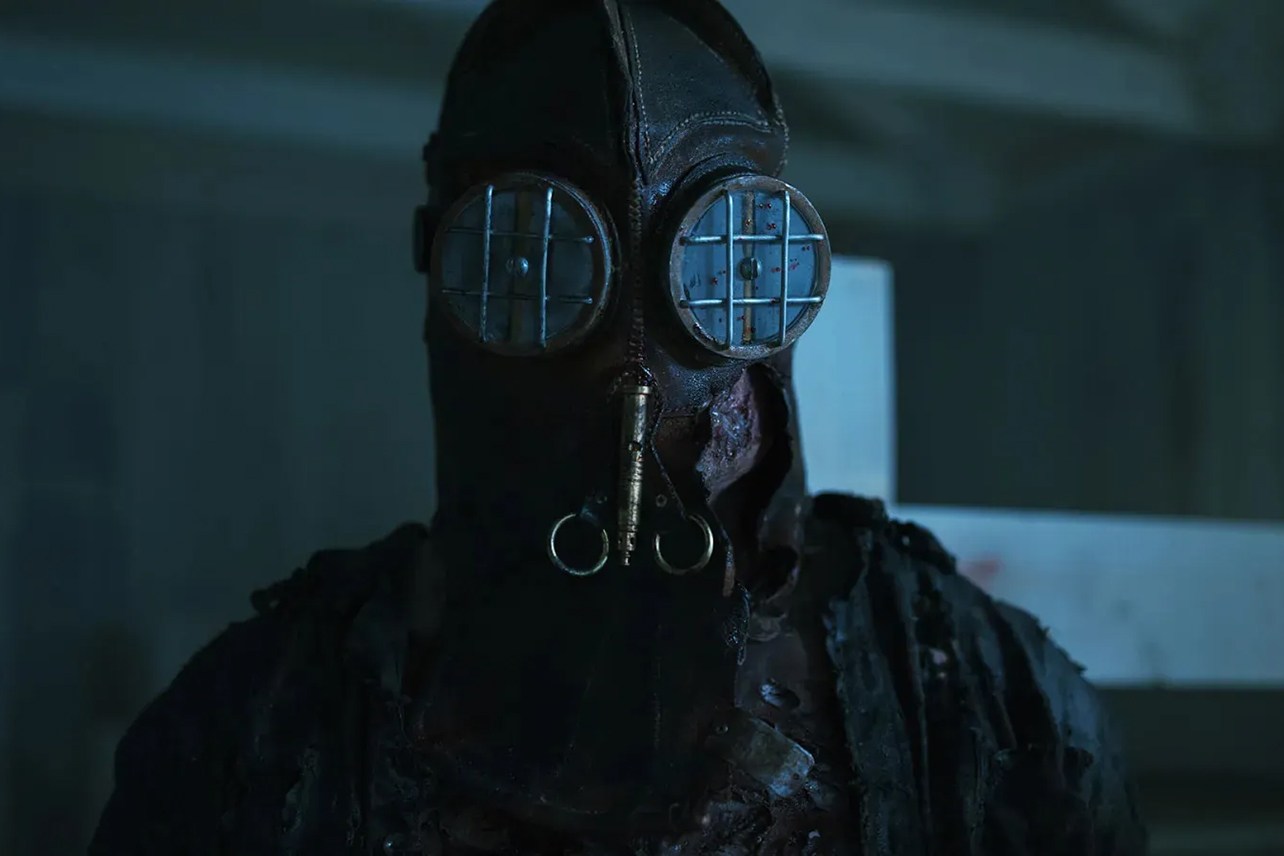
Kris (Hannah Einbinder) is a young filmmaker hired to reboot her favorite horror franchise, Camp Miasma, a formerly hit slasher series featuring a killer known as Little Death (Jack Haven), a spear-wielding monster with a giant vented cube over their head. Like so many slasher franchises from the 1980s and into the 1990s, Camp Miasma blossomed in the subgenre's golden age before fading away, and while it has its admirers, it's also viewed as deeply problematic due to a transphobic twist (think Sleepaway Camp) embedded in Little Death's origin story. Kris, a progressive, intersectionality-minded young artist, is out to update the whole thing for modern audiences.
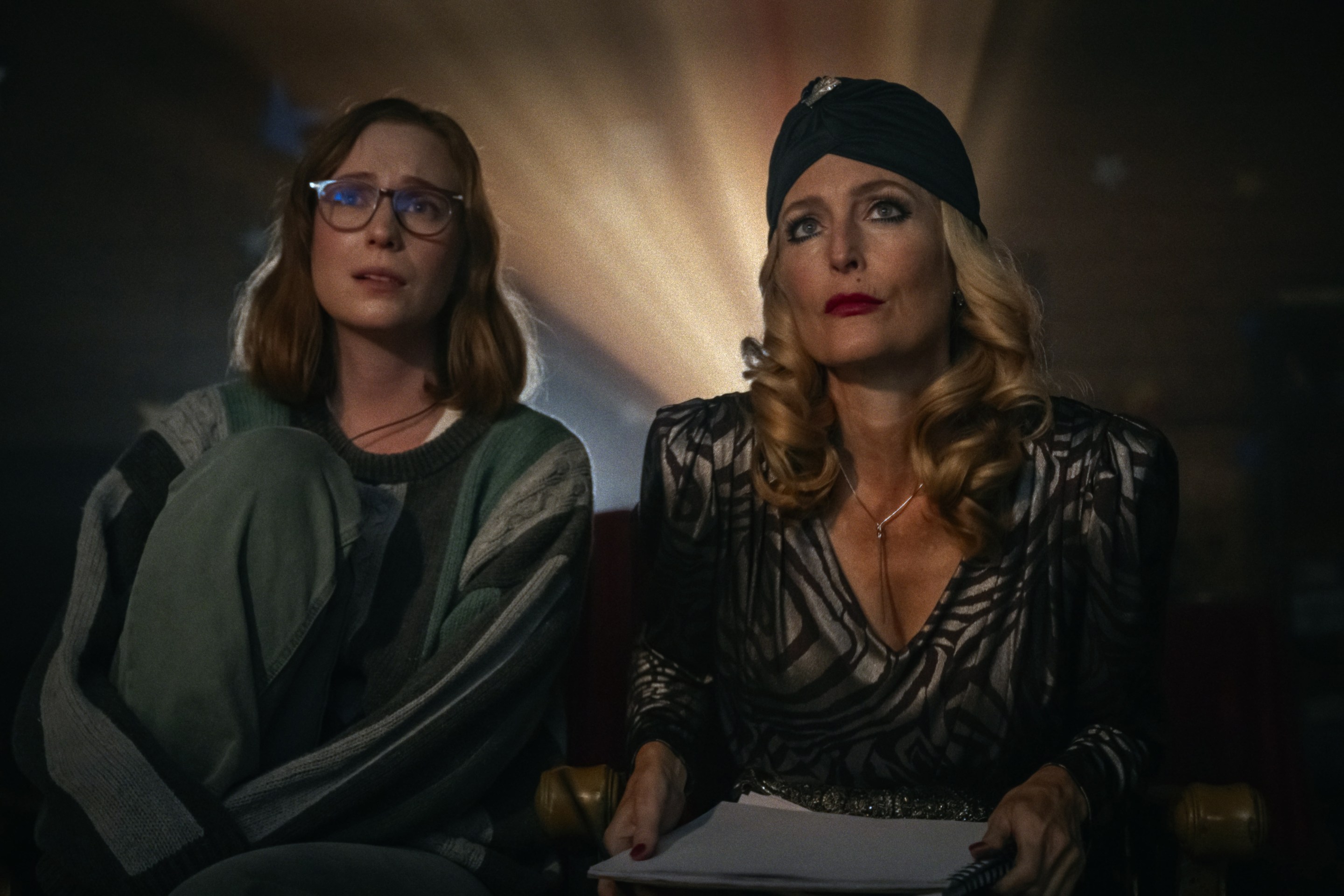
To do this, Kris begins not by looking to the future, but to the past, namely to the original Camp Miasma movie's star, Billy Presley (Gillian Anderson). These days, Billy stays away from the Hollywood limelight, living in seclusion as a painter in the Pacific Northwest, but Kris wants her to return for a legacy sequel, and she's ready to make her case in person. What she doesn't know is that Billy doesn't live just anywhere. After retiring from acting, she bought the former summer camp where the original movie was filmed, dubbed it "her own private alternate universe," and retreated. Now, surrounded by the trappings of the franchise she loves, it's up to Kris to coax Billy back out, unaware that something else is still lurking under the waters of the camp's lake.
It's the setup for a perfect horror legacy sequel, or even just a straightforward slasher homage that plays with the genre's many conventions while delivering all the goods of the slasher formula, but Schoenbrun doesn't take that route…mostly. Instead, they opt for the psychosexual and the expressionistic, wielding the many visual tools afforded by the slasher genre — and the summer camp slasher subgenre in particular — to make it clear that we have indeed stepped into another world, an alternate universe where sex and violence are inextricably intertwined.
Let's talk about the least subtle elements of this first. Little Death's weapon of choice is a massive spear, because Schoenbrun wanted a weapon even more phallic than a chainsaw. Little Death's "mask," a massive cube of metal, looks like the commercial vents you'll see if you look up into the acoustic tiles of a movie theater. At one point, realizing that Billy possesses an original print of the first Camp MIasma film, Kris fondles the celluloid in a way that's just short of orgasmic. Junk food plays a crucial role, emerging first as Kris's road trip snacks and then becoming a motif so recurrent that it's literally used as decor near the end, a nod to the "junk food cinema" epithet so often hurled at slasher films from the '80s. The kills, when they do come, are both brutal and cartoonishly extreme, mimicking and mocking the style of classic gore-and-tits strewn slashers of old. It works as satire, and as homage, but what Schoenbrun's really after takes us deeper into the murky waters of the lake where Little Death resides.
Schoenbrun often gets tagged as a "tone poem" or "vibes" filmmaker, in part because their moments resist linear narrative conventions and in part because so much of what they do as a director seems built on instinct, an expressionist tendency that goes hand-in-hand with their desire to mine their own obsessions and pop culture proclivities to create direct links between filmmaker and subject. You don't expect to hear a mournful Counting Crows track in the middle of a slasher massacre, or to see chandeliers made of bags of gummy candy, or to be surprisingly moved by a '90s one-hit-wonder that I won't spoil here, and yet Schoenbrun delivers those things, because it would be inauthentic if they didn't. There's an element of pastiche there, yes, but we're also not simply talking about references for references' sake.
I'm almost exactly Schoenbrun's age, so I understand the references, but I also understand that feeling of growing up in a world where pop culture came first in a trickle, then a flood, then an internet-fueled deluge that stirs up the unlikeliest feelings at the unlikeliest moments. Schoenbrun reaches for those unlikely emotional responses, and because they are a hyper-competent filmmaker with immense attention to detail in everything from shot composition to sound design, they work.
But as gifted as Schoenbrun is, they are not the star of this film. Teenage Sex and Death at Camp Miasma would not work without the double threat of Einbinder and Anderson. Einbinder's role, as an ambitious young artist butting heads with an aging star, delightfully mirrors her work in Hacks, but allows her room to stretch her dramatic muscles, to mine the unspoken that hovers over so much of the script. Then there's Anderson, who deserves an Academy Award nomination for the restrained, delightfully weird work she's doing in this movie. Together they are a magnetic duo, sexy and funny and strange. Even if you go into this film completely blind to everything else it's depicting, they are its steadfast emotional anchors.
Camp Miasma has been described over and over again, since its festival debut earlier this year, as a "love letter" to slasher movies, and while I think it's an appropriate descriptor, I also don't think it tells the whole story. Like Schoenbrun's previous films, there is a sense of awakening, of transformation, that's both explicitly queer and implicitly about the ways in which the art we love can change us, but there's also something else. This is a movie that looks at the problematic, hyperviolent, hypersexualized history of the slasher film and asks not only what that's done to each of us who loves these movies, but what it means to be changed and shaped by something the rest of society deems depraved and dirty and "junk food." What transformations — shifts in our perspectives and emotions — do we take on when we engage with the darkness, the "flesh and fluids" (as Anderson's character memorably says) at work in this kind of art that make us more human, not less? There will not be one definitive answer, but Teenage Sex and Death at Camp Miasma's ability to ask the question and take its characters on a satisfying emotional journey at the same time makes it a triumph for Jane Schoenbrun. This is, undeniably, one of the best films of the year, not just because of what it says, but because of what it invites us to say about ourselves.
Teenage Sex and Death at Camp Miasma expands to theaters nationwide on August 14.