

Welcome to 2026's 31 Days of Heistoween, a daily dose of spooky icons, spine-tingling oddities, and — most harrowing of all — memes. Check back every day from now through October 31 for each daily entry!
Every October, I return to the same rituals: carving pumpkins, eating an irresponsible amount of candy, browsing the usual stores for more macabre home decor, and of course, revisiting The Simpsons’ annual Halloween specials. I’ve been watching "Treehouse of Horror" since I was seven, which means I’ve spent most of my life watching Homer die in increasingly inventive ways and treating it as a perfectly reasonable seasonal activity.
The specials have always been one of the show's best excuses to experiment with horror, science fiction, and the occasional deeply weird detour into a pop culture homage. They're a chance to just get weird within the realm of Springfield and a tradition I refuse to give up at this point.
Naturally, "Treehouse of Horror V" (Season 6) tends to dominate conversations about the series, and for good reason. "The Shinning," "Time and Punishment," and "Nightmare Cafeteria" make for one of the strongest lineups in the franchise's history. But returning to the specials year after year has also made me appreciate the segments that don't receive quite as much attention. Some get overshadowed by stronger stories in the same episode; others simply haven't stuck in the cultural memory the way the classics have.
Rewatching them as an adult is especially rewarding as jokes that went over my head as a kid land differently now, and some of the more unusual premises reveal a surprising amount of thought beneath the blood, gags, and cartoon violence. Disney+ has made revisiting the annual specials easier, even if sometimes it will jump to the next episode in a season rather than the next special, making me go through an unnecessary test of patience every year.
With Halloween approaching, I wanted to revisit five segments that deserve another look. This isn't a ranking of the "greatest 'Treehouse of Horror' stories ever made," and there's no need to reopen the eternal debate over when The Simpsons stopped being "good". These are simply five memorable entries that have earned a little more appreciation than they typically receive.
And yes, one of them involves Milhouse summoning a childhood icon, and you can imagine how well that goes.
1. "The Genesis Tub" — Treehouse of Horror VII (Season 8)
Lisa Simpson creates an entire civilization on a tooth, and suddenly she has a theological problem on her hands.
The segment begins when one of Lisa's science experiments expands into a miniature history of civilization. The microscopic inhabitants develop their own society, religious beliefs, and understanding of the universe, all while Lisa watches from above. Their world grows increasingly complex as they attempt to make sense of their creator, who happens to be an eight-year-old girl with a science fair project.
There's an interesting wrinkle to the premise when you consider Lisa's own relationship with religion. For much of the series, she's been a secular-minded skeptic who prefers reason and scientific inquiry to supernatural explanations. She's also a practicing Buddhist, having embraced Buddhism in Season 13's "She of Little Faith" so her worldview has never fit neatly into a single category. She's even entertained the possibility of souls, suggesting that her skepticism leaves room for questions she can't entirely answer.
The segment finds plenty of comedy in that predicament, particularly as the inhabitants develop their own religious traditions, including — at one point — Lutherism. Their attempts to explain existence echo humanity's own search for answers, while Lisa's position above them raises questions about the relationship between scientific discovery and religious belief.
What makes "The Genesis Tub" so easy to overlook is its company. "Treehouse of Horror VII" also features "The Thing and I," with its unsettling Bart-and-Hugo storyline, and "Citizen Kang," which remains one of the franchise's most memorable political satires.
It's worth revisiting for its ambition alone. In just a few minutes, the segment manages to explore creation, faith, and the difficulty of understanding a universe that may be far beyond our comprehension. It also gives Lisa an unusual perspective on religion, placing her on the other side of the very questions she's spent so much of her life asking.
2. "The HΩmega Man" — Treehouse of Horror VIII (Season 9)
The apocalypse has arrived. Civilization is gone. Homer Simpson is thrilled.
"The HΩmega Man" takes the familiar post-apocalyptic scenario and gives it the one protagonist least equipped to appreciate the gravity of humanity's extinction. Following a nuclear disaster that devastates Springfield, Homer believes he's the last man alive. His response is less existential despair than the realization that, at long last, nobody is around to tell him what to do.
For Homer, the end of civilization is basically an unexpected vacation with unlimited access to beer, movies, and naps.
While the segment obviously riffs on The Omega Man, the 1971 science-fiction film starring Charlton Heston, the real comedy comes from watching Homer interpret the end of the world as a personal lifestyle upgrade. No boss. No neighbors. No responsibilities.
Then things get complicated. The supposedly empty Springfield turns out to have other survivors, and Homer's brief fantasy of solitary paradise becomes considerably less relaxing. It's a wonderfully Homer-centric take on a familiar science-fiction premise, and one that deserves to be mentioned more often alongside the episode's other highlights.
If humanity ever does end in a nuclear catastrophe, I suspect Homer will be the first person to ask whether the Kwik-E-Mart is still open.
3. “Scary Tales Can Come True” — Treehouse of Horror XI (Season 12)
There's something about classic fairy tales that are supposed to teach children valuable lessons, but more often than not become their first horror stories. This segment kind of approaches it from that direction in the usual Simpsons manner, and involves a bear mauling and a cannibalistic witch.
“Scary Tales Can Come True” sends Bart and Lisa into a seemingly all too familiar storybook world where the familiar rules of fairy tales apply, except everyone seems to have skipped the part about providing a happy ending. Homer strands Bart and Lisa into a dark forest as he feels he can no longer provide for his family, leaving the Simpsons children to fend for themselves against trolls and a witch with a gingerbread house. Sound familiar?
The Simpsons have done their share of dipping into twisted fairy tale parodies, so this doesn't reinvent the wheel or anything, but there's some great bits in here. The absolute sin against nature that Homer gets transformed into — part chicken, part fish — and also George Cauldron is a GREAT name and a great Brady Bunch joke, too.
4. “The Island of Dr. Hibbert” — Treehouse of Horror XIII (Season 14)
Dr. Hibbert has spent years reassuring Springfield residents that everything is fine, usually while laughing at their misfortune. It was only a matter of time before someone asked what he was doing with all that medical equipment after hours.
"The Island of Dr. Hibbert" reimagines H. G. Wells' sci-fi classic The Island of Doctor Moreau as a tropical nightmare in which Springfield's favorite physician conducts experiments that combine humans and animals. The Simpson family arrives expecting a relaxing getaway and instead discovers that their doctor has been treating medical ethics as more of a loose suggestion.
Hibbert's constant cheerful bedside manner has always carried a faintly unsettling quality, thanks to his habit of laughing at patients during some of the worst moments of their lives.
The segment also gives the animators plenty of opportunities to indulge in grotesque transformations, one of the "Treehouse of Horror" franchise's oldest pleasures. The human-animal hybrids are suitably bizarre, with the tropical setting providing a nice contrast to the usual haunted houses, laboratories, and Springfield streets. Also, who else was, uh confused, by cat Marge? Just me? Oh. Cool.
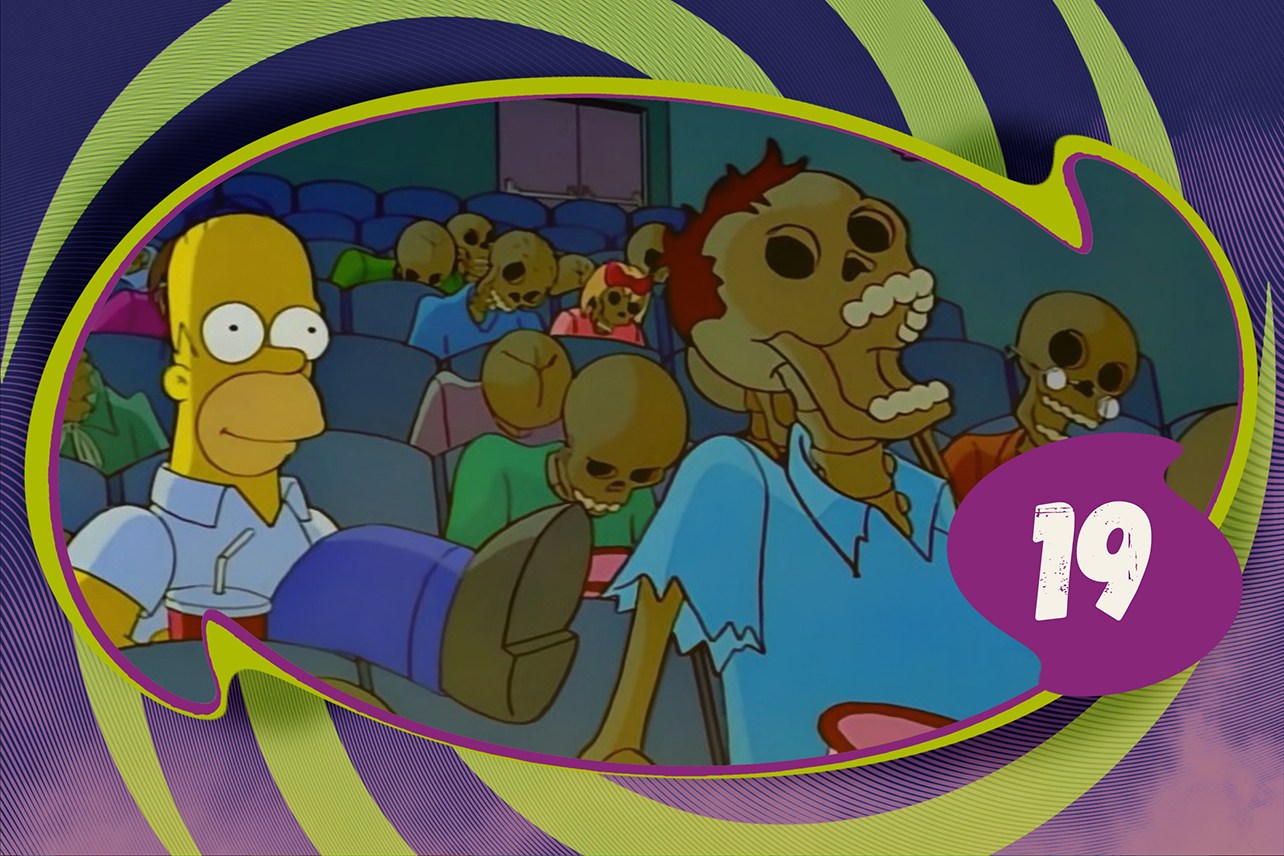
5. "It's the Grand Pumpkin, Milhouse" — Treehouse of Horror XIX (Season 20)
Nobody in Springfield deserves a little childhood magic more than Milhouse. However, that magic and whimsy soon becomes everyone else's problem.
"It's the Grand Pumpkin, Milhouse" takes aim at It's the Great Pumpkin, Charlie Brown, the beloved Peanuts Halloween special in which Linus faithfully waits for the Great Pumpkin to appear. The original is gentle, sincere, and built around the peculiar optimism of a child who refuses to abandon his beliefs just because everyone else thinks he's ridiculous.
Here, The Simpsons' version borrows a pinch from Season 7's "Attack of the 50-Foot Eyesores" and spikes a holiday classic into a monstrous affair.
Milhouse is a natural choice for the Linus role. His best friend routinely abandons him, his parents have the chemistry of baking soda and vinegar, and his general luck suggests offended a powerful deity at some point. If anyone is going to spend Halloween waiting for a giant pumpkin to validate his existence, it's this weird, lonely kid.
Then the chaos starts. Not only is the Grand Pumpkin summoned via Milhouse's crybaby tears but he's soon faced with the truth of how we use pumpkins during the season. I still get a kick out of "You roast the unborn?" line bellowing from the giant gourdman. He then vows revenge by eating several people whole, including Homer, Groundskeeper Willie, and Nelson and later kills Principal Skinner.
We get a double dose of holiday mascots as Lisa realizes that Milhouse can bring things to life by believing in them, Lisa tells him about "Tom Turkey", a symbol of Thanksgiving (and a decades-old parade mascot) who comes to life and kills the Grand Pumpkin, freeing everyone he ate. However, when Tom Turkey learns of what people do to turkeys on Thanksgiving, he vows revenge and starts his own holiday massacre.
So this October, give these segments another watch. Revisit the microscopic civilization, enjoy Homer's radioactive staycation, and spare a thought for Milhouse, who continues to have one of the roughest childhoods in animated television.
Come knock on our door tomorrow for even more 31 Days of Heistoween treats.
If you haven't already, consider supporting worker-owned media by subscribing to Pop Heist's newsletter or leaving a tip. We are ad-free and operating outside the algorithm, so all dollars go directly to paying the staff members and writers who make articles like this one possible.