


Finding Emily
Writer: Rachel Hirons
Director: Alicia MacDonald
Cast: Angourie Rice, Spike Fearn, Minnie Driver
There is a desperate gulf in modern British cinema for the original rom-com. The days where a Richard Curtis-scribed flick like Notting Hill would swan into cinema, or the delight that is About Time would parade itself in front of cinemagoers are now just souvenirs of an industry that has moved on to chase the next IP. There was a brief glimmer of hope for the cinematic rom-com in 2023 with Raine Allen-Miller’s irresistibly fresh Rye Lane, but the rom-com landscape has been relatively barren outside of Allen-Miller’s film, confining anything that could break through onto cinema screens to a streaming platform. Even Sophie Hyde’s sensational film Good Luck To You, Leo Grande — arguably a romantic drama — barely scratched the itch for the British rom-com. Here, then, comes Alicia Macdonald’s Finding Emily: a larger than life rom-com that invigorates a love for cinema again, one that makes you see colors of love more vibrantly by embracing and deconstructing the comforting conventions of the British rom-com but does so with a thematically sharp Gen Z spin on the anxieties that men face in a digital age that is poisoned by cynicism.
It is love at first sight for 23-year-old Owen (Spike Fearn), a sound engineer at the Manchester student union who drinks one of his four free soft drinks with a metal straw, plays indie music on the guitar and looks like he went to the barber and requested the "Oasis" look. He bumps — literally — into a girl (Sadie Soverall) dressed as a fairy, locks eyes and is instantly infatuated with her. A fleeting glimpse becomes a tangible connection when they see each other again in the bathroom, have a flirt and then slip out onto the dance floor together, spinning around into a brief state of blissful, reciprocal attraction as time stands still and the world dissolves around them. But as they lean in to kiss, the girl is whisked away by her friend to a birthday party, leaving Owen to race after her for her name and phone number. She tells him it is Emily over the shouts of Manchester nightlife, hurriedly puts her phone number in his phone, and flutters off into the night. It’s a meet-cute that is extremely heavy on the cute, especially as we’re viewing the experience solely from Owen’s perspective.
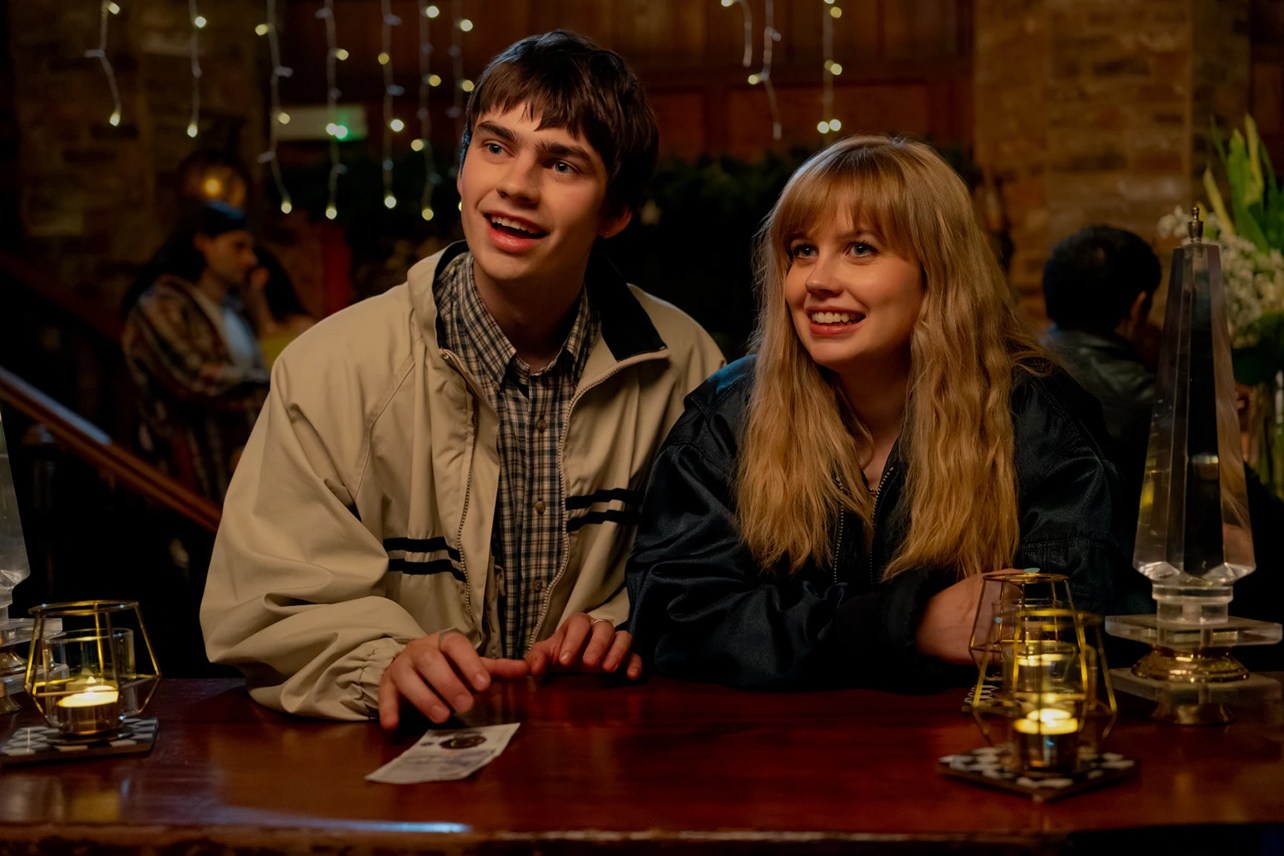
Alas, when Owen wakes up the next day with a literal skip in his step and tries texting Emily, he is met with the message "Not Delivered": she has only given him ten digits. Not one to give up, the charming but hapless Owen starts searching for his manic pixie dream girl by filtering through Canal Street and putting up handwritten posters around the city of "MISSING: a digit of your phone number." Stumbling around campus, he finds Emily — not the costumed Emily that he nearly kissed, but Emily Raine (Angourie Rice), an American Psychology student who is about to lose her student visa if she doesn’t pass her thesis on how romantic attachments are an evolutionary hangover, and that they can and will cause one to self-sabotage. They become friends in a bid to jointly search for the Emily, but in a fairly standard romcom trope, one is hiding a secret: the Idaho-born Emily Raine is recording and collecting data on Owen’s search, gently nudging him to do bigger and wilder things in his bid for “true love” so she can evidence his self-sabotage for her thesis.
Such things include sending an Emily-wide email — to all 318 of them! — and jumping on a University podcast to sing a song he wrote about her. This in turn brings Owen to the top of the For You page for the entire campus, resulting in his story going viral. If this all seems a tad creepy about a girl who may well have “wrong numbered” (a move used by women to avoid giving their real number to unwanted advances) him, you’d be right. But what MacDonald achieves — alongside Rachel Hiron’s hilarious and layered screenplay — is to walk that tightrope between being a creep or doing a grand gesture to such fine margins that it begins to loop around into a thematic piece on the anxieties of modern dating within a world that attempts to impose cancel culture. His virality prompts protests led by Emily Thewlis (Kat Ronney) and social media articles describing him as a “sex pest or a sexy pest” and as overreaching as that of a rapist, but this works to show the dichotomy between that of what occurs in real life and the snippets of information grasped by online users, which can lead to an escalation beyond what is merited.
Owen’s actions aren’t malicious and he hasn’t misread the situation, but what he does (even with the ethically wrong nudging from Emily Raine) is ultimately a selfish act. To paraphrase the mop-headed Mancunian: “Why shouldn’t I try to find her if I feel this way. Wouldn’t it be wrong to not at least try?” And so he does, without thought for how his fairy-winged dream girl would feel about the grand gesture he’s performing, and without taking the advice from a smattering of excellent supporting characters who are his moral compass.
He is reminded throughout the entire time of his poor decision making by charismatic butch lesbian Rhea (Amber Grappy), his brother Matt (Jack Riddiford) and partner Freya (Isabelle Laughland) who exists amongst a snazzy ensemble of bright young talents — a scene with Emily Raine’s flatmate Anna (Cora Kirk) to a rave-injected remix of Yeah Yeah Yeah’s "Heads will Roll" is a cathartic highlight — and turns from comedian Phil Wang as Pervy Martin, Minnie Driver as the university dean and Prasanna Puwanarajah as a jaded professor all serve to ensure that Finding Emily has charm coming from every angle.
This is especially important to note because these supporting roles both sufficiently distract and complement the absurdity of the fictional world in which Finding Emily exists. MacDonald finds this delicate tonal balance within her music choices, a stranger-than-fiction tone that feels slightly autobiographical, and by having the young Spike Fearn (soon to be a hot property) play such a delicate softboi character who loves the idea of love. And Finding Emily is about love, sure, but it is a film in direct competition with cynicism and the cynical eccentricities of cancel culture. Take Emily Raine’s thesis subject. The essay springs to life from cynicism, as her university-long situationship has made her believe that romance is dead.
No points for guessing that this is a friends-to-lovers story as romcom genre conventions, like the manic pixie dream girl, are deconstructed and embraced in a warm and comforting way. The genre builds itself on being a hopeful outlook for life and love so having Emily Raine be, as much as anyone can be in this scenario, an antagonist of sorts — or at the very least, her cynical outlook on love and romance is what MacDonald’s flick is placing in her directorial headlights here — is a refreshing switch on conventions.
Even Fearn’s casting: He’s no Colin Firth or Hugh Grant, but he is cute and attentive and funny and so so sweet. He is a normal, fully-realized character while still being an everyman. He’s just a lad trying his best — and failing! No one is perfect!. His casting feels deeply rooted within the contemporary idea of the Female Gaze, as he is attractive in a way that you only get from a female perspective. With little in the way of stereotypical leading man qualities that Hollywood puts value in of being broody, tall, or muscular, his casting feels like a direct statement of intent against genre norms and of the very concept of male allure in Hollywood.
Finding Emily is absolutely the tried and tested romcom structure, sure, but it does so while being very self-aware of its own position in the genre and brings a contemporary spin onto the romcom. It is a romcom that doesn’t just have a big indie heart at the centre of it, but has an adoration for Manchester, whose vibrant nightlife populates several scenes, almost becoming its own character. An argument can be made to suggest its 12A rating led the film to be slightly neutered, where a 15 rating would have allowed them to be the slightly more uncouth and unhinged that the story and a student lifestyle may have merited. But the film still really works in spite of that due to how charismatic Rice and Fearn are as leads, a bop-heavy soundtrack that never feels like a jukebox musical, and a witty script that slyly finds itself navigating the anxieties of modern dating.